

In The Media
Vikram Nehru
{
  "authors": [
    "Vikram Nehru"
  ],
  "type": "legacyinthemedia",
  "centerAffiliationAll": "dc",
  "centers": [
    "Carnegie Endowment for International Peace"
  ],
  "collections": [],
  "englishNewsletterAll": "asia",
  "nonEnglishNewsletterAll": "",
  "primaryCenter": "Carnegie Endowment for International Peace",
  "programAffiliation": "AP",
  "programs": [
    "Asia"
  ],
  "projects": [],
  "regions": [
    "Southeast Asia"
  ],
  "topics": [
    "Economy"
  ]
}
Source: Getty
If politicians are serious about improving the lot of Indonesia's poor, they should focus on reforming labor laws that protect formal sector jobs at the expense of nine out of 10 Indonesians who are employed informally.
Source: Wall Street Journal

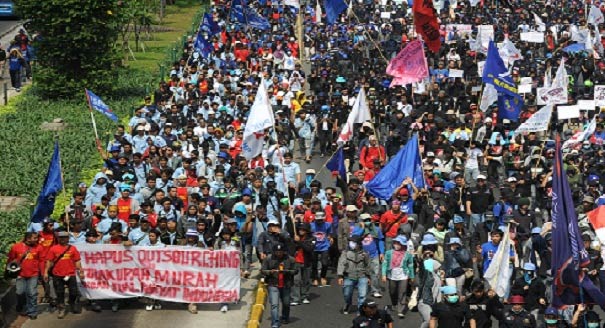
These latter workers get lost in the din when thousands of union members flood Jakarta's streets and threaten to halt traffic, as occurred last November in the latest round of wage demonstrations. Now an annual feature, such disturbances have spurred local governments to implement unusually high minimum-wage increases.
Minimum wages have increased across Indonesia by an average of 10% per year over the past four years. For 2013, some 25 provinces, regencies and cities agreed to raise the minimum wage by an average of 30%, with a few as high as 50%. Greater Jakarta, which accounts for the bulk of Indonesia's manufacturing and services, agreed to 44%, bringing the minimum wage there to 2.2 million rupiah ($225) a month. Unions are encouraged, and their demonstrations are likely to grow in size and assertiveness in the years ahead.
These increases are great for union members employed in factories and offices, but not for the 90% employed informally—in small, make-shift businesses such as road-side tea stalls, or in factories or other businesses where managers conveniently forget about record-keeping (and government officials conveniently forget to check on it).
These Indonesians work without the high wages or job security their formal counterparts command. The policy goal should be to allow them to transition to formal work. But the minimum-wage hikes raise the barrier to such a transition.
The problem is the 2003 Manpower Act. This places tight constraints on dismissing workers by requiring one of the world's highest severance payments: 32 months' worth of wages.
Each time the minimum wage rises, so do legally mandated severance payments. The increases in the minimum wage therefore make layoffs so costly that there is no incentive to hire an informal worker at the margin. Employment is virtually guaranteed for those who already have a formal job.
Such job protection does not help productivity. Nor does it improve Indonesia's overall employment picture. A 2010 World Bank study shows that a 10% increase in Indonesia's minimum wage reduces formal employment by 1%. Formal employment in Indonesia is around 44 million today, so a 30% average rise in the minimum wage could reduce formal employment by more than 1.3 million workers.
These labor regulations are so expensive that a large proportion of firms skirt around the law. They don't pay the minimum wage at all. Those who try to stay within the letter of the law can circumvent its requirements by employing "temporary" workers, without a contract.
The strategy is a less-than-ideal work-around, for one thing because "temporary" workers can't climb up the wage and skill ladder. Jakarta's 2011 average wage in manufacturing was about the same as the minimum wage. But laborers nevertheless obtain legal employment that wouldn't otherwise be available.
This practice is about to end, though. A new government regulation on "temporary" workers restricts their employment to a few occupations. The intention of the new regulation is commendable: to encourage firms to hire workers on long-term contracts at the minimum wage or higher.
The outcome, however, is likely to be the opposite. In concert with existing laws and labor politics, the new restriction on temporary workers will further discourage formal employment. It will drive a bigger wedge between wages in the formal and informal sectors, discourage labor-intensive businesses and impede structural change toward globally competitive industries.
Indonesia has time to ensure these scenarios don't become reality. To begin with, it should bring its policies on severance payments more in line with international standards.
Next, minimum wages should be automatically adjusted each year to take local inflation into account. The 2003 labor law also stipulates annual wage negotiations among unions, employers and local governments. These should be discontinued because they usually involve two parties, the union and the politician, ganging up on the businessman.
Jakarta is enjoying an economic boom, so leaders may not see the urgency of correcting labor policies. Foreign investment in manufacturing is flowing in, while economic growth is among the fastest in Asia. These good times conceal a multitude of sins.
But over time, labor market policies that favor the few over the many will exert a drag on growth. As worrying, these policies could lead to social instability. The rise in income inequality in Indonesia has been among the fastest in the world. Instead of the 10% who are unionized and protesting today, it may be the 90% shut out of formal jobs take the streets in the future.
Van Tran provided research assistance for this article.
This article was originally published in the Wall Street Journal.
Former Nonresident Senior Fellow, Asia Program
Nehru was a nonresident senior fellow in the Carnegie Asia Program. An expert on development economics, growth, poverty reduction, debt sustainability, governance, and the performance and prospects of East Asia, his research focuses on the economic, political, and strategic issues confronting Asia, particularly Southeast Asia.
Recent Work
Vikram Nehru
Vikram Nehru
Carnegie does not take institutional positions on public policy issues; the views represented herein are those of the author(s) and do not necessarily reflect the views of Carnegie, its staff, or its trustees.

China’s banking crisis in the 2000s was resolved by transferring the costs to households through financial repression—a decision that recapitalized the banks while exacerbating the structural imbalances that continue to shape the Chinese economy today.

Michael Pettis

U.S. unpredictability has allowed China to capitalize on its positioning as the “responsible great power”. Paradoxically, the more China wins the perception game, the more likely expectations will rise for Beijing to deliver not just words but to demonstrate with its deeds.

Chong Ja Ian

Hanoi and Beijing have long treated each other as distant cousins rather than comrades in arms. That might be changing as both sides draw closer to hedge against uncertainty and America’s erratic behavior.

Nguyễn Khắc Giang

In the latest Five-Year Plan, the Chinese president cements the shift to an innovation-driven economy over a consumption-driven one.

Damien Ma

Malaysia’s chairmanship sought to fend off short-term challenges while laying the groundwork for minimizing ASEAN’s longer-term exposure to external stresses.

Elina Noor