

Paper
James M. Acton, Ankit Panda
{
  "authors": [
    "James M. Acton"
  ],
  "type": "legacyinthemedia",
  "centerAffiliationAll": "dc",
  "centers": [
    "Carnegie Endowment for International Peace"
  ],
  "collections": [
    "U.S. Nuclear Policy",
    "Korean Peninsula"
  ],
  "englishNewsletterAll": "ctw",
  "nonEnglishNewsletterAll": "",
  "primaryCenter": "Carnegie Endowment for International Peace",
  "programAffiliation": "NPP",
  "programs": [
    "Nuclear Policy"
  ],
  "projects": [],
  "regions": [
    "North America",
    "United States",
    "East Asia",
    "North Korea"
  ],
  "topics": [
    "Nuclear Policy",
    "Arms Control"
  ]
}
Source: Getty
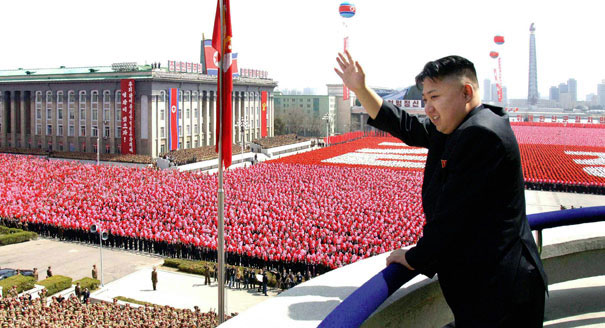
North Korea carried out a third nuclear test underground at a remote location in the northeastern part of the country, prompting new fears and international condemnation.
Source: PBS NewsHour
IMGXYZ15964IMGZYXAppearing on PBS's NewsHour, Carnegie's James Acton said that most people believe that Pyongyang's long term goal is developing a ballistic missile armed with a nuclear warhead that can threaten the United States. "In order to do that," said Acton, "you need a miniaturized, physically smaller and lighter nuclear device, so Pyongyang is claiming that is has successfully done that."
North Korea carried out a nuclear test underground at a remote location in the northeastern part of the country, prompting new fears and international condemnation. This is third nuclear test by North Korea since 2006 and the first test under the new leader, Kim Jong-un.
The U.N. Security Council voted just weeks ago to impose additional sanctions on North Korea. This latest test forced the Council into an emergency session where members condemned the actions and discuss more sanctions. Even China, North Korea’s sole ally, condemned the act, Acton said.
Acton clarified that the size of the device tested and the material it was made from remain unknown. "In fact, we don't even know definitively that this was larger than the previous two tests," said Acton. However, he went on to say that this test demonstrates North Korea is "moving along its arc of developing nuclear weapons that can threaten the United States."

Jessica T. Mathews Chair, Co-director, Nuclear Policy Program
Acton holds the Jessica T. Mathews Chair and is co-director of the Nuclear Policy Program at the Carnegie Endowment for International Peace.
Recent Work

James M. Acton, Ankit Panda
James M. Acton
Carnegie does not take institutional positions on public policy issues; the views represented herein are those of the author(s) and do not necessarily reflect the views of Carnegie, its staff, or its trustees.

The nuclear relationship between China and the United States is increasingly shaped by widening perception gaps rather than deliberate strategic design.

Tong Zhao

Chinese biotech companies have been on the receiving end of U.S. economic coercion. Yet their responses have differed significantly because firm and state interests are not uniformly aligned. For Washington, treating all Chinese tech firms the same, irrespective of their actual interests, risks pushing them farther into Beijing’s corner.

Xue Gong

But their "principal to principal" model will only be as effective as the political strength of each leader back home.

Damien Ma

U.S. unpredictability has allowed China to capitalize on its positioning as the “responsible great power”. Paradoxically, the more China wins the perception game, the more likely expectations will rise for Beijing to deliver not just words but to demonstrate with its deeds.

Chong Ja Ian

Across Asia, China is better positioned to withstand energy shocks from the fallout of the Iran war. Its abundant coal capacity can ensure stability in the near term. Yet at the same time, the country’s energy transition away from coal will make it even less vulnerable during the next shock.
Damien Ma