

In The Media
David Rothkopf
{
  "authors": [
    "David Rothkopf"
  ],
  "type": "legacyinthemedia",
  "centerAffiliationAll": "",
  "centers": [
    "Carnegie Endowment for International Peace"
  ],
  "collections": [],
  "englishNewsletterAll": "",
  "nonEnglishNewsletterAll": "",
  "primaryCenter": "Carnegie Endowment for International Peace",
  "programAffiliation": "",
  "programs": [],
  "projects": [],
  "regions": [
    "North America",
    "United States"
  ],
  "topics": [
    "Political Reform",
    "Security",
    "Foreign Policy"
  ]
}
Source: Getty
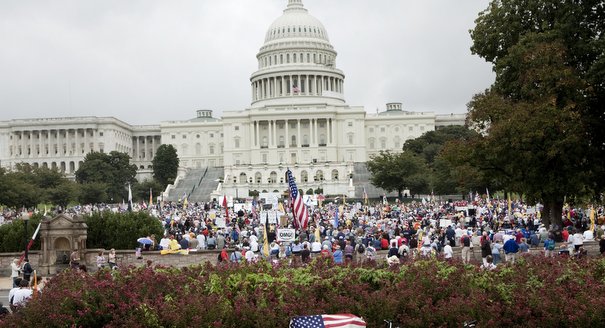
The United States has crossed the fine line that separates national security from national insecurity.
Source: Foreign Policy
Behind closed doors but with language and intonation that ensured his remarks would be heard around the world, Bill Clinton last week said that U.S. President Barack Obama risks looking like a "wuss" and a "fool" by letting politics and a search for ideal solutions keep him from taking action to stop the slaughter in Syria.
Days later, speaking before a congressional committee on June 18, Gen. Keith Alexander, top man at the National Security Agency, and a phalanx of other top administration terror-fighters argued that the unprecedentedly sweeping measures undertaken by the U.S. government to gather telephone metadata, email communications, and Internet records had resulted in thwarting over 50 terrorism threats against the United States.The two sets of statements might appear at first glance to be unrelated. But they hint at a shift that has taken place in U.S. policymaking in the years since the 9/11 attacks. The country has crossed the fine line that separates national security from national insecurity. Fear now seems to drive more of the country's policies than the vision, self-awareness, and courage that used to be the recipe for protecting and advancing U.S. interests internationally.
That is not to say that U.S. soldiers in the field or American law enforcement officers or the members of the intelligence community do not individually and collectively regularly display extraordinary courage. Nor is it to say that fear plays no role in sound policymaking. Sound risk assessment and management are as essential to getting approaches right as bravado and overconfidence are deadly.
But at the highest level, throughout George W. Bush's administration and continuing in a number of key instances during the Obama years, we have too often seen policy promulgated as a consequence of our fear of overstated risks and worst-case scenarios, and, most disturbingly of all, as Clinton alluded to, as a result of the fear of politicians that they might suffer in opinion polls or at the ballot box as a consequence of a misstep or unpopular action.
From the invasion of Iraq to the Patriot Act to the embrace of torture to the expansion of domestic surveillance programs to the failure to intervene earlier in Syria to the constant shifting of "red lines" in that country or Iran to the bumbling and lack of follow-through in Libya to the failure to stand up to abuses by "allies" in Afghanistan, Pakistan, and Iraq or by rivals like Russia or Iran, fear has warped Americans' perspectives, justified alternatively both overreaction and inaction, and enabled the United States to rationalize bad policies into prudent ones on an ongoing basis for over a decade.
Against the existential threats of Nazism and Soviet communism, the United States faced oblivion squarely in the eye and did not flinch, recognizing that steadfastness, clear goals, and the willingness to undertake both political and military risks were crucial to defending the American way of life. There were times in those eras when Americans did let their fears drive them, however, and in every instance -- from internment camps for Japanese-Americans to the incineration of Dresden, Hiroshima, and Nagasaki, from McCarthyism to the miscalculations in Vietnam -- the United States harmed its national standing and took actions that are debated to this day.
In some cases, as with the overreach by U.S. surveillance agencies, the country falls into the trap that led to the internment camps for Japanese-Americans. A threat is overstated to the point that it forces the country to compromise its values and justifies taking sweeping actions that likely could have been avoided by other approaches -- whether more legwork (good old-fashioned police investigations) or paperwork (using existing legal procedures and guidelines). Furthermore, of course, it is also likely that options existed for additional investments in manpower or that new programmatic initiatives could have reduced what real risks existed in systematic and effective ways that did not violate the ideals the United States was theoretically trying to defend.
It should also be observed that an element of political calculus almost certainly drove the Obama team to embrace and expand the Bush-era surveillance programs -- the anxiety that if an attack did take place and the programs had been rolled back, they would have a higher level of culpability.
Of course, as Clinton suggested in his remarks before the McCain Institute, fear of culpability carries its own risks. Thus far, the administration has failed to successfully mobilize its allies to take action to contain the humanitarian catastrophe in Syria and effectively weaken Bashar al-Assad's regime because it has noted the absence of a clear, coherent, virtuous opposition to which the United States could be allied. The irony that this is America's stance in a country that borders Iraq and is in the same neighborhood as Afghanistan and Libya (where the United States placed bets on the most dubious sorts of "frenemies") is pointed. That said, the risks of inaction should the crisis spill more dangerously into Jordan, Lebanon, Iraq, or Turkey also pose a risk for Obama. In short, the absence of an easy answer does not obviate the need for an answer -- some effective way to contain the real risks to national interests posed by spread of chaos in Syria, its spillover to the region, a possible future government in Damascus hostile to a Washington seen as abetting that chaos, and U.S. failure to take advantage of the potential to seriously limit Iranian influence in a vital part of the Middle East.
Former Secretary of State Colin Powell once observed "you break it, you own it," but he should have added a corollary: If failure to act invites a greater calamity, you own that too. As few have observed more persuasively than Samantha Power, America's next ambassador to the United Nations and the author of the profound A Problem from Hell (one of the 10 greatest books on international relations I have ever read), we have a century of genocides for which our inaction was partially responsible that should be on our consciences -- even if they are not. Clinton, of course, when speaking at the McCain event, noted that these issues certainly still weigh heavily on his mind given his own inaction in Rwanda. It should be interesting to see how Obama addresses this point when he visits Africa this month.
Prudence is a term often invoked by the fearful for doing too much or too little. But it shouldn't obscure what is really happening. Our insecurity rather than our goals is too often playing too great a role in driving our actions. Whether this is a momentary anomaly or longer-term symptom common to declining nations that have lost confidence in important aspects of themselves remains to be seen.
Former Visiting Scholar
David Rothkopf was a visiting scholar at the Carnegie Endowment as well as the former CEO and editor in chief of the FP Group.
Recent Work
David Rothkopf
David Rothkopf
Carnegie does not take institutional positions on public policy issues; the views represented herein are those of the author(s) and do not necessarily reflect the views of Carnegie, its staff, or its trustees.

China’s political future will be shaped between now and next October. As the Communist Party enters its intense “campaign season” to prepare for a major political transition in 2027, reading Beijing's actions and responses may become more difficult as domestic politics weigh on its behavior more than usual.

Damien Ma

The nuclear relationship between China and the United States is increasingly shaped by widening perception gaps rather than deliberate strategic design.

Tong Zhao

But their "principal to principal" model will only be as effective as the political strength of each leader back home.
Damien Ma

U.S. unpredictability has allowed China to capitalize on its positioning as the “responsible great power”. Paradoxically, the more China wins the perception game, the more likely expectations will rise for Beijing to deliver not just words but to demonstrate with its deeds.

Chong Ja Ian

Hanoi and Beijing have long treated each other as distant cousins rather than comrades in arms. That might be changing as both sides draw closer to hedge against uncertainty and America’s erratic behavior.

Nguyễn Khắc Giang