

Article
C. Raja Mohan, Darshana M. Baruah
{
  "authors": [
    "C. Raja Mohan"
  ],
  "type": "legacyinthemedia",
  "centerAffiliationAll": "dc",
  "centers": [
    "Carnegie Endowment for International Peace",
    "Carnegie China",
    "Carnegie India"
  ],
  "collections": [
    "China’s Foreign Relations"
  ],
  "englishNewsletterAll": "ctw",
  "nonEnglishNewsletterAll": "",
  "primaryCenter": "Carnegie India",
  "programAffiliation": "SAP",
  "programs": [
    "South Asia"
  ],
  "projects": [],
  "regions": [
    "Southeast Asia",
    "North America",
    "United States",
    "South Asia",
    "India",
    "East Asia",
    "China"
  ],
  "topics": [
    "Foreign Policy",
    "Security",
    "Military"
  ]
}
Source: Getty
ASEAN’s annual summit has grown from a regional gathering to talk shop into a forum for great power politics.
Source: Indian Express
The annual gatherings of the Association of Southeast Asian Nations—at the ministerial level in July and summit level in November at the East Asia Summit—have become good indicators of Asia's volatile geopolitical temperature. It was at the ASEAN Regional Forum in Hanoi, Vietnam, three years ago that the then U.S. Secretary of State Hillary Clinton injected America into the growing tensions between Beijing and its Southeast Asian neighbors in the South China Sea. Clinton's diplomacy in Hanoi heralded America's much-debated pivot to Asia a year later.
Since 2010, the United States has stepped up its economic engagement in the region and outlined plans to shift forces from the Atlantic and the Middle East to the Pacific waters facing China. The United States has also tightened its military alliances with Japan, South Korea, Australia and the Philippines. Its newly vigorous Asian diplomacy included the rapid normalization of relations with Myanmar, expanded security cooperation with Vietnam, and stronger engagement with Indonesia. The United States has also been urging India to beef up its Look East policy.For years, Washington dismissed the ASEAN meetings as talk shops that did not aim for specific outcomes. After the Clinton intervention in 2010, the ASEAN forums have not been the same. The U.S. secretary of state and the president have made annual diplomatic pilgrimages to the ASEAN and the East Asia Summit, and have actively shaped the results. Meanwhile, the arguments between the US and China, and between Beijing and its Southeast neighbors and Tokyo, have become sharper in annual ASEAN meetings. In 2011, China found itself isolated by US activism on the South China Sea issue. In 2012, China hit back. Working with Cambodia, China's strong ally that chaired the meetings during 2012-13, Beijing successfully divided the ASEAN members.
For the first time in its history, the ASEAN ended without an agreed statement, revealing the deepening differences within the forum on how to deal with China's rising power and assertiveness in the South China Sea. This year, though, the ASEAN is determined to put across a show of unity in Bandar Seri Begawan, Brunei.
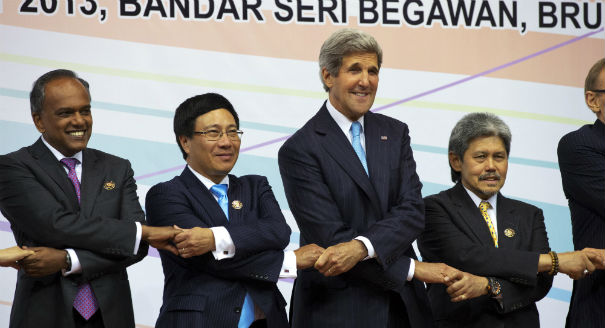
As the ASEAN copes with its internal fissures and the changing external power balance between the United States and China, all eyes in Brunei this week are on U.S. Secretary of State John Kerry. In the Chinese media, Kerry has been projected as a vast improvement over Clinton, who was seen as confrontational and is accused of mobilizing the ASEAN against China.
Many others in the region are worried for the same reason. They suspect that the new secretary of state might be soft on China and less interested in the pivot to Asia than his predecessor. In his address to the ASEAN this week, Kerry said much the same things as Clinton did three years ago on the South China Sea and reaffirmed the American role in the region.
But not all in the ASEAN are reassured about the depth of American security commitment to the region. For Kerry seems focused on the Middle East, and the recent U.S. defense budget cuts have raised questions about the sustainability of the pivot to Asia. The region is also wary of Kerry's efforts to cultivate a special relationship with China.
Like Kerry, the Chinese Foreign Minister Wang Yi made his debut at the ASEAN this week. Wang, however, had an easier task than Kerry. Representing the new political leadership in Beijing, Wang removed some of the rough edges that had crept up into China's diplomacy towards the ASEAN in the last three years. Wang called for a formal dialogue with the ASEAN states on drafting a code of conduct for the South China Sea. He also proposed stronger trade ties between China and the ASEAN. Wang's softer tone made it more difficult for the ASEAN to quibble with China.
However, the Philippines, which is locked in an escalating maritime territorial dispute with China, was not impressed. At Brunei, it accused Beijing of militarizing the South China Sea and violating the earlier agreements between China and the ASEAN. "The overwhelming presence of Chinese ships, including military and paramilitary ships, and the issuance of threats, pose serious challenges for the region as a whole," the Philippines declared.
Former Nonresident Senior Fellow, Carnegie India
A leading analyst of India’s foreign policy, Mohan is also an expert on South Asian security, great-power relations in Asia, and arms control.
Recent Work

C. Raja Mohan, Darshana M. Baruah


Alexander Gabuev, Paul Haenle, C. Raja Mohan, …
Carnegie does not take institutional positions on public policy issues; the views represented herein are those of the author(s) and do not necessarily reflect the views of Carnegie, its staff, or its trustees.

The Plaza Accord was not an externally imposed punishment of Japan but part of a broader restructuring that Japanese economists and policymakers themselves recognized was necessary. Its effects were undermined, however, when Tokyo responded to the resulting slowdown with policies that exacerbated investment, credit expansion, and the very imbalances the adjustment was intended to resolve.

Michael Pettis

The nuclear relationship between China and the United States is increasingly shaped by widening perception gaps rather than deliberate strategic design.

Tong Zhao
China’s banking crisis in the 2000s was resolved by transferring the costs to households through financial repression—a decision that recapitalized the banks while exacerbating the structural imbalances that continue to shape the Chinese economy today.
Michael Pettis

Chinese biotech companies have been on the receiving end of U.S. economic coercion. Yet their responses have differed significantly because firm and state interests are not uniformly aligned. For Washington, treating all Chinese tech firms the same, irrespective of their actual interests, risks pushing them farther into Beijing’s corner.

Xue Gong

China’s latest energy plan explicitly calls for integrating data centers into the electricity system, particularly connecting them to green energy. It appears Beijing wants to use compute as a source of domestic demand to absorb renewables excess capacity.

Damien Ma