

Q&A
Matt Ferchen
{
  "authors": [
    "Matt Ferchen"
  ],
  "type": "legacyinthemedia",
  "centerAffiliationAll": "",
  "centers": [
    "Carnegie Endowment for International Peace",
    "Carnegie China"
  ],
  "collections": [
    "China and the Developing World",
    "China’s Foreign Relations"
  ],
  "englishNewsletterAll": "",
  "nonEnglishNewsletterAll": "",
  "primaryCenter": "Carnegie China",
  "programAffiliation": "",
  "programs": [],
  "projects": [],
  "regions": [
    "East Asia",
    "China",
    "North America",
    "South America"
  ],
  "topics": [
    "Economy"
  ]
}
Source: Getty
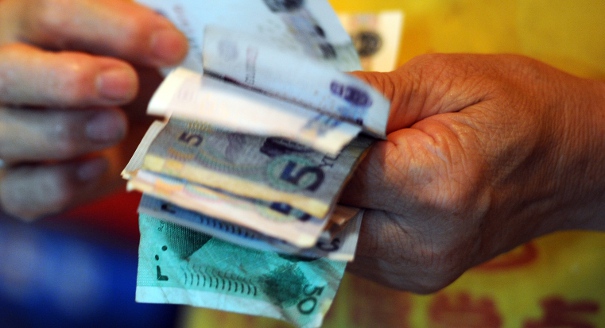
The latest World Bank report predicts China will likely surpass the United States as the world’s largest economy in 2014. This report underscores the contradiction in China’s identity as a developing country.
Source: Caijing
In late April the World Bank released a report unexpectedly forecasting that China was likely to surpass the United States as the world’s largest economy sometime in 2014. Until this announcement, the conventional wisdom was that China’s leap to the very front of the world’s GDP league tables wouldn’t happen until around 2019. But for many in the international media, more surprising than the announcement itself was the overwhelmingly negative Chinese official as well as public response. In fact, the negative responses to being suddenly, and prematurely, vaulted into the position of Number One highlight Chinese sensitivities and insecurities about a range of domestic and international challenges. In particular, the report and its rejection underscore the importance, but also the contradictions, of China’s identity as a “developing” country. Ultimately neither China nor its developing country comrades around the world are comfortable with China’s status as a developing country.
For the majority of my Chinese students, as well as for the Chinese public in general I suspect, it is simply an obvious truth that China is a developing country (fazhanzhong guojia). This popular self-identity is both reinforced and extended by the government and media, which frequently underscore China’s status as “the world’s largest developing country.” Therefore, a key part of the explanation for popular as well as official Chinese rejections of the new World Bank GDP rankings is based on the challenges that accepting such a status would present to China’s identity as a developing country. These challenges are both domestic and international.Domestically, the new Chinese leadership team has recommitted itself to reforming the country’s economic development model in order to avoid the “middle income trap” into which it sees other developing countries, at similar stages of development as itself, having fallen. China’s domestic economic reform agenda is thus about confronting China’s own challenges as a developing country. For all of China’s rapid economic growth in recent decades, both the government and the public are acutely aware of the many development challenges the country faces, from air pollution to food quality to social and economic inequality. And any headline gross GDP figure, such as the World Bank’s new one, must account for China’s huge population. In this more humbling perspective, China’s approximately US$10,000 per capita GDP places it around 90th in the world. Thus just as there has been a reticence to officially trumpet a “Beijing Consensus” or “China Model” of development, accepting the status as world’s biggest economy seems a poor fit with the actual domestic challenges the country faces.
Internationally, not only are China’s core foreign principles of “Peaceful Development” predicated on the country’s status as a developing country, but one of its most important diplomatic initiatives is to build “South-South” relations with other developing countries. At the heart of China’s Peaceful Development foreign policy is the idea that China requires a peaceful international environment in order to maintain its globally interdependent (via trade and investment) strategy of economic development. China’s relations with other developing countries and regions, such as Africa and Latin America as well as Southeast Asia, feature prominently in China’s efforts to take a leadership role among developing countries. However, the World Bank’s re-rankings, which would catapult China to the status of world’s largest economy, sit uneasily with these Chinese efforts to promote a “South-South” developing country global agenda.
In fact, China’s taken-for-granted popular identity as a developing country, as well as the government’s explicit promotion of its “Southern” (hence, not Northern or “developed”) status in its engagement with other developing countries, highlights important contradictions and challenges. In the last decade, China’s rapidly expanding diplomatic and commercial relations with two of the regions at the core of its South-South strategy, Latin America and Africa, have largely been received with good will by political and business leaders in those regions, many of whom are happy to have China as a new commercial and diplomatic partner. But from the beginning, especially in Latin America, China was perceived as a different kind of developing country, or a different type of “Southern” partner.
Brazil exemplifies a wariness that its trade relationship with China is a repeat of regional patterns of commodity export dependence. Upon coming to office in 2011, president Dilma Rousseff expressed a need to move “beyond complementarity” in Brazil’s commercial relations with China. More dramatically, former president and “dependency” theorist Fernando Henrique Cardoso explicitly stated that “China for many years cleverly tried to frame the relationship as ‘south-south’... that its interest was the same as Brazil’s interest. But China’s not the south. China is China, with its own set of interests.” Clearly, even some of China’s BRICS partners are wary of China’s claims to be engaging on equal, developing country terms.
Ultimately, such concerns from China’s developing, or “South-South” partners in places like Latin America and Africa, rest on worries about unequal and unsustainable trade and investment patterns. Closer to home in Southeast and South Asia, developing countries such as the Myanmar, India, and the Philippines have also expressed similar concerns about unsustainable trade and investment patterns as well as a perception that China is increasingly behaving as an aggressive, regional hegemon. Anxieties from other developing countries about China’s rising economic and political influence simply underscore that the World Bank’s new rankings, placing China at Number One, are more than just a concern for the Chinese people and government.

Former Nonresident Scholar, Carnegie-Tsinghua Center for Global Policy
Ferchen specializes in China’s political-economic relations with emerging economies. At the Carnegie–Tsinghua Center for Global Policy, he ran a program on China’s economic and political relations with the developing world, including Latin America.
Recent Work
Matt Ferchen
Matt Ferchen, Anarkalee Perera
Carnegie does not take institutional positions on public policy issues; the views represented herein are those of the author(s) and do not necessarily reflect the views of Carnegie, its staff, or its trustees.

China’s banking crisis in the 2000s was resolved by transferring the costs to households through financial repression—a decision that recapitalized the banks while exacerbating the structural imbalances that continue to shape the Chinese economy today.

Michael Pettis

Chinese biotech companies have been on the receiving end of U.S. economic coercion. Yet their responses have differed significantly because firm and state interests are not uniformly aligned. For Washington, treating all Chinese tech firms the same, irrespective of their actual interests, risks pushing them farther into Beijing’s corner.

Xue Gong
China’s latest energy plan explicitly calls for integrating data centers into the electricity system, particularly connecting them to green energy. It appears Beijing wants to use compute as a source of domestic demand to absorb renewables excess capacity.

Damien Ma

But their "principal to principal" model will only be as effective as the political strength of each leader back home.
Damien Ma

U.S. unpredictability has allowed China to capitalize on its positioning as the “responsible great power”. Paradoxically, the more China wins the perception game, the more likely expectations will rise for Beijing to deliver not just words but to demonstrate with its deeds.

Chong Ja Ian