

Paper
Renée DiResta, Rachel Kleinfeld, Margot Treadwell
{
  "authors": [
    "Rachel Kleinfeld"
  ],
  "type": "legacyinthemedia",
  "centerAffiliationAll": "dc",
  "centers": [
    "Carnegie Endowment for International Peace",
    "Malcolm H. Kerr Carnegie Middle East Center"
  ],
  "collections": [
    "Democracy and Governance"
  ],
  "englishNewsletterAll": "democracy",
  "nonEnglishNewsletterAll": "",
  "primaryCenter": "Carnegie Endowment for International Peace",
  "programAffiliation": "DCG",
  "programs": [
    "Democracy, Conflict, and Governance",
    "Middle East"
  ],
  "projects": [],
  "regions": [
    "Middle East",
    "Bahrain",
    "Gulf"
  ],
  "topics": [
    "Political Reform",
    "Security",
    "Democracy",
    "Foreign Policy"
  ]
}
Source: Getty
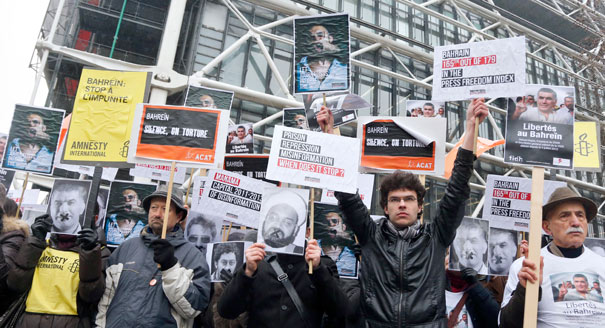
If the United States does not respond to Bahrain’s expulsion of U.S. diplomat Tom Malinowski, it will not just be interpreted as weakness by other countries, it will also damage America’s ability to conduct foreign policy.
Source: Hill
What should we do when a tiny island nation ousts a Senate-appointed U.S. official for doing his job?
On Monday, Bahrain expelled Tom Malinowski, assistant secretary of State for democracy, human rights and labor, for meeting with the heads of a leading political party during a break-the-fast dinner for Ramadan.
It was meant to be an affront. Nor was it the first: Bahrain also signed an investment deal with Russia the same week the U.S. slapped sanctions on the country for its stealth invasion of the Ukraine.
Leaving such a slap in the face unanswered will not only be interpreted as weakness by other countries; it also damages America's ability to conduct foreign policy. If little Bahrain can first require that it approve all meetings to be held by a senior U.S. official, then without warning assign a government handler so that he can hold no private meetings, then expel him for one of those meetings — well, then anyone can prevent the mighty U.S. from engaging in basic diplomacy.Many may wish to do nothing. After all, there is a lot of unrest in the Middle East just now, and our Navy's Fifth Fleet is based in Bahrain — why rock the (literal) boat?
But doing nothing is a slippery slope that will endanger other U.S. officials. Malinowski was expelled: Will a future diplomat be "accidentally" pepper-sprayed at a rally, roughed up by rebels in (say) eastern Ukraine, or "temporarily detained" in another country seeking to show its dislike for U.S. policy? Meanwhile, if we let this go and start down that slippery slope, but then react when one of our military or trade officials is harmed by another country — what will that say about where the Obama administration prioritizes human rights and democracy?
Finally, we should be aware that Malinowski may be the canary in the coal mine. As a veteran of this work in the field told me: "It's when they start denying U.S. officials the right to see the opposition or NGO leaders that you really have to worry. That's when crackdowns often start."
So what should we do? Luckily, Malinowski himself provided some ideas two years ago, in his own congressional testimony on Bahrain.
First: The U.S. should show that we back our senior officials and their human rights mission. If they deny access to our leading human rights voice, the U.S. should deny visas and access to the U.S. banking system to those officials and members of the security forces in Bahrain who have been credibly linked to serious human rights crimes — such as the torture of opposition activists. We can use Bahrain's own Bassiouni Commission report to determine the guilty: In effect, we are asking Bahrain's government to act on their own findings against their own officials. Such a visa ban has the benefit of being targeted, as well as proportional: Bahrain has had a de facto entry ban on journalists, NGO leaders and human rights activists for years.
Next: we should recognize Bahrain for what it is. Bahrain is an authoritarian monarchy riddled with corruption – an ill that has brought down governments from Tunisia to Ukraine in just the past few years, often with violent and dangerous repercussions. It has used torture and Saudi military might to quell peaceful requests from its Shia majority who were radically demanding (drumroll, please) a constitutional monarchy. We have seen this script before, and it does not end well.
Our State Department has tried to push for dialogue, and our military tried to use its aid to help moderates in government. But that aid was taken by hardliners as carte blanche, and failed to secure many real changes on the ground. Bahrain has shown it can get hardware elsewhere if we cut off equipment, so that is not the most useful avenue. But they want our visible military friendship and training. As my colleague at the Carnegie Endowment for International Peace, Fred Wehrey, has outlined, we can require more quid for our quo in providing that military training, asking for real reforms first, training second.
Finally, we need to face the situation of our Fifth Fleet. Currently, we are letting a tiny country the size of San Diego have us over a barrel. "The Fifth Fleet is there — we can’t afford to alienate our Bahraini allies" is the refrain — while they repress their people, expel our diplomats and tie up deals with Russia in the face of our sanctions. In fact, it's not even the country that is holding us hostage: It's a tiny ruling clique despised by many, perhaps most, of its own people.
Having a U.S. naval base in the Middle East is essential — and options are extremely limited. All the countries with ports are problematic. But we do ourselves no favors by placing all our eggs in such a rickety basket. The question of where to base our fleet may be taken out of our hands if some of the currents from Syria and Iraq spill over and Bahrain breaks out into conflict. While other ports are far from ideal, it would be worth quietly exploring and planning for a contingency in which we were forced to move all or part of the Fifth Fleet. At the least, word of such quiet exploration would send a message. And if conflict does break out, we won't be stuck in the dock.
Senior Fellow, Democracy, Conflict, and Governance Program
Rachel Kleinfeld is a senior fellow in Carnegie’s Democracy, Conflict, and Governance Program, where she focuses on issues of rule of law, security, and governance in democracies experiencing polarization, violence, and other governance problems.
Recent Work
Renée DiResta, Rachel Kleinfeld, Margot Treadwell
Political Violence Researchers, Rachel Kleinfeld, ed., Dalya Berkowitz, ed.
Carnegie does not take institutional positions on public policy issues; the views represented herein are those of the author(s) and do not necessarily reflect the views of Carnegie, its staff, or its trustees.

But their "principal to principal" model will only be as effective as the political strength of each leader back home.

Damien Ma

U.S. unpredictability has allowed China to capitalize on its positioning as the “responsible great power”. Paradoxically, the more China wins the perception game, the more likely expectations will rise for Beijing to deliver not just words but to demonstrate with its deeds.

Chong Ja Ian

Hanoi and Beijing have long treated each other as distant cousins rather than comrades in arms. That might be changing as both sides draw closer to hedge against uncertainty and America’s erratic behavior.

Nguyễn Khắc Giang

Across Asia, China is better positioned to withstand energy shocks from the fallout of the Iran war. Its abundant coal capacity can ensure stability in the near term. Yet at the same time, the country’s energy transition away from coal will make it even less vulnerable during the next shock.
Damien Ma

Malaysia’s chairmanship sought to fend off short-term challenges while laying the groundwork for minimizing ASEAN’s longer-term exposure to external stresses.

Elina Noor