

In The Media
Petr Topychkanov
{
  "authors": [
    "Petr Topychkanov"
  ],
  "type": "commentary",
  "centerAffiliationAll": "",
  "centers": [
    "Carnegie Endowment for International Peace",
    "Carnegie Russia Eurasia Center"
  ],
  "collections": [],
  "englishNewsletterAll": "",
  "nonEnglishNewsletterAll": "",
  "primaryCenter": "Carnegie Russia Eurasia Center",
  "programAffiliation": "",
  "programs": [],
  "projects": [],
  "regions": [
    "South Asia",
    "India",
    "East Asia",
    "China",
    "Russia"
  ],
  "topics": [
    "Foreign Policy",
    "Nuclear Policy",
    "Arms Control"
  ]
}
Source: Getty
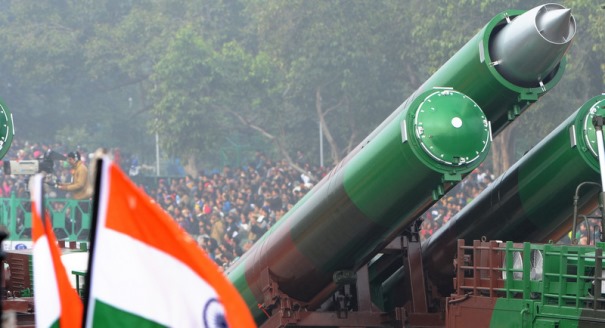
China and India would definitely want to know if Russia is really so afraid of the missiles they are developing that is ready to abandon the INF Treaty.
Russia’s official pronouncements have been increasingly critical of the Intermediate-Range Nuclear Forces Treaty (INF) and other Russian-American agreements that are alleged to run counter to the Russian national interests. Even the Russian president made numerous statements about the changed international climate that may put compliance with the INF into question for the sake of national security.
Putin alluded to it in his speech at the Munich Security Conference on February 10, 2007. He made a similar comment quite recently on August 14 while meeting the members of Duma factions in Yalta. Responding to the remark by the Communist Duma member Leonid Kalashnikov that the time to abandon the treaty has come, the president said, "we are thinking of it, of course; we are analyzing it. Today we are capable of ensuring our security with the systems that we have and are developing. But this is not an idle question".
Subsequently, on September 22, the Presidential Administration Chief of Staff Sergei Ivanov named the countries whose development of intermediate and short-range missiles causes Russia’s concern. He said that "all the countries on the arch that spans from North Korea to Israel, including Pakistan, India and Iran, possess this type of weapons."
Let us put the Russian-American dimension of this issue aside and discuss the third countries. The president and other officials speak of the threat posed to Russia by North Korea, China, India, Pakistan, Israel, and possibly other states located along the arch spanning from North Korea to Israel that possess short and/or intermediate-range missiles.
Thus, in the context of the country’s escalating tensions with the West, Russian officials have chosen to stress the missile threats coming from many countries in the East, which necessitates Russia’s leaving the INF Treaty to counteract these threats.
These statements could be ignored if they were made by some scandalous Duma member or concerned a particular regime that discredited itself. However, they are repeated time and again by the highest-ranking officials and concern most countries located on the arch spanning from North Korea to Israel, including the countries that Russia is developing strategic partnership with – namely, China and India. Therefore, this is a deliberate position that Moscow is consistently advancing in its foreign and defense policies.
If this is indeed Russia’s position, it certainly requires clarification, at least with respect to Russia’s partners in Beijing and New Delhi. China and India would definitely want to know if Russia is really so afraid of the missiles they are developing that is ready to abandon the INF Treaty.

Former Fellow, Nonproliferation Program, Moscow Center
Topychkanov was a fellow in the Carnegie Moscow Center’s Nonproliferation Program.
Recent Work
Petr Topychkanov
Petr Topychkanov
Carnegie does not take institutional positions on public policy issues; the views represented herein are those of the author(s) and do not necessarily reflect the views of Carnegie, its staff, or its trustees.

Malaysia’s chairmanship sought to fend off short-term challenges while laying the groundwork for minimizing ASEAN’s longer-term exposure to external stresses.

Elina Noor
For Malaysia, the conjunction that works is “and” not “or” when it comes to the United States and China.
Elina Noor

ASEAN needs to determine how to balance perpetuating the benefits of technology cooperation with China while mitigating the risks of getting caught in the crosshairs of U.S.-China gamesmanship.
Elina Noor
In July 2025, Vietnam and China held their first joint army drill, a modest but symbolic move reflecting Hanoi’s strategic hedging amid U.S.–China rivalry.

Nguyễn Khắc Giang

Regulation, not embargo, allows Beijing to shape how other countries and firms adapt to its terms.

Alvin Camba