

Paper
Christopher S. Chivvis, Rohan Mukherjee, Milan Vaishnav
{
  "authors": [
    "Milan Vaishnav"
  ],
  "type": "legacyinthemedia",
  "centerAffiliationAll": "dc",
  "centers": [
    "Carnegie Endowment for International Peace"
  ],
  "collections": [],
  "englishNewsletterAll": "ctw",
  "nonEnglishNewsletterAll": "",
  "primaryCenter": "Carnegie Endowment for International Peace",
  "programAffiliation": "SAP",
  "programs": [
    "South Asia"
  ],
  "projects": [],
  "regions": [
    "South Asia",
    "India"
  ],
  "topics": [
    "Political Reform",
    "Economy"
  ]
}
Source: Getty
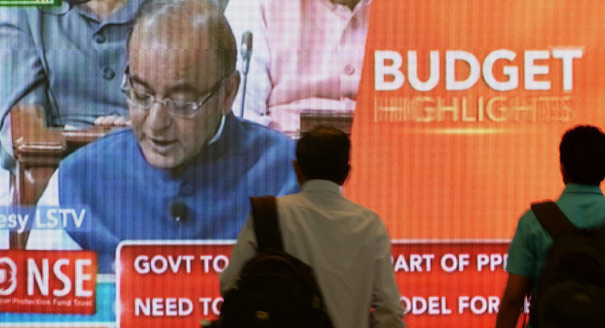
The new budget is clearly pro-growth in its orientation and is a marked improvement from the government’s first provisional budget issued last July.
Source: Deutsche Welle
The 2015 budget "will further reignite our growth engine, signaling the dawn of a prosperous future," wrote PM Modi on Twitter, referring to his government's recently unveiled budget, widely viewed as business-friendly.
On February 28, Finance Minister Arun Jaitley announced a host of new measures in the government's first full budget, including increased spending in infrastructure, a universal social security scheme and an unprecedented corporate tax cut to 25 percent over the next four years. Jaitley said India was "about to take off" and it was time for a "quantum leap" on reforms.
The finance minister also said he expects the country's GDP to grow between 8 and 8.5 percent year-on-year, adding that a double digit growth rate may be achievable soon. The announcement comes a month after India's Statistics Office unveiled changes in the way it calculates the country's GDP.
There were high expectations on the newly released budget as Modi's ruling BJP party swept to power nine months ago on promises of reviving the country's sluggish economy. Last year's "mini budget" - unveiled by the ruling BJP in July - had been viewed by analysts as lacking on key issues.
Milan Vaishnav, an expert on India's political economy and an associate in the South Asia Program at the Carnegie Endowment for International Peace, talks in a DW interview about the keystones of the new budget and the areas where the government needs to make additional efforts.
On the latter, there is broad continuity with the policies of the previous Congress-led United Progressive Alliance (UPA) government headed by Prime Minister Manmohan Singh. On the former, we continue to see a strategy of reform "incrementalism." We should put all talk of "big bang" away because this government has clearly calculated that this is not the strategy it is going to pursue during its tenure.
Early in the budget speech, Finance Minister Jaitley said that, "it is quite obvious that incremental change is not going to take us anywhere." That is ironic because the budget is highly incremental in nature. I would characterize many of the steps as positive –rationalizing subsidies, expanding public investment, easing the way for private sector investment –but I would not characterize these as "quantum leaps."
I think the one area where the government does get high marks for dramatic change is in decentralizing expenditures to the state level, although this was achieved mainly by adopting recommendations made by the 14th Finance Commission.
There are four highlights in my view. First, the government remains committed to fiscal consolidation but it has eased up on its deficit reduction targets in the short run. This is necessary to ramp up capital expenditure in order to stimulate the investment cycle. In the medium term, it has not deviated from the previously outlined fiscal targets.
Second, is its commitment to decentralizing expenditures. In 2015-16, roughly 62 percent of India's total tax revenues will go to the states. In 2014-2015, this share stood at around 55 percent. Going forward, states will have greater leeway to decide their own priorities. Third, there is the issue of subsidy reform. To my surprise, the budget was rather silent on this score.
The Government's Economic Survey, which was released the day before the budget, was quite ambitious - almost revolutionary - in its approach to shifting subsidies to direct cash transfers, relying on the ambitious biometric identification scheme known as Aadhaar to authenticate beneficiaries (thereby reducing leakage). The budget restated the government's commitment to shift to direct benefit transfers (DBT) but was very vague on the details.
There were rumblings in the days before the budget that the government would announce new details about shifting food subsidies and even payments through MGNREGA (Mahatma Gandhi National Rural Employment Guarantee Act) through the DBT platform. This did not happen.
Finally, there was a push to incentivize manufacturing, primarily through off-budget incentives. These make sense, but absent real changes that will liberalize factor markets (land, labor, capital), their impact will be rather limited I am afraid.
First and foremost, industry was looking for a full-throated commitment to a sound macroeconomic policy framework. I think it was largely reassured in this regard, with the one exception being a slight deviation from fiscal deficit targets in the short term. On inflation, the government committed itself to a new monetary policy framework, with the objective of keeping inflation below 6 percent.
The major quibble here would be vague action on the subsidy front. Second, industry was looking for improvements to the ease of doing business.
One highlight here was the establishment of an "expert committee" to explore the idea of replacing the myriad permissions needed to start a business with a single, unified permission - the exact contours of which will have to be worked out. Finally, industry had high hopes on simplifying the tax structure and reducing rates.
Jaitley announced the government's intention to institute GST beginning on April 1, 2016, which is an ambitious timeline given continued disagreements on the specifics between the centre and the states. The main highlight for industry on the tax side was an announced reduction of the corporate tax rate from 30 percent to 25 percent.
Then there is the issue of new rules on tax avoidance, which have been highly controversial to say the least. Jaitley announced that General Anti Avoidance Rule (GAAR) would not come into effect for another two years, and even at that point, would apply on prospectively.
The budget said very little about land. The government's main priority on this front is pushing through legislation that would amend the existing Land Acquisition Act to make it less onerous for industry to procure land. The government was unable to pass its new bill in the previous session of Parliament so it was forced to rely on an executive ordinance to implement the act.
But ordinances are short-term measures; if Parliament does not pass a bill in this session, the ordinance will expire (unless the Presdent re-issues the ordinance). Right now, the opposition has refused to compromise on the bill and even the BJP's alliance partners have come out against it. The Prime Minister has signaled the government would consider "constructive" suggestions to tweak the bill. This fight is only beginning.
There were no new announcements on the lifting of existing foreign investment caps, which will be disappointing to the foreign investment community. What the government did do is to announce its intention to eliminate the artificial (and confusing) distinction between foreign portfolio investment (FII) and foreign direct investment (FDI). This will be cheered by foreign investors.
The general reaction to the railway budget has been positive. For the first time in a long time, the Railway Minister did not announce any new rail lines, instead focusing on ramping up investments to modernize and expand rail infrastructure.
The government is proposing a quantum jump in rail investment, some of which will come from private sector sources and via public-private partnerships (PPPs). Although the budget did not announce any new passenger fare hikes - which are, to put it mildly, highly unpopular - it did raise freight rates on certain goods.
Looking ahead, the Modi government has its hands full trying to implement its economic vision. Although it has a commanding majority in the Lok Sabha, or lower house of parliament, the same cannot be said about the Rajya Sabha, the upper house.
This divided legislature has been a major thorn in the government's side, as it has been largely unable to move big economic bills through both houses. To date, its parliamentary management has been rather unimpressive, although an obstructionist opposition certainly has not helped.
Unfortunately for the government, many from within its own quarters (and from its extra-government allies like the RSS) have helped to sabotage the government's economic agenda with a series of inflammatory pro-Hindu, majoritarian statements. These are, frankly, own goals. If they continue, we are in for a very frustrating few years.
This interview was originally published by Deutsche Welle.
‘ ’

Director and Senior Fellow, South Asia Program
Milan Vaishnav is a senior fellow and director of the South Asia Program and the host of the Grand Tamasha podcast at the Carnegie Endowment for International Peace. His primary research focus is the political economy of India, and he examines issues such as corruption and governance, state capacity, federalism, and electoral behavior. He also conducts research on the Indian diaspora.
Recent Work


Christopher S. Chivvis, Rohan Mukherjee, Milan Vaishnav



Sophia Besch, Eric Ciaramella, Steve Feldstein, …
Carnegie does not take institutional positions on public policy issues; the views represented herein are those of the author(s) and do not necessarily reflect the views of Carnegie, its staff, or its trustees.

The Plaza Accord was not an externally imposed punishment of Japan but part of a broader restructuring that Japanese economists and policymakers themselves recognized was necessary. Its effects were undermined, however, when Tokyo responded to the resulting slowdown with policies that exacerbated investment, credit expansion, and the very imbalances the adjustment was intended to resolve.

Michael Pettis
China’s banking crisis in the 2000s was resolved by transferring the costs to households through financial repression—a decision that recapitalized the banks while exacerbating the structural imbalances that continue to shape the Chinese economy today.
Michael Pettis

In the latest Five-Year Plan, the Chinese president cements the shift to an innovation-driven economy over a consumption-driven one.

Damien Ma
Rather than climate ambitions, compatibility with investment and exports is why China supports both green and high-emission technologies.

Mathias Larsen
“Involution” is a new word for an old problem, and without a very different set of policies to rein it in, it is a problem that is likely to persist.
Michael Pettis