

Research
- +6
Yasmine Farouk, Nathan J. Brown, Maysaa Shuja Al-Deen, …
{
  "authors": [
    "Anouar Boukhars"
  ],
  "type": "other",
  "centerAffiliationAll": "dc",
  "centers": [
    "Carnegie Endowment for International Peace",
    "Malcolm H. Kerr Carnegie Middle East Center"
  ],
  "collections": [],
  "englishNewsletterAll": "menaTransitions",
  "nonEnglishNewsletterAll": "",
  "primaryCenter": "Carnegie Endowment for International Peace",
  "programAffiliation": "MEP",
  "programs": [
    "Middle East"
  ],
  "projects": [],
  "regions": [
    "North Africa",
    "Algeria",
    "Morocco",
    "Tunisia",
    "Southern, Eastern, and Western Africa",
    "Maghreb"
  ],
  "topics": [
    "Security"
  ]
}
Source: Getty
A coordinated international approach that skilfully uses the comparative advantage of each regional institution would greatly help tackle rising insecurity across the Sahara and the Sahel.
Source: FRIDE
There has been a marked intensification of conflict across the Sahara and the Sahel. This has created a new normal, where ethnic tensions are reinforced, religious divisions are more pronounced and crises are less local. The current conflicts in Mali, Libya, and Nigeria – for example – show this, having been deeply shaped by a cross-section of Saharan radicalised militants that mix with transnational smuggling networks and independence movements. To be sure, the old normal was also marred by terrorism and other forms of political violence, border disputes, and occasional acts of banditry. But the nature of conflicts in the Sahel and the Sahara has changed, and the patterns of violence have become more complex. The sources of crises have also become more mobile, acquiring a cross-border dimension that requires regional solutions. So far, bilateral, regional, and international responses have been numerous, but largely contradictory and short-sighted.The good news is that regional and international actors are increasingly aware that any effective response framework needs to be wellcoordinated, and adapted to the geographic and organisational interdependence of networks and populations across the Sahel-Sahara zones. The bad news, however, is that it has been very difficult to design and implement a coordinated security and development strategy that transcends the narrow confines of counter-terrorism, international institutional rivalries, and regional inter-state rivalries....
Former Nonresident Fellow, Middle East Program
Boukhars was a nonresident fellow in Carnegie’s Middle East Program. He is a professor of countering violent extremism and counter-terrorism at the Africa Center for Strategic Studies, National Defense University.
Recent Work



Yasmine Farouk, Nathan J. Brown, Maysaa Shuja Al-Deen, …

Frederic Wehrey, Nathan J. Brown, Bader Al-Saif, …
Carnegie does not take institutional positions on public policy issues; the views represented herein are those of the author(s) and do not necessarily reflect the views of Carnegie, its staff, or its trustees.

The Thai-Cambodian conflict highlights the limits to China's peacemaker ambition and the significance of this role on Southeast Asia’s balance of power.

Pongphisoot (Paul) Busbarat

Beijing believes that Washington is overestimating its own leverage and its ability to handle the trade war’s impacts.


Rick Waters, Sheena Chestnut Greitens

Tapping our network of China experts in the region, Carnegie China offers this latest “China Through a Southeast Asian Lens” report to offer preliminary assessments of whether the U.S. effort to reshape the global trading order will lead countries in the region to tilt toward Beijing.



Selina Ho, Khin Khin Kyaw Kyee, Joseph Ching Velasco, …
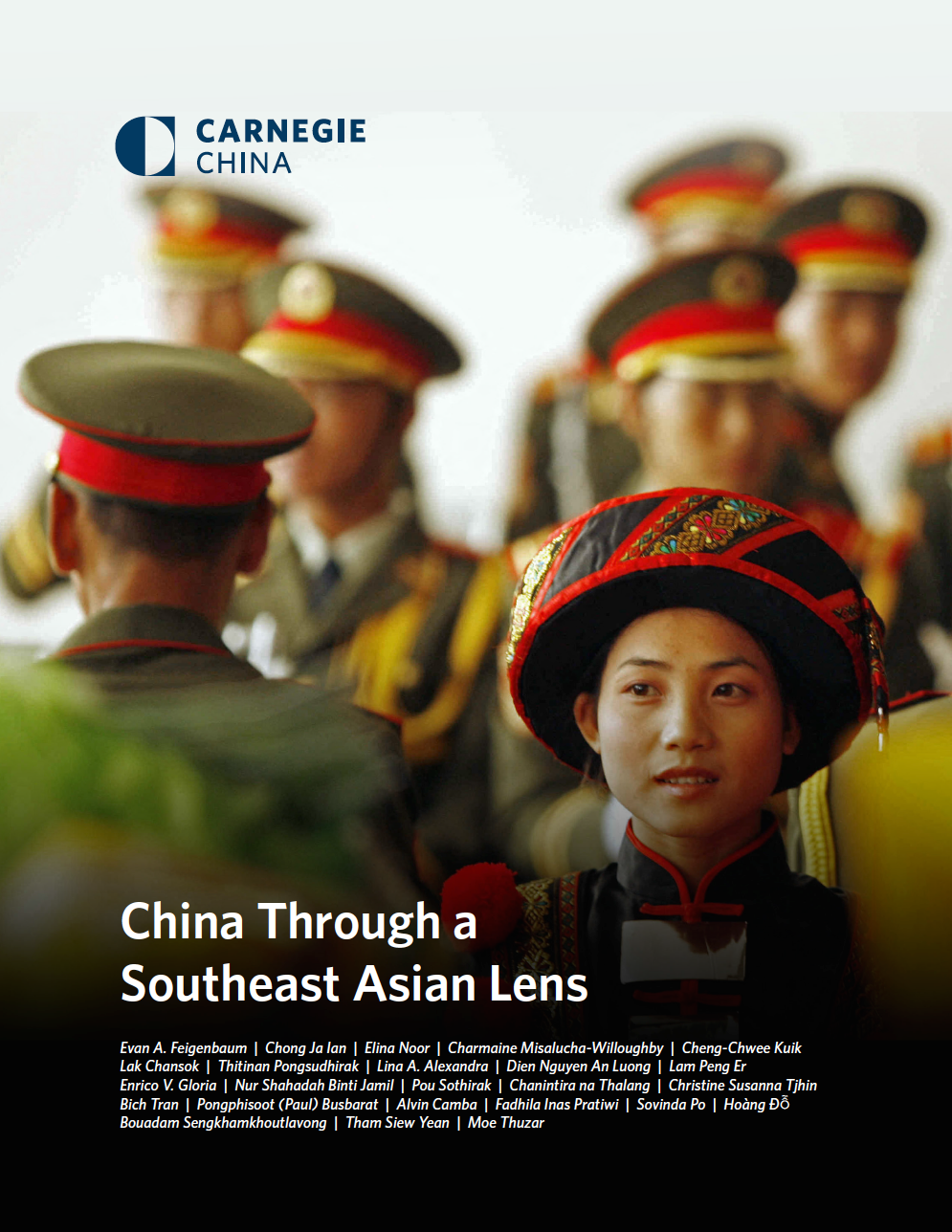
Because strategic, economic, and ideological perceptions of China contain multiple, sometimes contradictory facets in Southeast Asia, receptions of and responses to Beijing diverge across and within state lines.



Evan A. Feigenbaum, Chong Ja Ian, Elina Noor

Most Southeast Asian states behave as if the actions of their Northeast Asian neighbors and the Philippines will be sufficient to maintain a regional status quo from which they can benefit.
Chong Ja Ian