

Article
Frederic Grare
{
  "authors": [
    "Frederic Grare"
  ],
  "type": "legacyinthemedia",
  "centerAffiliationAll": "dc",
  "centers": [
    "Carnegie Endowment for International Peace"
  ],
  "collections": [],
  "englishNewsletterAll": "ctw",
  "nonEnglishNewsletterAll": "",
  "primaryCenter": "Carnegie Endowment for International Peace",
  "programAffiliation": "SAP",
  "programs": [
    "South Asia"
  ],
  "projects": [],
  "regions": [
    "South Asia",
    "India",
    "Pakistan",
    "East Asia",
    "China"
  ],
  "topics": [
    "Foreign Policy"
  ]
}
Source: Getty
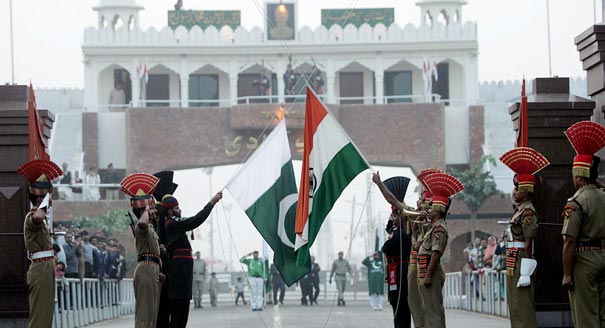
A year into Modi’s prime ministership, relations between India and Pakistan are in many ways unchanged, but the role Pakistan plays in India’s broader foreign policy has been evolving and is increasingly complex.
Source: Hindustan Times
A year into Narendra Modi’s prime ministership, relations between India and Pakistan are in many ways unchanged. The role Pakistan plays in India’s broader foreign policy, however, has been evolving and is increasingly complex. The initiatives taken by Modi, and his capacity to surprise outsiders’ expectations, have gained him political space, both internally and externally. But India’s position vis-à-vis Pakistan and more broadly in the Indian Subcontinent is increasingly constrained by China’s growing clout in South Asian affairs.
Over the past 12 months, relations between the two countries have experienced everything short of open conflict. The invitation of Pakistan’s Prime Minister Nawaz Sharif to Modi’s inauguration prompted a cautious optimism. However, positive developments were soon soured by the unsettled question of Pakistan granting most favoured nation status to India and India’s cancellation of the bilateral foreign secretaries’ talks in July. By the end of summer, the two countries were exchanging artillery fire. However, foreign secretary S Jaishankar’s visit to Pakistan in March marked the resumption of the dialogue between Islamabad and New Delhi. The meeting between the two foreign secretaries ended with no major announcement.
Substantially, the new policy has not borne any fruit and Modi has obtained nothing more than any of his predecessors and was probably not expecting to. New Delhi is still unable to coerce Islamabad into any agreement of its liking. Its strategic options remain limited to either punishing Pakistan or prompting dialogue, although both options can be avoided. Pakistan — more specifically the evolution of civil-military relations in Islamabad, rather than Indian politics — remains the key to eventual normalisation between the two countries.It would be a mistake, however, to conclude that Modi’s first year in office has brought no new developments in the bilateral relationship. By retaliating systematically to every Pakistani provocation in the early stages of his mandate he has strengthened his image as a strongman and gained domestic political support at no or limited cost and risk.
Externally, Modi has also managed to increase his ability to ignore Pakistan while avoiding international pressures. The message sent to Pakistan over the past 12 months has been consistent and simple: India is ready for dialogue, but will respond to any Pakistan recourse to violence with disproportionate force.
Islamabad has been cornered into a defensive position, forced to continuously demonstrate the seriousness of its willingness to talk to India while simultaneously exposing its own internal contradictions over the relationship. The result has been the Pakistani military and some like-minded civilians resorting to new provocations every time the government attempts to improve its relationship with India. However, it is no coincidence that these provocations have become increasingly less violent. The release of Zaki-ur-Rehman Lakhvi, a top leader of the Lashkar-e-Taiba and the mastermind of the 26/11 Mumbai terrorist attacks, may be enough to thwart any real dialogue between India and Pakistan, but it is much less lethal than the infiltration of terrorists across the LoC and potential terrorist attacks in Jammu & Kashmir or elsewhere.
The picture changes slightly in a broader perspective. India’s relations with Pakistan are both facilitated and increasingly constrained by China’s growing influence in the region. Modi’s diplomacy vis-à-vis Pakistan has been aided by the rapprochement with Beijing and Washington initiated by his predecessor and reinvigorated since he took office. China’s desire to benefit from India’s economic growth and to prevent New Delhi from growing too close to Washington has prompted Beijing to pursue a more nuanced India policy. While Beijing remains Islamabad’s strongest regional ally and will likely ensure that it remains a potential threat for India, the Chinese leadership also seems determined to not let its Pakistan policy stand in the way of better relations with India.
On the other side, the new Chinese attitude is not without risks for India. While Islamabad’s policy vis-à-vis New Delhi is becoming increasingly contingent upon Beijing’s own interests in South Asia, it comes with the growing influence of China across South Asia. China’s dynamic economic diplomacy, which India is currently unable to match, makes Beijing’s presence felt in every corner of the subcontinent. China may have a moderating influence on Pakistan, but it is now also a facilitator of Pakistan’s policy in Afghanistan.
Even the United States’ role in the region has become increasingly uncertain for India. Washington may be willing to cooperate with New Delhi on counter-terrorism, but its determination to extricate itself from the Afghan conflict by de facto delegating the management of the conflict to China and Pakistan only reinforces India’s problem.
Modi cannot be held responsible for this situation. He inherited the structural and growing capacity problem he is facing vis-à-vis China in Pakistan and elsewhere. Pakistan is using its own weakness as an argument for requesting support as much with China as it does with the United States, even though the extent to which China is willing to play along remains unclear. A close examination of the actual investments announced by Xi Jinping during his recent visit to Pakistan shows more promise than actual commitment. For the time being, however, the Pakistani security establishment seems to take comfort in the idea that, at least economically, China will come to Pakistan’s rescue should the need arise. This has allowed them to resist every attempt to normalise economic relations with India. In such conditions, Modi can at best be a skilful manager of the India-Pakistan relationship, but a skilful manager of the status quo.
This article was originally published in the Hindustan Times.

Former Nonresident Senior Fellow, South Asia Program
Frédéric Grare was a nonresident senior fellow at the Carnegie Endowment for International Peace, where his research focuses on Indo-Pacific dynamics, the search for a security architecture, and South Asia Security issues.
Recent Work
Frederic Grare
Frederic Grare
Carnegie does not take institutional positions on public policy issues; the views represented herein are those of the author(s) and do not necessarily reflect the views of Carnegie, its staff, or its trustees.

The Plaza Accord was not an externally imposed punishment of Japan but part of a broader restructuring that Japanese economists and policymakers themselves recognized was necessary. Its effects were undermined, however, when Tokyo responded to the resulting slowdown with policies that exacerbated investment, credit expansion, and the very imbalances the adjustment was intended to resolve.

Michael Pettis

The nuclear relationship between China and the United States is increasingly shaped by widening perception gaps rather than deliberate strategic design.

Tong Zhao
China’s banking crisis in the 2000s was resolved by transferring the costs to households through financial repression—a decision that recapitalized the banks while exacerbating the structural imbalances that continue to shape the Chinese economy today.
Michael Pettis

Chinese biotech companies have been on the receiving end of U.S. economic coercion. Yet their responses have differed significantly because firm and state interests are not uniformly aligned. For Washington, treating all Chinese tech firms the same, irrespective of their actual interests, risks pushing them farther into Beijing’s corner.

Xue Gong

China’s latest energy plan explicitly calls for integrating data centers into the electricity system, particularly connecting them to green energy. It appears Beijing wants to use compute as a source of domestic demand to absorb renewables excess capacity.

Damien Ma