

Article
C. Raja Mohan, Darshana M. Baruah
{
  "authors": [
    "C. Raja Mohan"
  ],
  "type": "legacyinthemedia",
  "centerAffiliationAll": "dc",
  "centers": [
    "Carnegie Endowment for International Peace",
    "Carnegie India"
  ],
  "collections": [],
  "englishNewsletterAll": "ctw",
  "nonEnglishNewsletterAll": "",
  "primaryCenter": "Carnegie India",
  "programAffiliation": "SAP",
  "programs": [
    "South Asia"
  ],
  "projects": [],
  "regions": [
    "Asia",
    "South Asia",
    "India",
    "East Asia",
    "China",
    "Japan"
  ],
  "topics": [
    "Security",
    "Foreign Policy"
  ]
}
Source: Getty
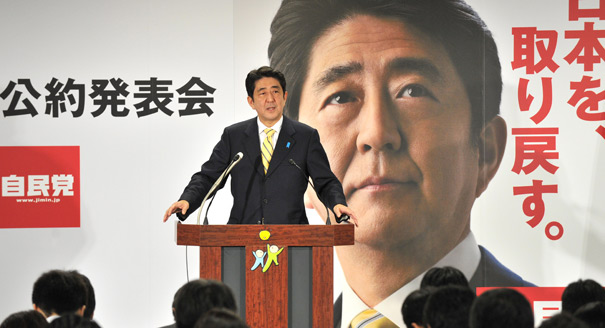
Going against the grain of entrenched pacifism in Japan, Abe is making the case that Tokyo should respond to the rapidly unfolding geopolitical changes in the region.
Source: Indian Express
Despite popular protests, noisy political opposition in parliament and falling approval ratings, Japanese Prime Minister Shinzo Abe is pressing ahead with the overhaul of Japan’s defence policies. Last week, the lower House of the Diet approved 11 pieces of legislation that allow Tokyo to take on a larger military role in the Asia Pacific and Indian Ocean. While the legislation will face difficulties in the upper House, Abe is well-positioned to turn this into law when the bill returns to the lower House.
It’s not often that one sees leaders take risks in the pursuit of a political conviction. Abe, a rare exception, has been steadfast in his determination to remove the extraordinary restraints on Japan’s military imposed by its post-war constitution. Abe wants Japan to be a “normal” power, 70 years after World War II.
Going against the grain of entrenched pacifism in Japan, Abe is making the case that Tokyo should respond to the rapidly unfolding geopolitical changes in the region, especially growing Chinese assertiveness in the maritime territorial disputes. Abe is also conscious of the fact that America is now having a hard time sustaining its primacy in the region amid China’s expanding military capabilities. Washington has been pressing Tokyo to take greater responsibility for regional security and share some of America’s burden. The constitutional changes proposed by Abe will make it easier for Japan to offer military support to the US and regional partners. Until now, the constitution has only allowed the use of Japan’s armed forces in self-defence.In a predictable response, China cautioned Japan against abandoning its traditional restraint and warned the region against the return of Japanese militarism. Beijing has long used Japan’s colonial past to put Tokyo on the defensive. In recent months, it has sought to mobilise Asian and international opinion against Abe’s policies.
Abe, however, has refused to back down and persisted in his efforts to reform Japanese defence policy and make it more robust. While he has faced some resistance at home, Abe appears confident that the Japanese people will eventually rally round to his view.
Externally, besides a stronger military alliance with the US, Abe has sought more intensive security partnerships with other countries in the region, including Australia and India. While his policies have generated much negative reaction in South Korea, there is greater concern in Southeast Asia about China’s regional policies than Japan’s. Despite suffering Japan’s imperial aggression, Vietnam and the Philippines are actively seeking defence cooperation with Tokyo. This is not surprising since Hanoi and Manila today face the brunt of Beijing’s muscular policies in the South China Sea.
In India, the NDA government has shed the UPA’s defensiveness on security cooperation with Japan. Although the strategic partnership with Japan was launched by the UPA when Abe was PM in 2006-07, New Delhi seemed reluctant to go too far. It was determined to not give any offence to Beijing.
The Narendra Modi government has taken a very different approach — intensifying the partnership with both China and Japan, but refusing to hold back with one for fear of upsetting the other. The last few weeks have seen Delhi announce the renewed participation of Japan in the annual Malabar exercises in the Indian Ocean that India has been conducting with the US for more than two decades.
After China protested against the 2007 edition of Malabar that saw the participation of Japan, Australia and Singapore along with the US, the UPA government insisted that Malabar must remain bilateral in the Indian Ocean. The NDA has reversed that decision. Modi’s Delhi is no longer willing to give Beijing a veto over its defence partnerships. Delhi is now emulating Beijing, which does not defer to India’s sensitivities on its all-weather security partnership with Pakistan.
There are also reports that Delhi has agreed to elevate its trilateral political consultations with Washington and Tokyo, which began in 2010 among senior officials of the three countries, to the ministerial level. The first round of talks between the three foreign ministers is expected to take place in September on the margins of the UN General Assembly.
This article was originally published in the Indian Express.
Former Nonresident Senior Fellow, Carnegie India
A leading analyst of India’s foreign policy, Mohan is also an expert on South Asian security, great-power relations in Asia, and arms control.
Recent Work

C. Raja Mohan, Darshana M. Baruah


Alexander Gabuev, Paul Haenle, C. Raja Mohan, …
Carnegie does not take institutional positions on public policy issues; the views represented herein are those of the author(s) and do not necessarily reflect the views of Carnegie, its staff, or its trustees.

China’s political future will be shaped between now and next October. As the Communist Party enters its intense “campaign season” to prepare for a major political transition in 2027, reading Beijing's actions and responses may become more difficult as domestic politics weigh on its behavior more than usual.

Damien Ma

China has showcased its engineering prowess with small modular reactor demonstration projects. But turning these technological achievements into commercial success will be a greater challenge.

Tong Zhao

The Plaza Accord was not an externally imposed punishment of Japan but part of a broader restructuring that Japanese economists and policymakers themselves recognized was necessary. Its effects were undermined, however, when Tokyo responded to the resulting slowdown with policies that exacerbated investment, credit expansion, and the very imbalances the adjustment was intended to resolve.

Michael Pettis

The nuclear relationship between China and the United States is increasingly shaped by widening perception gaps rather than deliberate strategic design.
Tong Zhao
China’s banking crisis in the 2000s was resolved by transferring the costs to households through financial repression—a decision that recapitalized the banks while exacerbating the structural imbalances that continue to shape the Chinese economy today.
Michael Pettis