

Paper
Ashley J. Tellis
{
  "authors": [
    "Ashley J. Tellis"
  ],
  "type": "legacyinthemedia",
  "centerAffiliationAll": "dc",
  "centers": [
    "Carnegie Endowment for International Peace"
  ],
  "collections": [],
  "englishNewsletterAll": "ctw",
  "nonEnglishNewsletterAll": "",
  "primaryCenter": "Carnegie Endowment for International Peace",
  "programAffiliation": "SAP",
  "programs": [
    "South Asia"
  ],
  "projects": [],
  "regions": [
    "North America",
    "United States",
    "South Asia",
    "India"
  ],
  "topics": [
    "Security",
    "Military",
    "Foreign Policy"
  ]
}
Source: Getty
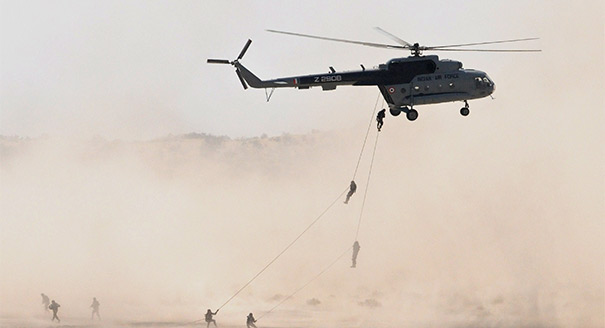
Defense cooperation is the cornerstone of the steadily strengthening bilateral U.S.-Indian relationship.
Source: Force
If there is any single proof of the transformation of US -Indian relations since 2001, burgeoning defence ties would stand out as ‘Exhibit A.’ Since the trying moments after the 1998 Indian nuclear tests — when Indian strategic entities became targets of US sanctions, when Indian weapons systems of US origin lay non-operational because spare parts were denied, and when US -Indian defence trade was minuscule — the flood of interactions that have now become commonplace mark defence cooperation as the cornerstone of the steadily strengthening bilateral relationship.At one level, this metamorphosis should not be surprising. Both the United States and India face common threats: Islamist terrorism, rising Chinese power, continued nuclear proliferation, and new dangers in the global commons. But despite these persistent perils, it required a civil nuclear agreement to dramatically seal the evolving strategic collaboration between Washington and New Delhi. The 18 July 2005 joint statement issued by President George W. Bush and Prime Minister Manmohan Singh did just that: by signalling that the United States would now treat India as a valued geopolitical partner rather than as a singular target of its nonproliferation policy, Bush (and, his successor, Barack Obama) declared— to the consternation of many— that the United States was serious about building a new relationship with India....
The full text of this article was originally published in Force.
Former Senior Fellow
Ashley J. Tellis was a senior fellow at the Carnegie Endowment for International Peace.
Recent Work
Ashley J. Tellis
Ashley J. Tellis
Carnegie does not take institutional positions on public policy issues; the views represented herein are those of the author(s) and do not necessarily reflect the views of Carnegie, its staff, or its trustees.

But their "principal to principal" model will only be as effective as the political strength of each leader back home.

Damien Ma

U.S. unpredictability has allowed China to capitalize on its positioning as the “responsible great power”. Paradoxically, the more China wins the perception game, the more likely expectations will rise for Beijing to deliver not just words but to demonstrate with its deeds.

Chong Ja Ian

Hanoi and Beijing have long treated each other as distant cousins rather than comrades in arms. That might be changing as both sides draw closer to hedge against uncertainty and America’s erratic behavior.

Nguyễn Khắc Giang

Across Asia, China is better positioned to withstand energy shocks from the fallout of the Iran war. Its abundant coal capacity can ensure stability in the near term. Yet at the same time, the country’s energy transition away from coal will make it even less vulnerable during the next shock.
Damien Ma

Malaysia’s chairmanship sought to fend off short-term challenges while laying the groundwork for minimizing ASEAN’s longer-term exposure to external stresses.

Elina Noor