

Commentary
Duyeon Kim, Andrei Lankov, Leon V. Sigal
{
  "authors": [
    "Duyeon Kim"
  ],
  "type": "other",
  "centerAffiliationAll": "dc",
  "centers": [
    "Carnegie Endowment for International Peace"
  ],
  "collections": [
    "U.S. Nuclear Policy",
    "Korean Peninsula"
  ],
  "englishNewsletterAll": "ctw",
  "nonEnglishNewsletterAll": "",
  "primaryCenter": "Carnegie Endowment for International Peace",
  "programAffiliation": "NPP",
  "programs": [
    "Nuclear Policy"
  ],
  "projects": [],
  "regions": [
    "North America",
    "United States",
    "East Asia",
    "South Korea"
  ],
  "topics": [
    "Nuclear Policy",
    "Nuclear Energy"
  ]
}
Source: Getty
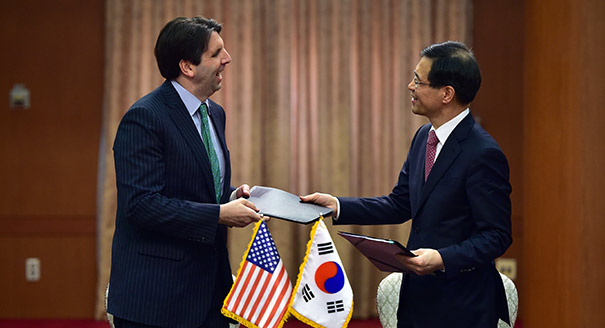
The successor agreement to the U.S.-South Korean 1974 civil nuclear cooperation accord reflects the interdependence of the American and South Korean nuclear industries as an equal partnership.
Source: CSIS
On June 15, the United States and South Korea signed a successor agreement to their 1974 civil nuclear cooperation accord. Updating the existing agreement took over four years of challenging negotiations complicated by Seoul’s demands for the right to enrich uranium and reprocess (or pyroprocess) spent nuclear fuel to which Washington objected. What began as nearly irreconcilable political differences resulted in win-win compromises that strike a balance between maintaining the U.S.' core nonproliferation policy and reflecting South Korea’s industrial maturity and desire to advance its civil nuclear program while establishing pathways for an unprecedented level of cooperation between the two allies. The new agreement reflects the interdependence of the American and South Korean nuclear industries as an equal partnership—from a unilateral obligation to reciprocal consent rights and obligations—as well as mature, strong bilateral relationship...This report was originally published by CSIS

Former Associate, Nuclear Policy Program, Asia Program
Kim is an expert on nuclear nonproliferation, diplomacy, and Northeast Asia.
Recent Work

Duyeon Kim, Andrei Lankov, Leon V. Sigal

James L. Schoff, Duyeon Kim
Carnegie does not take institutional positions on public policy issues; the views represented herein are those of the author(s) and do not necessarily reflect the views of Carnegie, its staff, or its trustees.

Chinese biotech companies have been on the receiving end of U.S. economic coercion. Yet their responses have differed significantly because firm and state interests are not uniformly aligned. For Washington, treating all Chinese tech firms the same, irrespective of their actual interests, risks pushing them farther into Beijing’s corner.

Xue Gong

But their "principal to principal" model will only be as effective as the political strength of each leader back home.

Damien Ma

U.S. unpredictability has allowed China to capitalize on its positioning as the “responsible great power”. Paradoxically, the more China wins the perception game, the more likely expectations will rise for Beijing to deliver not just words but to demonstrate with its deeds.

Chong Ja Ian

Across Asia, China is better positioned to withstand energy shocks from the fallout of the Iran war. Its abundant coal capacity can ensure stability in the near term. Yet at the same time, the country’s energy transition away from coal will make it even less vulnerable during the next shock.
Damien Ma
For Malaysia, the conjunction that works is “and” not “or” when it comes to the United States and China.

Elina Noor