

Commentary
But their "principal to principal" model will only be as effective as the political strength of each leader back home.
Damien Ma
{
  "authors": [
    "David Livingston",
    "Jeffrey Feldman"
  ],
  "type": "other",
  "centerAffiliationAll": "dc",
  "centers": [
    "Carnegie Endowment for International Peace",
    "Carnegie Europe"
  ],
  "collections": [],
  "englishNewsletterAll": "ctw",
  "nonEnglishNewsletterAll": "",
  "primaryCenter": "Carnegie Endowment for International Peace",
  "programAffiliation": "SCP",
  "programs": [
    "Sustainability, Climate, and Geopolitics"
  ],
  "projects": [],
  "regions": [
    "North America",
    "United States",
    "Eastern Europe",
    "Western Europe"
  ],
  "topics": [
    "Climate Change"
  ]
}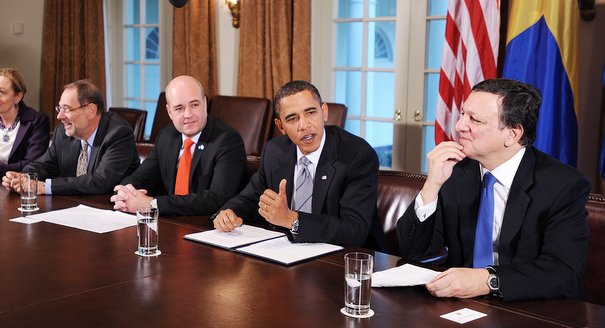
Source: Getty
Energy security is critical to a whole range of public policy objectives, but it cannot be successfully addressed in isolation from other policy aims.
Source: Heinrich Boell Stiftung
On both sides of the Atlantic, energy continues to be a complex, multifaceted issue that is relevant for a whole range of public policy objectives. Energy security is one of the most important aspects, but it cannot be successfully addressed in isolation from other public policy aims. The aim of this paper is to shed light on how three policy communities – those dealing with security, foreign policy, and energy issues – can come together to discuss and find solutions to the transatlantic energy agenda in light of transforming energy security realities on both sides of the Atlantic. Its findings are based on a transatlantic workshop series held in Washington D.C., Brussels and Warsaw in 2015.
This report demonstrates the interconnectivity of the different dimensions of energy policy. The report breaks down the policy silos, providing a comprehensive overview of some of the myriad of issues that any 21st century energy order faces. With workshops in Brussels, Warsaw and Washington D.C., this report has escaped the traditional energy security echo chamber by including in its considerations climate milestones, such as the COP21 Paris Climate Agreement, trade developments such as the transatlantic trade and investment partnership (TTIP), global governance as well as regional co-operation such as the link-up of regional carbon-markets and the creation of sustainable low-carbon energy partnerships....
This report was originally published by Heinich Boell Stiftung.
Former Associate Fellow, Energy and Climate Program
Livingston was an associate fellow in Carnegie’s Energy and Climate Program, where his research focuses on emerging markets, technologies, and risks.
Jeffrey Feldman
Former Junior Fellow, Energy and Climate Program
Carnegie does not take institutional positions on public policy issues; the views represented herein are those of the author(s) and do not necessarily reflect the views of Carnegie, its staff, or its trustees.

But their "principal to principal" model will only be as effective as the political strength of each leader back home.

Damien Ma

U.S. unpredictability has allowed China to capitalize on its positioning as the “responsible great power”. Paradoxically, the more China wins the perception game, the more likely expectations will rise for Beijing to deliver not just words but to demonstrate with its deeds.

Chong Ja Ian

For Malaysia, the conjunction that works is “and” not “or” when it comes to the United States and China.

Elina Noor

Regulation, not embargo, allows Beijing to shape how other countries and firms adapt to its terms.

Alvin Camba
Beijing believes that Washington is overestimating its own leverage and its ability to handle the trade war’s impacts.


Rick Waters, Sheena Chestnut Greitens