

Commentary
Tatiana Stanovaya
{
  "authors": [
    "Tatiana Stanovaya"
  ],
  "type": "commentary",
  "centerAffiliationAll": "",
  "centers": [
    "Carnegie Endowment for International Peace",
    "Carnegie Russia Eurasia Center"
  ],
  "collections": [
    "Inside Russia"
  ],
  "englishNewsletterAll": "",
  "nonEnglishNewsletterAll": "",
  "primaryCenter": "Carnegie Endowment for International Peace",
  "programAffiliation": "",
  "programs": [],
  "projects": [],
  "regions": [],
  "topics": []
}
Source: Getty
The nominal architects of the internal political machine must be replaced with operators: people who will manage the status quo without changing its fundamental principles. This is the role that Sergei Kiriyenko is going to play. It’s a case of the trends dictating the logic of the management, rather than the manager setting the trends.
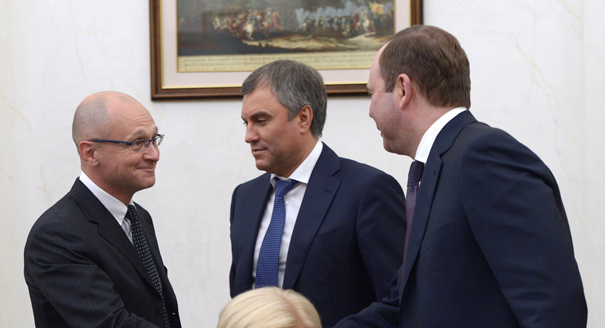
President Vladimir Putin’s appointment of Vyacheslav Volodin, the architect of Russia’s updated political system, to the position of speaker of the Duma and his replacement with Sergei Kiriyenko, a former liberal opposition figure and long-term head of the state corporation Rosatom, is a seemingly illogical move that has sent analysts scurrying to look for hidden meanings. It can in fact be explained by four domestic political trends of the last four years.
First are the political reforms that followed the protests of 2011–2012, before quickly turning into counterreform. Direct gubernatorial elections were reinstated, legislation regulating parties was liberalized, and the non-systemic opposition returned to the playing field. The emphasis on openness and competition was generally associated with the new style of Volodin, who was appointed first deputy chief of staff in December 2011.
In fact, the gubernatorial elections were limited by a municipal filter, which made it impossible to nominate truly oppositional candidates, and very few new political parties took part in elections for the Duma, the lower house of the Russian parliament. The landscape of political parties didn’t actually become more pluralized, and today there is talk of again toughening the legislation regulating parties.
From the Kremlin’s point of view, the system has returned to equilibrium, and the prevailing trend of conservatism must be maintained. This means that the nominal architects of the internal political machine like Volodin must be replaced with operators: people who will manage the status quo without changing its fundamental principles. This is the role that Kiriyenko is going to play.
The second trend is the disappearance of the line between internal politics and security policy. In recent years, as Putin has focused on foreign affairs, domestic politics has become the job of those previously responsible for security issues, with the FSB removing and imprisoning governors with whom the directorate of domestic politics was quite content.
This has forced the locus of internal politics out from the presidential administration and into the Duma, dominated by United Russia and its three junior partners (the Communist Party, LDPR, and A Just Russia). This is the new core of internal politics that the new speaker, Volodin, is to guard. He will no longer be able to make decisions regarding opposition parties, or to curate public projects, and those who say that Volodin will increase his influence within the walls of the Duma are most likely confusing fantasy with reality, but the role is still one of political value, not least due to the third political trend of recent years.
This third trend is the re-politicization of the Duma. Prior to 2012, the body had become de-politicized: “Parliament is no place for discussion,” the parliament’s former speaker Boris Gryzlov famously said. But since 2012, the Duma has slowly but surely been getting its voice back. The deputies are no longer just stamping laws that come down from the Kremlin, but are producing their own legislative initiatives.
Far from demonstrating their independence, however, the parliamentarians have become the most active guardians of the regime, co-authors of the foreign policy rhetoric issued by the Ministry of Foreign Affairs, and a personal resource of the president. This is the kind of Duma that the Kremlin can allow to express itself. The new Duma could become an ideological framework and at the same time a personnel resource, a pool from which the Kremlin can scoop up its next batch of patriotic employees—and this is where the new political potential of Volodin lies.
Positions with status but without a clear-cut role within the political machine, such as speaker of the Duma, gain their political content based on who holds them, and Volodin can now adapt his political value to his new role.
The fourth trend is the appearance of government institutions, another result of Putin’s preoccupation with foreign policy in recent years. If in previous years the political will of Putin was the driving force of the nation, in the last two years things have changed. The previously paralyzed government is suddenly starting to stand in for a Security Council at which the economy, trade, and the financial system are also on the agenda.
While Volodin is elevating the role and status of Duma deputies, over at the Central Election Commission, its new head, veteran human rights campaigner Ella Pamfilova, is annulling elections, firing election commissions, arguing with governors, and interfering with attempts to take the opposition off the ballot. If before outside control was the name of the game, now administrative mechanisms are becoming more internal. These apparent liberal reforms are in fact part of the fight to preserve the stability of the Putin regime, to help it along the path to conservation.
Kiriyenko is a reformer associated with the default of 1998, an oppositionist who reached out to Putin when the latter took the helm of the country in December 1999, and an effective manager, though of a state corporation. For eleven years, he quietly managed Russia’s atomic energy industry, regularly reporting on records and achievements.
But who is Kiriyenko today? Is he a political appointee or an executor? A liberal or a neutral figure, a reformer or a conservator? Should we expect a thaw or a crackdown?
The Kiriyenko of the 2010s is an in-system, depoliticized senior manager, one who perfectly fulfilled the tasks the state assigned him and remained outside politics. The same was once true of the current head of the Federal Antimonopoly Service, Igor Artemyev, formerly a member of the opposition party Yabloko and a prominent figure for the democratic opposition. Today, he is an institutional helper of the ruling elite, assigning economic assets in their favor.
Using a liberal to execute counterreform is fully in keeping with Putin’s style of rule, and one of Kiriyenko’s first assignments is to toughen the legislation governing political parties.
Status, it appears, forces people to fall in line. So, under the logic of the political development of the country, the status of curator of internal politics will force Kiriyenko to protect the existing political system. It’s a case of the trends dictating the logic of the management, rather than the manager setting the trends.
Kiriyenko was once an outspoken liberal, and it’s impossible to rule out a thaw. But the tendency of recent years is to transform and reduce political responsibility and to exclude in-system liberals from power. Everything points against optimistic expectations, including the regime’s vast track record for digesting once-liberal democrats such as Igor Artemyev and Ella Pamfilova, the former Yabloko members Elena Mizulina and Irina Yarovaya, and human rights officials Vladimir Lukin and Mikhail Fedotov. Some have turned into fierce guardians of the regime, others into quiet task managers: court democrats.
Today, two things are undeniable. The Russian state is moving away from democratization and does not tolerate reformers, unless the reformer is the president himself. The arrival of Kiriyenko means only one thing: internal politics is becoming compact and automatic, and its management is becoming corporate and conventional. We are seeing the end of political creativity.
The liberal image of the curator is merely an attempt to sweeten the pill for the section of society that still hopes the country will turn toward progress and modernization.

Senior Fellow, Carnegie Russia Eurasia Center
Tatiana Stanovaya is a senior fellow at the Carnegie Russia Eurasia Center.
Recent Work
Tatiana Stanovaya
Tatiana Stanovaya
Carnegie does not take institutional positions on public policy issues; the views represented herein are those of the author(s) and do not necessarily reflect the views of Carnegie, its staff, or its trustees.
By co-opting the masses against the elite, the President Putin has shaped Russia to echo his values and grievances. And now he’s working to secure his legacy.
Dmitri Trenin