

Paper
The nuclear relationship between China and the United States is increasingly shaped by widening perception gaps rather than deliberate strategic design.
Tong Zhao
{
  "authors": [
    "Rachel Kleinfeld",
    "Stephen J. J. Hadley"
  ],
  "type": "other",
  "centerAffiliationAll": "dc",
  "centers": [
    "Carnegie Endowment for International Peace"
  ],
  "collections": [
    "Violence and Conflict"
  ],
  "englishNewsletterAll": "democracy",
  "nonEnglishNewsletterAll": "",
  "primaryCenter": "Carnegie Endowment for International Peace",
  "programAffiliation": "DCG",
  "programs": [
    "Democracy, Conflict, and Governance"
  ],
  "projects": [],
  "regions": [
    "North America",
    "United States",
    "South America",
    "Middle East",
    "North Africa",
    "Eastern Europe"
  ],
  "topics": [
    "Political Reform",
    "Security",
    "Foreign Policy"
  ]
}
Source: Getty
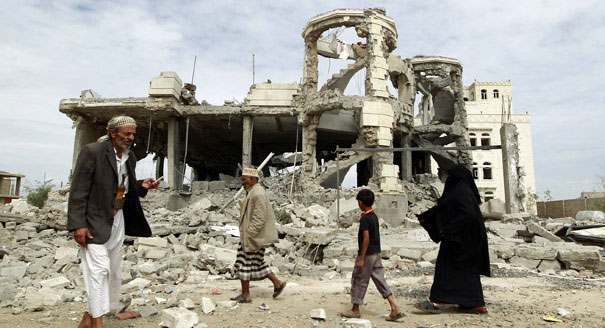
The United States has tended to focus on rebuilding state structures through outside assistance. But in the absence of an inclusive state-society compact, post-conflict states are extremely likely to return to conflict.
Source: Fragility Study Group Policy Brief
Since the end of the Cold War, every President has been forced – sometimes proactively, sometimes reluctantly – to conduct war in a fragile state. Each time, the U.S. has tried a different strategy in an attempt to learn from past mistakes. Yet regardless of the particulars—composition of forces, leadership, and international engagement—in each case the states remained fragile or failed and required ongoing international intervention for years to come. After a quarter century, it appears to many that, in the fragile states where the U.S. has committed the most money, blood, and effort, there are no solutions.
Why are these countries not able to rebuild, as Germany and Japan were able to after World War II? Why have none of our largest interventions in the post-Cold War era seemed to work?
In fact, as James Dobbins and Laurel Miller of RAND have found, international post-conflict efforts have been on the whole far more successful than is generally acknowledged.1 But recent high-profile U.S. failures have been particularly costly to the idea of U.S. leadership and effectiveness.2 The reality is that the U.S. has tended to focus on rebuilding state structures through outside assistance. But in the absence of an inclusive state-society compact, post-conflict states are extremely likely to return to conflict.3 It’s time to shift our focus from outside state-building to helping societies rebuild themselves from the inside.

Senior Fellow, Democracy, Conflict, and Governance Program
Rachel Kleinfeld is a senior fellow in Carnegie’s Democracy, Conflict, and Governance Program, where she focuses on issues of rule of law, security, and governance in democracies experiencing polarization, violence, and other governance problems.

Stephen J. J. Hadley
is a principal of Rice, Hadley, Gates & Manuel LLC, an international strategic consulting firm founded with Condoleezza Rice, Robert Gates, and Anja Manuel. Mr. Hadley served for four years as the Assistant to the President for National Security Affairs from 2005 to 2009. From 2001 to 2005, Mr. Hadley was the Assistant to the President and Deputy National Security Advisor, serving under then National Security Advisor Condoleezza Rice.
Carnegie does not take institutional positions on public policy issues; the views represented herein are those of the author(s) and do not necessarily reflect the views of Carnegie, its staff, or its trustees.

The nuclear relationship between China and the United States is increasingly shaped by widening perception gaps rather than deliberate strategic design.

Tong Zhao

But their "principal to principal" model will only be as effective as the political strength of each leader back home.

Damien Ma

U.S. unpredictability has allowed China to capitalize on its positioning as the “responsible great power”. Paradoxically, the more China wins the perception game, the more likely expectations will rise for Beijing to deliver not just words but to demonstrate with its deeds.

Chong Ja Ian

Hanoi and Beijing have long treated each other as distant cousins rather than comrades in arms. That might be changing as both sides draw closer to hedge against uncertainty and America’s erratic behavior.

Nguyễn Khắc Giang

Across Asia, China is better positioned to withstand energy shocks from the fallout of the Iran war. Its abundant coal capacity can ensure stability in the near term. Yet at the same time, the country’s energy transition away from coal will make it even less vulnerable during the next shock.
Damien Ma