

Q&A
Eugene Rumer
{
  "authors": [
    "Eugene Rumer"
  ],
  "type": "legacyinthemedia",
  "centerAffiliationAll": "dc",
  "centers": [
    "Carnegie Endowment for International Peace"
  ],
  "collections": [],
  "englishNewsletterAll": "ctw",
  "nonEnglishNewsletterAll": "",
  "primaryCenter": "Carnegie Endowment for International Peace",
  "programAffiliation": "russia",
  "programs": [
    "Russia and Eurasia"
  ],
  "projects": [],
  "regions": [
    "North America",
    "United States",
    "Russia"
  ],
  "topics": [
    "Foreign Policy"
  ]
}
Source: Getty
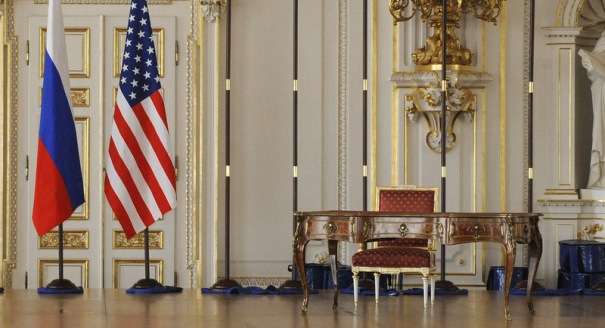
The United States should strike a “middle path” in its policy toward Russia: standing up for core U.S. principles and values but also cooperating with Russia where necessary.
Source: C-SPAN’s Washington Journal
The Trump administration faces both challenges and opportunities in its relations with Russia. In a recent joint task force report, Eugene Rumer, Andrew S. Weiss, and Richard Sokolsky argued that the United States must “skillfully manage, rather than permanently resolve, tension with Moscow,” striking a middle path in its policy toward Russia.
Eugene Rumer, director of the Russia and Eurasia Program at the Carnegie Endowment, expanded on the concept of a middle path in an interview with Steve Scully on C-SPAN’s Washington Journal:
“The middle path is the path of standing up for our core principles and core values that have been guiding our foreign policy for a long time, but also cooperating with Russia where necessary and working to diffuse the situation in a number of very tense global hot spots; one of course being in Syria... and the other in Europe, where we see a military confrontation standoff between Russia and NATO in a way we haven’t seen since the end of the Cold War.”
This interview was originally broadcast on C-SPAN’s Washington Journal.
Director and Senior Fellow, Russia and Eurasia Program
Rumer, a former national intelligence officer for Russia and Eurasia at the U.S. National Intelligence Council, is a senior fellow and the director of Carnegie’s Russia and Eurasia Program.
Recent Work
Eugene Rumer
Eugene Rumer
Carnegie does not take institutional positions on public policy issues; the views represented herein are those of the author(s) and do not necessarily reflect the views of Carnegie, its staff, or its trustees.

But their "principal to principal" model will only be as effective as the political strength of each leader back home.

Damien Ma

U.S. unpredictability has allowed China to capitalize on its positioning as the “responsible great power”. Paradoxically, the more China wins the perception game, the more likely expectations will rise for Beijing to deliver not just words but to demonstrate with its deeds.

Chong Ja Ian

Hanoi and Beijing have long treated each other as distant cousins rather than comrades in arms. That might be changing as both sides draw closer to hedge against uncertainty and America’s erratic behavior.

Nguyễn Khắc Giang

Across Asia, China is better positioned to withstand energy shocks from the fallout of the Iran war. Its abundant coal capacity can ensure stability in the near term. Yet at the same time, the country’s energy transition away from coal will make it even less vulnerable during the next shock.
Damien Ma

Malaysia’s chairmanship sought to fend off short-term challenges while laying the groundwork for minimizing ASEAN’s longer-term exposure to external stresses.

Elina Noor