

Commentary
Despite its flop at the box office, the film raises important questions for the climate community to answer.
Leonardo Martinez-Diaz
{
  "authors": [
    "Nate Reynolds",
    "Eugene Rumer"
  ],
  "type": "commentary",
  "blog": "Emissary",
  "centerAffiliationAll": "dc",
  "centers": [
    "Carnegie Endowment for International Peace",
    "Carnegie Russia Eurasia Center"
  ],
  "englishNewsletterAll": "ctw",
  "nonEnglishNewsletterAll": "",
  "primaryCenter": "Carnegie Russia Eurasia Center",
  "programAffiliation": "russia",
  "programs": [
    "Russia and Eurasia"
  ],
  "projects": [],
  "regions": [
    "Russia",
    "Ukraine",
    "Europe",
    "United States"
  ],
  "topics": [
    "Security",
    "Defense",
    "EU Foreign Policy",
    "Foreign Policy",
    "Global Governance"
  ]
}
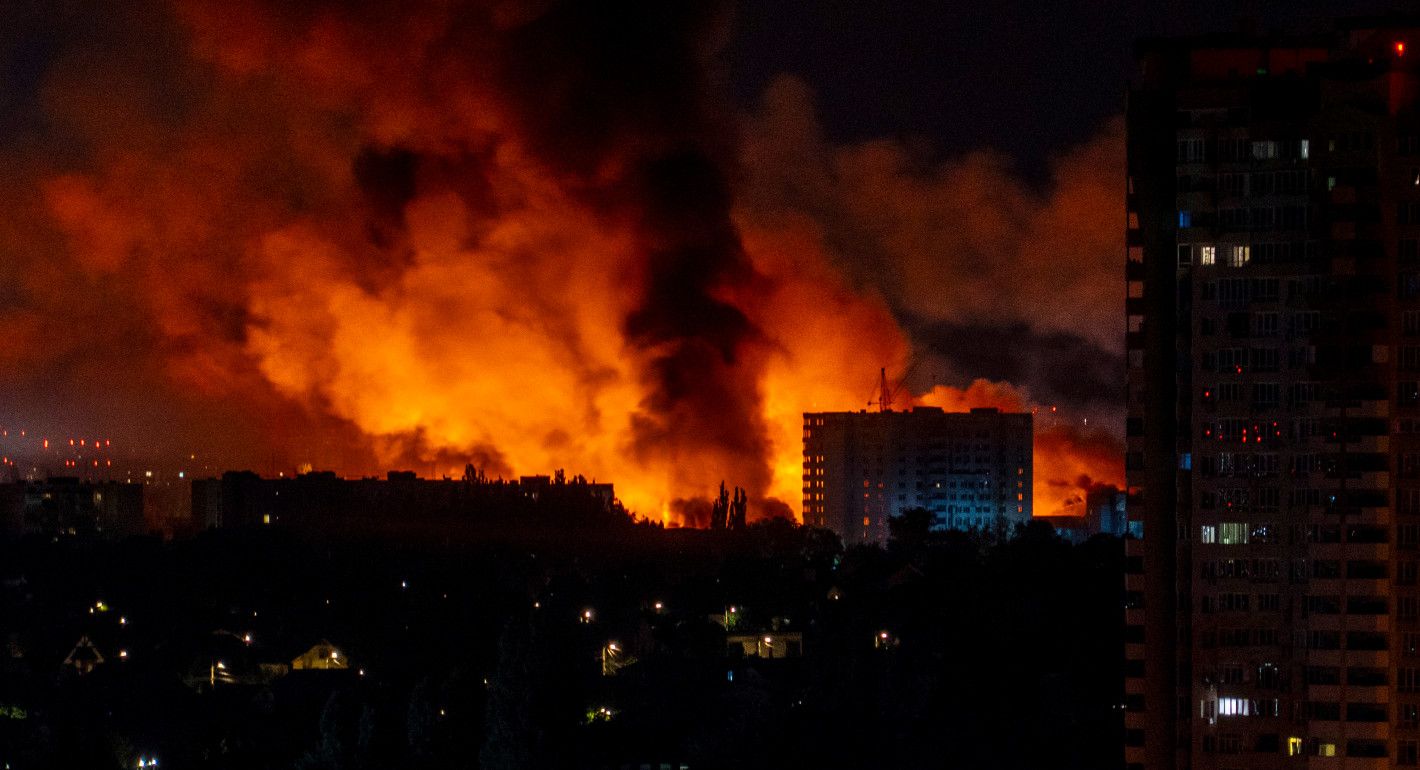
Flames and smoke billow from buildings in Kyiv during Russian drone and missile strikes on July 4, 2025. (Photo by Oleksii Filippov/AFP via Getty Images)
The continent must act urgently to put Kyiv on a path toward a resilient defense that would eventually force Putin to accept a ceasefire.
The Pentagon’s decision to suspend shipments of weapons and materiel to Ukraine is the latest reminder that a dangerous complacency about the war has set in on both sides of the Atlantic. U.S. and European leaders are well aware that Ukraine has been gradually losing ground in the war with Russia since 2023, when its offensive failed to deliver a decisive breakthrough and force the Kremlin to negotiate in earnest. As U.S. military assistance arranged by former president Joe Biden’s administration dries up, the danger to Ukraine is bound to grow. It is now up to Europe’s leaders to deliver on vaunted pledges to prevent Russia from winning its war of aggression.
The worst has not happened. The Russian offensive in the fall of 2024 failed to achieve a major advance. Fears that President Donald Trump’s administration would immediately cut off all aid to Ukraine did not come to pass. The damage from the disastrous Oval Office meeting between Trump and Ukrainian President Volodymyr Zelenskyy in February was patched up a short while later. And, contrary to widespread fears, the transatlantic relationship survived the NATO summit in The Hague more or less unscathed.
But the reality looks much worse. The worst could still happen.
Two rounds of Russian-Ukrainian talks in Istanbul have confirmed what had long been obvious—Russian President Vladimir Putin has no interest in a ceasefire. Betting on Russia’s superiority in numbers, even amid brutal losses unimaginable for Western leaders, he is increasingly confident that he can force Ukraine to capitulate. Putin also knows that the Trump administration is not planning to ask Congress for another large tranche of emergency funding for Ukraine anytime soon. Threats of more U.S. sanctions sound increasingly hollow to Putin, given the Trump administration’s reluctance to target even those circumventing the existing sanctions regime. Putin has been staring down the barrel of the West’s economic weapons since his illegal land grab of Crimea in 2014. At every turn of the crank, he has shown tolerance for economic pain and confidence in the resilience of the Russian economy.
Sensing an opportunity, Putin is keeping up the pressure on Ukraine, hoping to break its will. The Russian army is expanding its offensive operations beyond Donbas, with fighting in the Kharkiv, Dnipro, and Sumy regions. The daring June 1 Ukrainian raid on Russian airfields was widely covered in the media as the stunning success that it was, but less reported was fact that Russia launched nearly 500 drones at Ukraine that night. Such large-scale Russian attacks, with hundreds of drones mixed with more dangerous and difficult-to-counter ballistic missiles, are becoming the norm. Ukraine’s air defenses are struggling to protect the country with a finite supply of interceptors that is dwindling over time, especially if U.S. deliveries are halted. The twelve-day Iran-Israel war is creating a strong demand signal inside the Pentagon and from U.S. partners across the Middle East that such weapons are urgently needed elsewhere.
Ukraine has weathered offensives and missile barrages before, and its resilience is often underestimated. At the same time, past may not be prologue as U.S. support declines, and the war drags on for the foreseeable future. Without U.S.-provided air defense interceptors, Russia would pummel Ukrainian cities, with more civilian casualties and more families deciding to leave the country. Ukraine’s energy grid would suffer more damage, especially without the U.S. Agency for International Development providing desperately needed generators and other critical supplies as it did in previous years. Ukrainian forces, already stretched thin, would have little choice but to give up more and more ground. Cumulatively, especially as the war goes into 2026, the Kremlin will simply continue grinding down Ukraine’s forces at the front line in the hope of achieving a major breakthrough.
But it is not too late for Ukraine and its supporters to act to prevent the worst—and, more importantly, to put Ukraine on a path toward a resilient defense that would eventually force Putin to accept a ceasefire. This requires urgently addressing two problems, one near- and one longer- term.
First, Europe needs to seize the initiative on arming Ukraine, avoiding any dangerous vacuum as U.S. supplies halt. Waiting for the Trump administration to change its mind about the war will only lead to more delays that neither Ukraine nor Europe can afford. Ukraine’s defeat would be catastrophic for Europe, which would then be left to deal with Russia, aggressive, aggrieved, and armed for the next war.
European defense companies can and do supply some of what Ukraine needs. But there are key systems and munitions, including critically important air defense interceptors, that only the United States can provide. Ad hoc discussions are already taking place in Kyiv and different European capitals about buying them from the United States. Unfortunately, this also means that Ukraine’s friends could end up competing with one another. Instead, a coalition of the willing should designate a European envoy close to Trump administration officials who can pool funds and propose a large-scale purchase based on Ukraine’s needs and a realistic assessment of what the United States can provide. Scale is important. A bigger price tag will gain the attention of U.S. defense companies and show Putin that Europe can deliver, undermining his expectation that Ukraine’s position will deteriorate as U.S. supplies dwindle.
Second, European allies need to make arming Ukraine sustainable over the long term. Europe must recognize that Ukraine will have to convince Putin that he cannot grind down its forces or break its will to fight, and will pay an even higher price if he tries to do so. To do that, Europe must finally resolve to use frozen Russian assets by seizing them outright. The caution in Europe is understandable, but Russia is clearly the aggressor in this case and the financial and legal risks are manageable. These funds will insulate European support from domestic politics and stretched national budgets as time goes on.
Just as importantly, European countries should boost Ukraine’s defense industrial base by streamlining investments and technology transfer, particularly for items in short supply in the West. There are already positive examples. The Biden administration put hundreds of millions of dollars into Ukraine’s drone program, which now shapes the battlefield. Germany is also smartly investing in Ukraine’s development of indigenous precision long-range strike capabilities. Ukraine ran through Western supplies of these missiles in 2024, but indigenous production will help sustain pressure on Russia’s rear and raise the costs on Moscow in ways Putin understands. The successful Ukrainian campaign to effectively neutralize the Russian Black Sea fleet demonstrated what Ukraine can do. Such targeted long-range strike campaigns will boost Ukraine’s deterrence and negotiating power over time.
For the past six months, European leaders have received constant reminders from Washington that a greater defense burden will now fall on their shoulders. Yet many of them have harbored hopes that they might yet cajole their U.S. counterpart back into playing America’s traditional role in Ukraine. That is not going to happen. Only by building a sustainable defense in Ukraine can Europe stave off the worst-case scenarios and put itself on a much better path to deter Russian aggression against the wider continent in the future.
Europe’s crisis management approach must now evolve into a long-term commitment to treat the security of Ukraine as the security of Europe. Ukraine will not be a member of NATO or the EU for a long time. But Ukraine is integral to Europe’s own defense. Failure to integrate Ukraine into Europe’s defense plans will greatly increase the risks to both. Waiting for the war to end to do so is not an option.

Senior Fellow, Russia and Eurasia Program
Nate Reynolds is a senior fellow in the Russia and Eurasia Program at the Carnegie Endowment for International Peace.
Director and Senior Fellow, Russia and Eurasia Program
Rumer, a former national intelligence officer for Russia and Eurasia at the U.S. National Intelligence Council, is a senior fellow and the director of Carnegie’s Russia and Eurasia Program.
Carnegie does not take institutional positions on public policy issues; the views represented herein are those of the author(s) and do not necessarily reflect the views of Carnegie, its staff, or its trustees.

Despite its flop at the box office, the film raises important questions for the climate community to answer.

Leonardo Martinez-Diaz

The acknowledgment has sparked fears of a new arms race with China and Russia.

Chris O’Meara

The summit may be remembered as a fatal blunder, when Washington, Beijing, and the AI industry collectively chose ceremony over action.

Jeffrey Prescott

The real test may come after the leaders leave the room.



Sheena Chestnut Greitens, Oriana Skylar Mastro, Yukon Huang, …

The Horn of Africa countries are among those facing a new security calculus.


Andrew Leber, Lesley Anne Warner