

Commentary
Marc Lynch
{
  "authors": [
    "Marc Lynch"
  ],
  "type": "legacyinthemedia",
  "centerAffiliationAll": "dc",
  "centers": [
    "Carnegie Endowment for International Peace",
    "Malcolm H. Kerr Carnegie Middle East Center"
  ],
  "collections": [],
  "englishNewsletterAll": "menaTransitions",
  "nonEnglishNewsletterAll": "",
  "primaryCenter": "Carnegie Endowment for International Peace",
  "programAffiliation": "MEP",
  "programs": [
    "Middle East"
  ],
  "projects": [],
  "regions": [
    "North America",
    "United States",
    "Middle East",
    "Syria",
    "Levant"
  ],
  "topics": [
    "Political Reform",
    "Security",
    "Foreign Policy"
  ]
}
Source: Getty
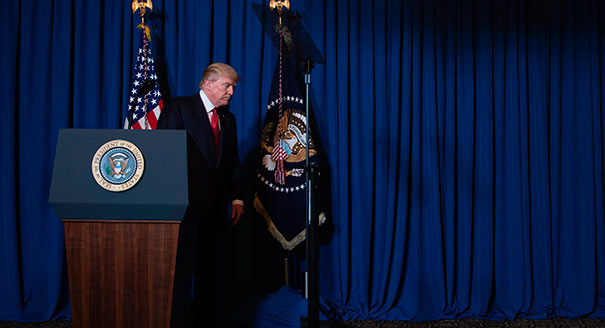
The airstrike has now brought Trump almost completely into alignment with the mainstream of Republican foreign policy and the bipartisan foreign policy consensus he once railed against.
Source: Washington Post
Late Thursday, President Trump announced a cruise missile strike against a Syrian air base in retaliation for the regime’s alleged use of chemical weapons against its people. Initial reports suggest that the strike involved 59 cruise missiles that destroyed Syrian aircraft and killed a dozen people. The missile strike has been widely praised by U.S. allies and condemned by Russia and Iran.
What does this sudden reversal in the Trump administration’s policy mean for the U.S. role in Syria? Others will weigh in soon on critical questions about legality, in the absence of either a U.N. Security Council resolution or congressional authorization, and the political fallout of his dramatic policy reversal. Here are four things to watch in terms of the military and strategic implications of the Syria strike.
The first direct U.S. military strike against Syrian regime targets is obviously a significant escalation. But a standoff strike against a single air base was also one of the smallest available military options available against Syria. On its own, it is a symbolic action which has virtually no impact on the course of the long, complex Syrian civil war. Damaged airstrips can be quickly rebuilt, destroyed airplanes can be easily replaced by Russia, and the balance of forces on the ground remains unaffected.
Missile strikes alone are meant to send a message, but do not change the strategic stalemate that has characterized Syria’s war for many years. Syria’s regime, with the support of Iran, Hezbollah and Russia, has proved able to resist either internal regime overthrow or military defeat on the ground. Syria’s insurgency has long been plagued by its internal divisions and growing radicalism. Control over territory and strategic initiative has ebbed and flowed, with the regime having the upper hand in the recent period. But neither the regime nor the insurgency has been capable of defeating the other.
International and regional competitive intervention has sustained this stalemate: Each time one side weakens, its external patron has increased support to ensure its survival. At moments when the regime faced serious challenge, external supporters such as Hezbollah, Iran and Russia increased their levels of support. Rebels, in turn, would receive greater support from a wide array of external actors such as the United States, Saudi Arabia, Qatar and Turkey. The same escalatory ladder is likely to play out now, with Russia increasing support to Assad to offset any new U.S. military role.
The primary effect of the missile strike will not be on the ground, but rather in how it affects expectations by allies and adversaries about the future U.S. role. The airstrikes were intended in large part to establish Trump’s credibility, by drawing a sharp contrast with Obama’s decision not to bomb in September 2013.
But credibility is a delicate creature. His newfound credibility will constantly be in question as it becomes clear that the airstrikes have not resolved the conflict. The limited strikes will also embolden those voices that have long pushed for the United States to force Assad from power. The missile strikes could be a large step onto the slippery slope toward a broader war, which the Obama administration feared.
This does not seem to be the intention. National security adviser H.R. McMaster and Secretary of State Rex Tillerson have taken pains to emphasize that the strike was intended as a one-off punitive strike intended to deter the use of chemical weapons. Key U.S. allies have pointedly praised the strike’s limited nature.
But this will be difficult to sustain if the war continues fundamentally unaltered. Even if the strikes deter Assad’s use of chemical weapons, it is much less likely to affect his ongoing conventional military campaign. Will the next regime airstrike that results in televised images of dead children trigger the same U.S. response, or only chemical weapons strikes?
The airstrikes could also significantly undermine rather than enhance Trump’s credibility. Although most initial analysis has focused on how the strikes prove Trump is willing to use military force, there is also widespread bafflement over the speed and nature of his policy shift.
Trump reversed himself overnight on one of his most prominently held foreign policy positions. This sends the message that none of his commitments, no matter how frequently stated, should be taken seriously — and encourages actors on all sides to seek ways to manipulate him in their direction.
Trump’s opposition to U.S. intervention in Syria against the Assad regime has long been one of his most unorthodox foreign policy positions. Before his election, he tweeted frequently against the Obama administration’s 2013 plans to bomb Syria over its chemical weapons use, argued passionately against getting involved in a pointless war in Syria, frequently denounced the Syrian opposition as dangerous jihadists and signaled a preference to work with the Assad regime.
Syria was the single Middle East policy issue on which Trump differed most significantly from mainstream Republican foreign policy and from the dominant mainstream policy consensus. Otherwise, Trump’s Middle East policy was already strikingly conventional: an alliance with Israel and Arab autocrats, more aggressive pushback against Iran across the region, an escalated campaign against jihadist forces, a downgrading of calls for democracy and human rights.
The airstrike has now brought Trump almost completely into alignment with the mainstream of Republican foreign policy and the bipartisan foreign policy consensus he once railed against.
There are a number of possible trajectories now.
The first, and arguably most likely, scenario is that the missile strike remains a one-off punitive attack and Syria’s war carries on as before. Having shown a willingness to use force, Trump could now work with Russia to establish slightly more restraint over its client and return to the long-running diplomatic process. This would disappoint those hoping to see Trump now rapidly move to topple Assad, but would allow him to claim a political victory without paying significant costs.
There are many less sanguine scenarios, though. Russia could respond in a variety of more confrontational ways, which could challenge Trump to either escalate or back down. The campaign against the Islamic State could experience setbacks in both Syria and Iraq, should Russia and Iran decide to alter their currently supportive role. U.S. troops deployed in Iraq and Syria could become targets for retaliation. Regional actors might decide to force Trump’s hand through sudden escalations of their own. Trump’s inexperienced and understaffed team could simply miscalculate in the intensely complex conflict.
The key point to watch in the coming days is whether Trump intends to, and is able to, keep the intervention limited to a punitive raid and manage the fallout.
This article was originally published in the Washington Post.
Former Nonresident Senior Fellow, Middle East Program
Marc Lynch was a nonresident senior fellow in Carnegie’s Middle East Program where his work focuses on the politics of the Arab world.
Recent Work
Marc Lynch
Marc Lynch
Carnegie does not take institutional positions on public policy issues; the views represented herein are those of the author(s) and do not necessarily reflect the views of Carnegie, its staff, or its trustees.

But their "principal to principal" model will only be as effective as the political strength of each leader back home.

Damien Ma

U.S. unpredictability has allowed China to capitalize on its positioning as the “responsible great power”. Paradoxically, the more China wins the perception game, the more likely expectations will rise for Beijing to deliver not just words but to demonstrate with its deeds.

Chong Ja Ian

Hanoi and Beijing have long treated each other as distant cousins rather than comrades in arms. That might be changing as both sides draw closer to hedge against uncertainty and America’s erratic behavior.

Nguyễn Khắc Giang

Across Asia, China is better positioned to withstand energy shocks from the fallout of the Iran war. Its abundant coal capacity can ensure stability in the near term. Yet at the same time, the country’s energy transition away from coal will make it even less vulnerable during the next shock.
Damien Ma

Malaysia’s chairmanship sought to fend off short-term challenges while laying the groundwork for minimizing ASEAN’s longer-term exposure to external stresses.

Elina Noor