

Report
- +2
George Perkovich, Jessica Tuchman Mathews, Joseph Cirincione, …
{
  "authors": [
    "Jon Wolfsthal"
  ],
  "type": "other",
  "centerAffiliationAll": "dc",
  "centers": [
    "Carnegie Endowment for International Peace",
    "Carnegie China"
  ],
  "collections": [
    "Korean Peninsula"
  ],
  "englishNewsletterAll": "ctw",
  "nonEnglishNewsletterAll": "",
  "primaryCenter": "Carnegie Endowment for International Peace",
  "programAffiliation": "NPP",
  "programs": [
    "Nuclear Policy"
  ],
  "projects": [],
  "regions": [
    "East Asia",
    "North Korea"
  ],
  "topics": [
    "Nuclear Policy",
    "Security",
    "Arms Control"
  ]
}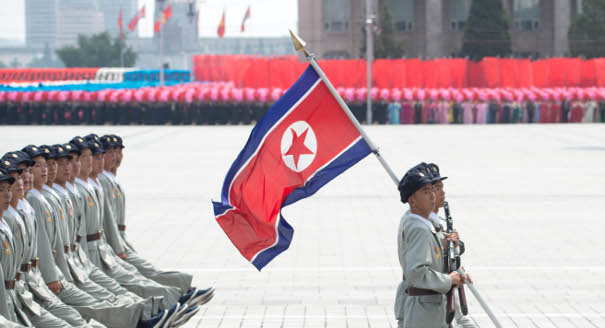
Source: Getty
As tensions between the United States and North Korea continue to simmer, questions arise concerning what war with a nuclear-powered North Korea would look like.
Source: WBUR
The Trump administration continues to talk with regional leaders in Southeast Asia about how to address rising tensions with North Korea. Many analysts say the possibility of a clash is improbable, but with U.S. naval fleets off the Korean Peninsula and tough diplomatic talk, relations are on a fine line.
That raises the question: What would war with a nuclear-powered North Korea even look like?
Here & Now’s Robin Young takes a look at the military strategy and North Korea’s capabilities with arms control specialist Jon Wolfsthal.
On whether the Trump administration’s language on North Korea has analysts worried
“Any normal person would be worried when the president of the United States talks about the possibility of a war with North Korea. There’s a reason that every president since Dwight Eisenhower has worked very hard to make sure we don’t have another war on the Korean Peninsula, because of how devastating it would be. But at the same time, any conflict launched by the United States would have to be, first, led by a major increase in military capability on the peninsula, to protect our allies and our interests — we haven’t seen that yet, so I think the talk is loose, but we’re not at the point that people are actively worried about a conflict.”
On whether the U.S. could have a conflict with North Korea that doesn't involve nuclear weapons
“I don’t think you can, I think the question is multiple-fold. One is, would the U.S. president launch preventive war against North Korea? We saw what happens in Iraq under President Bush when you try to prevent a country from having the capability to hurt you, and that was a country that wasn’t nearly as strong as North Korea is, so preventive wars can be a disaster. But I think you also have to look at the real risk of accidental conflict, or unintended escalation. We have all kinds of problems with North Korea — we have ships that stray into the wrong waters, we have artillery that goes off accidentally, you have individuals that cross the [Demilitarized Zone] without permission. And when you’re ratcheting up the tension, by talking about armadas, or the possibility that we might go first, that’s gonna raise the fear in North Korea that they may have to go first just to prevent us from doing so.”
“There’s no way to bomb your way out of this problem — this has to be a negotiated settlement.” Jon Wolfsthal
On the goal in applying greater pressure on China and other nations to aid negotiations
“The goal is to bring North Korea back to the negotiating table — that was explicitly the statement made by Secretary of State Rex Tillerson to members of the Senate last week, that our goal is to bring North Korea back into negotiations, and that I think is the only way we will ever prevent North Korea from possessing these capabilities, through negotiations.”
“The goal here is to put more Chinese skin in the game. So China for a long time has had leverage over North Korea that they’ve been unwilling to use. ... And up until now, China has feared North Korean collapse more than American pressure, and I think that's part of what has to change. Chinese banks should be forced to make a decision — do they wanna do business with North Korea, or do business in the United States? Chinese shipping firms have to decide, do they wanna do business with North Korea, or do business in the United States? We have known for a long time that China needs the United States more than we need China, and up until this point, we have not been willing to put enough of a point on that choice for China.”
On how a conflict with North Korea could unfold from a war-planning perspective
“We tried to do this at the beginning of the Iraq War, we actually struck at one of Saddam ’s palaces in 2003, the day before the invasion began, and we missed. We thought we had splendid intelligence, and in fact we just destroyed a palace but nobody was in it. So we look at the options, but it's extremely hard to know where everything is. So even if you wanted to target, for example, all of North Korean nuclear weapons, they know that we might wanna target them, they don’t put them in one place, or two places, and they harden them, and they put them underground. Because they are thinking, how vulnerable are they? At the same time, we’re thinking, “How can we get at them?” There’s no way to bomb your way out of this problem — this has to be a negotiated settlement.”
This segment aired on May 1, 2017.

Former Nonresident Scholar, Nuclear Policy Program
Jon Wolfsthal was a nonresident scholar with the Nuclear Policy Program.
Recent Work



George Perkovich, Jessica Tuchman Mathews, Joseph Cirincione, …
Jon Wolfsthal
Carnegie does not take institutional positions on public policy issues; the views represented herein are those of the author(s) and do not necessarily reflect the views of Carnegie, its staff, or its trustees.

The nuclear relationship between China and the United States is increasingly shaped by widening perception gaps rather than deliberate strategic design.

Tong Zhao

Chinese biotech companies have been on the receiving end of U.S. economic coercion. Yet their responses have differed significantly because firm and state interests are not uniformly aligned. For Washington, treating all Chinese tech firms the same, irrespective of their actual interests, risks pushing them farther into Beijing’s corner.

Xue Gong

Across Asia, China is better positioned to withstand energy shocks from the fallout of the Iran war. Its abundant coal capacity can ensure stability in the near term. Yet at the same time, the country’s energy transition away from coal will make it even less vulnerable during the next shock.

Damien Ma
The Thai-Cambodian conflict highlights the limits to China's peacemaker ambition and the significance of this role on Southeast Asia’s balance of power.

Pongphisoot (Paul) Busbarat
GDP growth means something fundamentally different in China than in most countries.

Michael Pettis