

Report
- +2
George Perkovich, Jessica Tuchman Mathews, Joseph Cirincione, …
{
  "authors": [
    "Jon Wolfsthal"
  ],
  "type": "other",
  "centerAffiliationAll": "dc",
  "centers": [
    "Carnegie Endowment for International Peace"
  ],
  "collections": [
    "Korean Peninsula"
  ],
  "englishNewsletterAll": "ctw",
  "nonEnglishNewsletterAll": "",
  "primaryCenter": "Carnegie Endowment for International Peace",
  "programAffiliation": "NPP",
  "programs": [
    "Nuclear Policy"
  ],
  "projects": [],
  "regions": [
    "East Asia",
    "North Korea"
  ],
  "topics": [
    "Nuclear Policy",
    "Arms Control"
  ]
}
Source: Getty
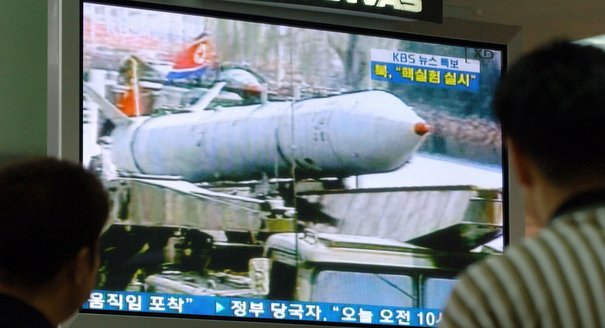
Previous debates focusing on freezing North Korea's nuclear program are played out. Today, the main challenge is preventing North Korea from hurting the United States and its allies now that the Kim regime has long-range nuclear missiles.
Source: Atlantic
Strategic milestones don’t come along everyday. Today was one of those days.
On Friday, North Korea tested a missile than can deliver a nuclear weapon to almost any target in the continental United States, marking a major accomplishment for a state than many thought was on its last legs in the early 1990s. But far from dead, North Korea has managed to evade every political, military, and economic barrier that five successive U.S. presidents put in its way. Now, the United States under President Donald Trump has a massive but surmountable challenge on its hands—deterring a nuclear-armed North Korea and preserving and strengthening America’s alliances with South Korea and Japan, countries currently questioning whether Kim Jong Un’s new capabilities might prevent the United States from coming to their defense.
In recent years, America’s North Korea debate has focused on whether Washington should talk to Pyongyang and seek a freeze on its program. Those debates now seem pretty played out. Today, the main challenge is preventing North Korea from hurting the United States and its allies now that the Kim regime has long-range nuclear missiles. This debate is the one that Washington should have been having for years—may as well have it now.
The first question for U.S. policymakers: What are America’s deterrence objectives for North Korea? In other words, what does it want North Korea not to do, and how can it be convinced not to do those things? Kim Jong Un must be made to understand that, under no uncertain terms, can he ever use his nuclear weapons; doing so would mean the end of North Korea. Whether the United States likes it or not, the country now poses a clear strategic threat, and it must be treated as such.
Deterrence is by no means a perfect solution, but for it to have a chance of success, the Trump administration must communicate directly with its North Korean counterparts to ensure they have a clear understanding of what actions would provoke a direct U.S. response. There are lots of ways to ensure North Korea gets the message, but none are as reliable or convincing as direct U.S. discussions with North Korean officials. These could take the form of military-to-military contacts, but whatever the choice, it will need to be well above the traditional channel U.S. diplomats have used in New York at the UN.
Even communicating through China, as the United States has done in the past, won’t be enough to ensure that Pyongyang feels the full impact of these messages. Those messages must make clear that the use of nuclear weapons, and any transfer of nuclear weapons or ICBMs or production capabilities to other states, is unacceptable. If America cannot prevent North Korea from possessing nuclear weapons, it has to make clear that any decision to use them would be the last one any North Korean leader would ever make. Senior officials in the Obama administration, where I worked on nuclear nonproliferation at the National Security Council, began to unpack these issues in anticipation that North Korea would continue to pursue an ICBM. It has now fallen to Trump to take that work and find a way to influence North Korea’s future actions.
As much as I would like North Korea to freeze and end its nuclear program, no combination of threats, engagement, negotiations, and sanctions, has produced that outcome. At best, any negotiations with the North must seek an agreement to avoid steps that could provoke a crisis, including no regular deployments of mobile missiles and an agreement to end or limit missile and nuclear weapon tests. In a perfect world, the United States could eventually start to negotiate an agreement where North Korea caps its nuclear program and stops producing materials that can be used to build nuclear weapons. But Washington does not know, and North Korea will not say, where all of its productions sites are. Nor will it allow inspectors access to verify they are shut down. Short of this, a ban is not viable and should not be a major focus of U.S. action.
The United States does not yet know what North Korea might demand in return for such constraints, but Washington and Seoul should consider offering their own steps that could reduce the risk of a military confrontation or escalation—something that’s in no one’s interest.
As important as deterrence is now, reassuring South Korea and Japan may be even tougher in the face of a growing North Korean threat. Leaders in both countries have been wondering if America will risk New York or Los Angeles to protect Tokyo and Seoul. Now that North Korea can reach those American cities with its missiles, those worries will naturally grow. America worked for decades to convince European states that it would defend them even in the face of global nuclear war with the Soviet Union. This process of making sure extended deterrence is credible continues to this day, especially in light of increasingly dangerous Russian behavior. It’s time to extend the principle to America’s friends in Asia.
Reassurance is hard—even harder these days because official U.S. statements and policies are difficult to discern and less consistent. But this is one challenge the country must get right, both through political statements and with increased military and security cooperation in the region, including possible increased deployments of missile defenses and other conventional systems in South Korea and Japan.
These actions must, first and foremost, defend U.S. allies, but may also make clear to China that it, too, has a price to pay. Having gone soft on North Korea for decades, Beijing has much to answer for in North Korea’s new nuclear status. If U.S. actions to defend its troops and allies in the region also undermine China’s security, that should no longer be a major impediment to action. Then, perhaps, China can use its influence to convince North Korea to accept certain limits on its program.
This day has been a long time coming. North Korea began its nuclear efforts in the 1950s. But the world is long since past the point of deciding whether or not to not accept a nuclear-armed North Korea. The question is how the United States can convince the world that these new weapons are unusable, and convince its allies that it means what it says. The first step: deciding, on its own, what to do.
The good news is America has done all this before, with more threatening states like the Soviet Union and China. The bad news is that it has lost valuable time and now has to play catch up. The Trump administration has its work cut out for it.

Former Nonresident Scholar, Nuclear Policy Program
Jon Wolfsthal was a nonresident scholar with the Nuclear Policy Program.
Recent Work



George Perkovich, Jessica Tuchman Mathews, Joseph Cirincione, …
Jon Wolfsthal
Carnegie does not take institutional positions on public policy issues; the views represented herein are those of the author(s) and do not necessarily reflect the views of Carnegie, its staff, or its trustees.

The nuclear relationship between China and the United States is increasingly shaped by widening perception gaps rather than deliberate strategic design.

Tong Zhao

Chinese biotech companies have been on the receiving end of U.S. economic coercion. Yet their responses have differed significantly because firm and state interests are not uniformly aligned. For Washington, treating all Chinese tech firms the same, irrespective of their actual interests, risks pushing them farther into Beijing’s corner.

Xue Gong

Across Asia, China is better positioned to withstand energy shocks from the fallout of the Iran war. Its abundant coal capacity can ensure stability in the near term. Yet at the same time, the country’s energy transition away from coal will make it even less vulnerable during the next shock.

Damien Ma

GDP growth means something fundamentally different in China than in most countries.

Michael Pettis
The Trump administration’s effort to reshape the global trading system and reset overseas security commitments is creating an historic inflection point. Less clear is how far China will be able to capitalize on these dynamics.



Li Mingjiang, Le Hong Hiep, Ngeow Chow Bing, …