Source: Global Times
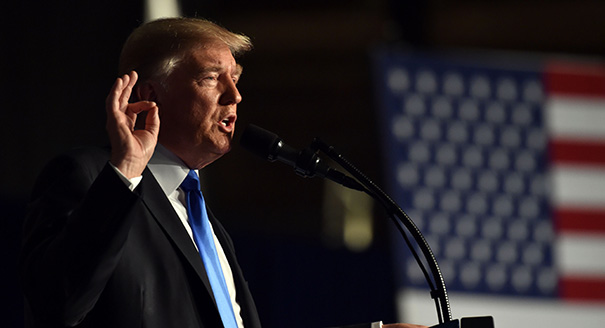
Since taking office, Donald Trump has worked to rally support under the flag of protectionism and made repeated threats to start trade wars. His actions are aimed at protecting the American domestic market, opening up international markets, and enforcing American trade rules abroad. It is important to remember, however, that Trump’s international economic policies have followed the same general path of previous administrations. The only difference in Trump’s approach is that his policies are even more drastic. Objectively speaking, cross-border economic relations and trade negotiations are governed by their own sets of rules, and success cannot be achieved simply because one side is more powerful or because they have decided to adopt aggressive polices. Trump’s aggressive trade policies are contradictory in at least three different respects.
First, Trump’s policy decisions are contradictory to his stated goals. He has called for aggressive protectionist policies within the United States while also demanding greater liberalization in international markets. These two policies are not compatible. Because of this, Trump can only threaten to employ destructive tactics, such as starting trade wars, in order to achieve his goals.
Second, the insistence on exercising national power is contradictory with the need to shoulder one’s own international responsibilities. Since the end of World War II, the United States has consistently played a key leadership role in multilateral trade systems. This willingness to shoulder international responsibility has been fundamental in ensuring America’s advantageous position in international trade relations. Even so, Donald Trump has stressed that domestic laws should take precedence over rules in the World Trade Organization (WTO). He has announced that America will do whatever is necessary to prevent the WTO from eroding its sovereignty, and that the United States wants to exercise its rights but is unwilling to shoulder the corresponding responsibilities.
Third, the pressures of reality contradict developing trends. Trump’s aggressive trade policies put the spotlight on trade deficits and focus on liberalizing international markets. He has insisted upon using American labor, moving production to the United States, and increasing exports to other countries. However, in this age of globalized production, different steps in the production process will take place in different regions around the world, depending on where the greatest comparative advantages can be found. So while Trump is shouting slogans like “Buy American” and “Use American Labor”, he has no choice but be realistic about what is to develop America’s international economic relationships. The result is that Trump’s aggressive trade policies waiver back and forth between the pressures of reality and the direction in which general trends are moving.
Unilateralism, often cloaked in the façade of multilateralism, has been the primary theme in the evolution of U.S. trade policies since the end of World War II. The United States has adopted aggressive trade policies from time to time, and this has intensified friction with its biggest trade partners. The United States had a trade war with Western Europe in the 1950s and 60s and another with Japan in the 1980s. By the end of these trade wars, the United States was successful in further opening the markets in these developed countries. As part of the Uruguay Round discussions, the United States promised developing countries that the new trade deals would allow them to enjoy favored trade policies related to textiles and agricultural products, if they were willing to make certain compromises and establish the WTO. After the Cold War ended, economic globalization took off at an unprecedented pace. Multinational corporations developed production methods that were both globalized and fragmented, and industries transferred between countries in differing degrees. This made it possible for America’s economic influence to spread throughout the world’s major coastal regions and truly became a globalized United States.
But this process did not unfold without a significant price. The transfer of labor-intensive industries left a large number of Americans in need of new jobs, and these changes made it more difficult for the middle class to prosper. At the same time, finance began to play an even greater role in the U.S. economy, creating a class of elites who are able to live off of the interest of their worldwide investments without actually working to provide tangible goods or services. This is precisely what American economist Jagdish Bhagwati has called the “Wall Street-Treasury complex.” This group has superior access to economic and political resources and is continually accelerating the speed of economic globalization. In addition, the onslaught of post-Cold War globalization fundamentally weakened the wealth redistribution mechanisms inside the United States, which were already quite weak to begin with. The resulting expansion of the wealth gap has led to the rise of populism. The Occupy Wall Street movement and the election of Donald Trump are both manifestations of the underlying frustration throughout American society.
The American economy is globalized and concentrated in finance. Because of this, it needs to adopt policies that encourage economic liberalization. Doing so would allow the United States to strengthen its connectivity to the world economy, penetrate offshore markets, and live off of its established financial investments. Conversely, it also needs to strengthen its protectionist trade policies in order to address the domestic social pressures that are continuing to intensify. An approach that would work over the long run would be to reconstruct the “social contract,” and to develop mechanisms by which all groups could benefit from policies of economic openness with other countries. This approach will be difficult, however, because of the intensified conflict between the classes, a lack of societal consensus and fighting between the Democrat and Republican parties. Donald Trump is putting on an act when it comes to his aggressive trade policies, and these efforts will prove futile in the end.
Guan Chuanjing is an assistant researcher at the Center for U.S.-China Relations at Tsinghua University.
A version of this op-ed was originally published in Global Times.