
• Commentary
  • Research
  • Experts
  • Events
Carnegie China logoCarnegie lettermark logo
{
  "authors": [
    "Sada Debate"
  ],
  "type": "commentary",
  "centerAffiliationAll": "",
  "centers": [
    "Carnegie Endowment for International Peace"
  ],
  "collections": [],
  "englishNewsletterAll": "",
  "nonEnglishNewsletterAll": "",
  "primaryCenter": "Carnegie Endowment for International Peace",
  "programAffiliation": "",
  "programs": [],
  "projects": [
    "Tunisia Monitor"
  ],
  "regions": [
    "North Africa",
    "Tunisia"
  ],
  "topics": [
    "Political Reform",
    "Democracy",
    "Economy",
    "Security"
  ]
}

Source: Getty

Commentary

Tunisia’s Unity Government, One Year On

How effective have Youssef Chahed’s policies been at addressing Tunisia’s underlying issues?

Link Copied
By Sada Debate
Published on Jul 26, 2017
Project hero Image

Project

Tunisia Monitor

Carnegie’s Tunisia Monitor project tracks the status of the country’s transition in the economic, political, and security spheres. This project provides original analysis and policy recommendations from a network of Tunisian contributors and Carnegie experts to inform decisionmakers in Tunisia, Europe, and the United States. This endeavor is supported by a grant from the Open Society Foundations.

Learn More

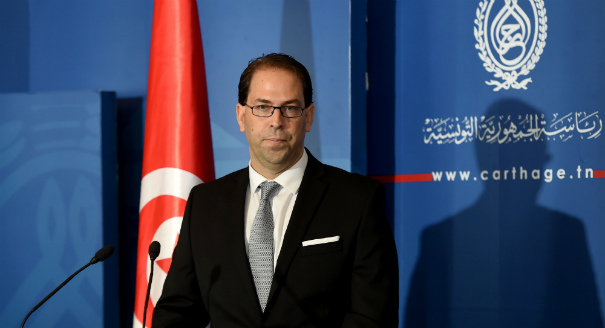
In August 2016, Tunisia’s parliament overwhelmingly approved Youssef Chahed as head of government, after a month of negotiations to form a unity government that many hoped would be more effective in implementing reforms than its internally divided predecessor. Chahed promised to prioritize fighting terrorism, boosting economic growth, and fighting corruption, among other issues. Nearly a year later, his government has made headlines for its progress on these fronts, but it still faces significant challenges.

Four experts take a look at the policies of the past year and examine how effective they have been at addressing underlying issues.

Please join the conversation by adding your thoughts in the comments section.

About the Author

Sada Debate

Sada Debate
Political ReformDemocracyEconomySecurityNorth AfricaTunisia

Carnegie does not take institutional positions on public policy issues; the views represented herein are those of the author(s) and do not necessarily reflect the views of Carnegie, its staff, or its trustees.

More Work from Carnegie China

  • Commentary
    How China’s Growth Model Determines Its Climate Performance

    Rather than climate ambitions, compatibility with investment and exports is why China supports both green and high-emission technologies.

      Mathias Larsen

  • Overproduction in China
    Commentary
    What’s New about Involution?

    “Involution” is a new word for an old problem, and without a very different set of policies to rein it in, it is a problem that is likely to persist.

      Michael Pettis

  • Commentary
    The Chinese Investment Riddle: What Cities Reveal

    While China's investment story seems contradictory from the outside, the real answers to Beijing's high-quality growth ambitions are hiding in plain sight across the nation's cities.

      Yuhan Zhang

  • Commentary
    China’s Mediation Offer in the Thailand-Cambodia Border Dispute Sheds Light on Beijing’s Security Role in Southeast Asia

    The Thai-Cambodian conflict highlights the limits to China's peacemaker ambition and the significance of this role on Southeast Asia’s balance of power.

      Pongphisoot (Paul) Busbarat

  • Commentary
    Using China’s Central Government Balance Sheet to “Clean up” Local Government Debt Is a Bad Idea

    China's stimulus addiction cannot go on forever. Beijing still has policy space to clean up the country's massive debt issue, but time is running short.

      Michael Pettis

Get more news and analysis from
Carnegie China
Carnegie China logo, white
  • Research
  • About
  • Experts
  • Events
  • Contact
  • Careers
  • Privacy
  • For Media
Get more news and analysis from
Carnegie China
© 2026 Carnegie Endowment for International Peace. All rights reserved.