

Report
- +2
George Perkovich, Jessica Tuchman Mathews, Joseph Cirincione, …
{
  "authors": [
    "Jon Wolfsthal"
  ],
  "type": "other",
  "centerAffiliationAll": "dc",
  "centers": [
    "Carnegie Endowment for International Peace"
  ],
  "collections": [
    "Korean Peninsula"
  ],
  "englishNewsletterAll": "ctw",
  "nonEnglishNewsletterAll": "",
  "primaryCenter": "Carnegie Endowment for International Peace",
  "programAffiliation": "NPP",
  "programs": [
    "Nuclear Policy"
  ],
  "projects": [],
  "regions": [
    "East Asia",
    "North Korea"
  ],
  "topics": [
    "Nuclear Policy",
    "Arms Control"
  ]
}
Source: Getty
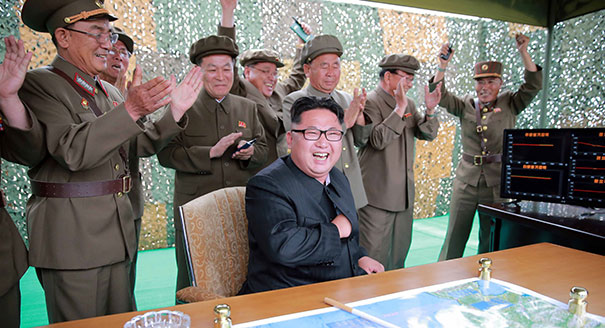
Kim Jong Un is likely to view President Trump much like his predecessors—as a president who doesn’t like North Korea’s nuclear capabilities but with few realistic options for stopping it.
Source: Politico
Most Americans think North Korea is a crazy place, led by a crazy man bent on global destruction. This view, of course, is almost completely wrong and explains in part why the current public discussion about what to do with a nuclear North Korea is so unsatisfying. Far from crazy, Kim Jong Un has been methodical and careful enough in advancing his nuclear and missile programs to suggest that he is deterred by America’s overwhelming military capabilities, and at the very least is not eager to spark a military conflict—at least not yet.
But what does Kim think of us? If we are going to continue to rely, as we have for decades, on deterrence to prevent a major conflict on the Korean Peninsula, it helps to know both a little about who we are trying to deter and what our deterrence partner thinks about America. As a senior director in the Obama White House charged with coordinating nonproliferation policy, I thought about this question a lot as we tried to ensure our actions and words intended to influence North Korea would send the right deterrent and diplomatic messages to Pyongyang.
This article was originally published in Politico
Former Nonresident Scholar, Nuclear Policy Program
Jon Wolfsthal was a nonresident scholar with the Nuclear Policy Program.
Recent Work



George Perkovich, Jessica Tuchman Mathews, Joseph Cirincione, …
Jon Wolfsthal
Carnegie does not take institutional positions on public policy issues; the views represented herein are those of the author(s) and do not necessarily reflect the views of Carnegie, its staff, or its trustees.

The nuclear relationship between China and the United States is increasingly shaped by widening perception gaps rather than deliberate strategic design.

Tong Zhao

Chinese biotech companies have been on the receiving end of U.S. economic coercion. Yet their responses have differed significantly because firm and state interests are not uniformly aligned. For Washington, treating all Chinese tech firms the same, irrespective of their actual interests, risks pushing them farther into Beijing’s corner.

Xue Gong

Across Asia, China is better positioned to withstand energy shocks from the fallout of the Iran war. Its abundant coal capacity can ensure stability in the near term. Yet at the same time, the country’s energy transition away from coal will make it even less vulnerable during the next shock.

Damien Ma

GDP growth means something fundamentally different in China than in most countries.

Michael Pettis
The Trump administration’s effort to reshape the global trading system and reset overseas security commitments is creating an historic inflection point. Less clear is how far China will be able to capitalize on these dynamics.

Li Mingjiang, Le Hong Hiep, Ngeow Chow Bing, …