

• Commentary
  • Research
  • Experts
  • Events
Carnegie China logoCarnegie lettermark logo
{
  "authors": [
    "Vipin Narang",
    "Ankit Panda"
  ],
  "type": "other",
  "centerAffiliationAll": "dc",
  "centers": [
    "Carnegie Endowment for International Peace"
  ],
  "collections": [
    "Korean Peninsula"
  ],
  "englishNewsletterAll": "ctw",
  "nonEnglishNewsletterAll": "",
  "primaryCenter": "Carnegie Endowment for International Peace",
  "programAffiliation": "NPP",
  "programs": [
    "Nuclear Policy"
  ],
  "projects": [],
  "regions": [
    "East Asia",
    "North Korea"
  ],
  "topics": [
    "Nuclear Policy"
  ]
}

Source: Getty

Other

Command and Control in North Korea: What a Nuclear Launch Might Look Like

For a new nuclear state like North Korea, questions concerning strategic implementation abound.

Link Copied
By Vipin Narang and Ankit Panda
Published on Sep 15, 2017

Source: War on the Rocks

A new nuclear state, in a major crisis with a conventionally superior nuclear-armed adversary, contemplates and prepares to move nuclear assets in the event it has to use them. Who controls the nuclear forces? Who decides when they might be assembled, mated to delivery vehicles, moved, and launched? Who has nominal authority to order those decisions? Who has the physical ability to implement them even without proper authorization? How experienced are the relevant units in these operations? What could go wrong?

These were the questions that bedeviled Pakistan in the 1999 Kargil War and again in the 10-month standoff with India in 2001-2002. They are the same challenges and issues that confront North Korea today.

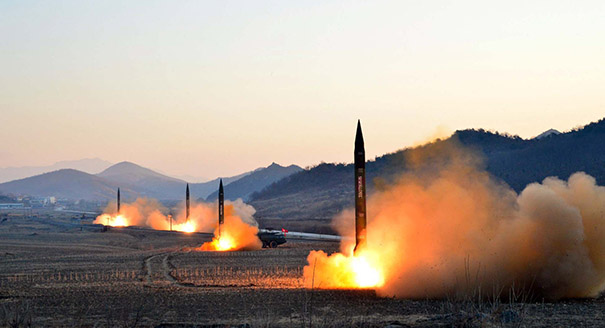
As the mountain of dust settles after North Korea’s purported thermonuclear bomb, intermediate-range ballistic missile, and intercontinental-range ballistic missile (ICBM) tests this summer and it becomes an increasingly operational nuclear state, one of the many deadly serious challenges it faces is how it manages its nuclear forces, or what command and control arrangement it erects. These arrangements are the transmission belt that makes a state’s nuclear strategy operational — how and when nuclear weapons are managed and might actually be employed. As a nuclear weapons power, North Korea now has to think about how precisely it wants to implement its “asymmetric escalation” strategy. And so does the United States, since these arrangements have very real implications for when nuclear weapons might be used intentionally — or unintentionally — in a conflict.

This article was originally published in War on the Rocks

Read the article

About the Authors

Vipin Narang

Former Nonresident Scholar, Nuclear Policy Program

Vipin Narang was a nonresident scholar in the Nuclear Policy Program at the Carnegie Endowment for International Peace.

Ankit Panda

Stanton Senior Fellow in the Nuclear Policy Program at the Carnegie Endowment for International Peace

Ankit Panda is the Stanton Senior Fellow in the Nuclear Policy Program at the Carnegie Endowment for International Peace.

Authors

Vipin Narang
Former Nonresident Scholar, Nuclear Policy Program
Ankit Panda
Stanton Senior Fellow in the Nuclear Policy Program at the Carnegie Endowment for International Peace
Ankit Panda
Nuclear PolicyEast AsiaNorth Korea

Carnegie does not take institutional positions on public policy issues; the views represented herein are those of the author(s) and do not necessarily reflect the views of Carnegie, its staff, or its trustees.

More Work from Carnegie China

  • Commentary
    China’s Energy Security Doesn’t Run Through Hormuz but Through the Electrification of Everything

    Across Asia, China is better positioned to withstand energy shocks from the fallout of the Iran war. Its abundant coal capacity can ensure stability in the near term. Yet at the same time, the country’s energy transition away from coal will make it even less vulnerable during the next shock.


      • Damien Ma

      Damien Ma

  • An aerial view shows containers stacked at a port in Taicang, in eastern China's Jiangsu province on May 18, 2025.
    Commentary
    How to Predict China’s Economic Performance for 2025: A Sectoral Approach

    GDP growth means something fundamentally different in China than in most countries.

      Michael Pettis

  • People wave Chinese flags as the plane carrying Chinese President Xi Jinping arrives for a two-day state visit at Hanoi's Noi Bai International Airport in Hanoi on April 14, 2025
    Article
    How Southeast Asia Sees Xi Jinping’s Regional Push Amid U.S.-China Tensions

    The Trump administration’s effort to reshape the global trading system and reset overseas security commitments is creating an historic inflection point.  Less clear is how far China will be able to capitalize on these dynamics.

      • +1

      Li Mingjiang, Le Hong Hiep, Ngeow Chow Bing, …

  • Article
    Northeast Asia Is for Deterrence and Southeast Asia Is (Mostly) for Freeriding: Appreciating Divergent East Asian Approaches to Order, Uncertainty, and Contestation

    Most Southeast Asian states behave as if the actions of their Northeast Asian neighbors and the Philippines will be sufficient to maintain a regional status quo from which they can benefit.

      Chong Ja Ian

  • Commentary
    Beyond the Putin-Kim Alliance: How Can the International Community Engage China to Contain Nuclear Risks Over the Korean Peninsula?

    Faced with an increase in strategic maneuvering by Moscow and Pyongyang, Beijing will not sit idly by and allow Putin and Kim to shape the security environment on its behalf.

      Tong Zhao

Get more news and analysis from
Carnegie China
Carnegie China logo, white
Keck Seng Tower133 Cecil Street #10-01ASingapore, 069535Phone: +65 9650 7648
  • Research
  • About
  • Experts
  • Events
  • Contact
  • Careers
  • Privacy
  • For Media
Get more news and analysis from
Carnegie China
© 2026 Carnegie Endowment for International Peace. All rights reserved.