

Report
- +2
George Perkovich, Jessica Tuchman Mathews, Joseph Cirincione, …
{
  "authors": [
    "Jon Wolfsthal"
  ],
  "type": "other",
  "centerAffiliationAll": "dc",
  "centers": [
    "Carnegie Endowment for International Peace"
  ],
  "collections": [
    "Korean Peninsula"
  ],
  "englishNewsletterAll": "ctw",
  "nonEnglishNewsletterAll": "",
  "primaryCenter": "Carnegie Endowment for International Peace",
  "programAffiliation": "NPP",
  "programs": [
    "Nuclear Policy"
  ],
  "projects": [],
  "regions": [
    "East Asia",
    "North Korea"
  ],
  "topics": [
    "Nuclear Policy"
  ]
}
Source: Getty
To reduce danger, we need less bombast and better communication.
Source: USA Today
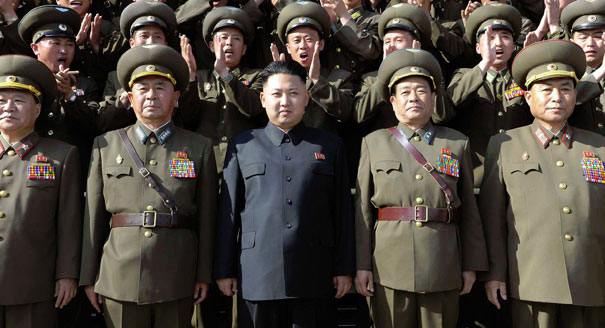
America’s top priority must be to avoid a second Korean war. Yet such a war is closer than ever and appears almost inevitable unless America changes the approach President Trump has been using since he took office. The greatest risk of war with North Korea is not sudden action by Kim Jong Un, but Kim responding to a perceived attack by Trump. North Korea foreign minister Ri Yong-ho drove that home Monday when he called Trump’s threats against his country “a clear declaration of war.”
The United States has been in a technical state of war with North Korea since the end of the Korean War in 1953. Every president since Dwight D. Eisenhower has had to navigate the risk of conflict with North Korea. What’s new is Trump’s bombastic approach to this long-standing challenge—his personal insults, crazy tweets and threat at the United Nations to "totally destroy North Korea."
Kim knows North Korea cannot win a war with the United States and that his only hope of survival is to strike fast and hard to stop a conflict before it gets going and he starts to lose. This is the strategy that led North Korea to deploy thousands of long-range artillery pieces near Seoul, and that is the thinking behind its nuclear program. Hit hard, hit first, seek a truce.
This article was originaly published in USA Today
Former Nonresident Scholar, Nuclear Policy Program
Jon Wolfsthal was a nonresident scholar with the Nuclear Policy Program.
Recent Work


George Perkovich, Jessica Tuchman Mathews, Joseph Cirincione, …
Jon Wolfsthal
Carnegie does not take institutional positions on public policy issues; the views represented herein are those of the author(s) and do not necessarily reflect the views of Carnegie, its staff, or its trustees.

The nuclear relationship between China and the United States is increasingly shaped by widening perception gaps rather than deliberate strategic design.

Tong Zhao

Chinese biotech companies have been on the receiving end of U.S. economic coercion. Yet their responses have differed significantly because firm and state interests are not uniformly aligned. For Washington, treating all Chinese tech firms the same, irrespective of their actual interests, risks pushing them farther into Beijing’s corner.

Xue Gong

Across Asia, China is better positioned to withstand energy shocks from the fallout of the Iran war. Its abundant coal capacity can ensure stability in the near term. Yet at the same time, the country’s energy transition away from coal will make it even less vulnerable during the next shock.

Damien Ma

GDP growth means something fundamentally different in China than in most countries.

Michael Pettis
The Trump administration’s effort to reshape the global trading system and reset overseas security commitments is creating an historic inflection point. Less clear is how far China will be able to capitalize on these dynamics.

Li Mingjiang, Le Hong Hiep, Ngeow Chow Bing, …