
• Commentary
  • Research
  • Experts
  • Events
Carnegie China logoCarnegie lettermark logo
{
  "authors": [
    "Se Young Jang"
  ],
  "type": "other",
  "centerAffiliationAll": "dc",
  "centers": [
    "Carnegie Endowment for International Peace"
  ],
  "collections": [
    "Korean Peninsula"
  ],
  "englishNewsletterAll": "",
  "nonEnglishNewsletterAll": "",
  "primaryCenter": "Carnegie Endowment for International Peace",
  "programAffiliation": "NPP",
  "programs": [
    "Nuclear Policy"
  ],
  "projects": [],
  "regions": [
    "East Asia",
    "South Korea"
  ],
  "topics": [
    "Nuclear Policy",
    "Nuclear Energy"
  ]
}

Source: Getty

Other

South Korea’s Nuclear Energy Debate

South Korean President Moon Jae-in’s announcement that he would resume the construction of two nuclear reactors which had been temporarily halted since mid-July will have a more complicated effect on South Korea’s long-term energy policy.

Link Copied
By Se Young Jang
Published on Oct 26, 2017

Source: Diplomat

South Korean President Moon Jae-in announced on October 22 that he would resume the construction of two nuclear reactors which had been temporarily halted since mid-July, accepting a deliberative poll in favor of the resumption. On the surface, this decision might be seen as a direct blow to Moon’s nuclear phase-out policy; however, this deliberative democratic process will have a more complicated effect on South Korea’s long-term energy policy. The majority of the respondents ironically supported restarting construction on the two plants and scaling down nuclear power generation at the same time. Such an ironic but eclectic decision made by citizens will contribute to managing a sharp conflict between pro- and anti-nuclear groups while giving some degree of domestic legitimacy to Moon’s long-term energy roadmap for a gradual nuclear phase-out.

South Korea is the fifth-largest producer of nuclear energy in the world, with its 24 reactors generating about a third of its electricity. During his presidential campaign early this year, Moon pledged to phase out coal and nuclear energy, mainly due to the public’s growing concerns about air pollution and nuclear safety. Instead, Moon vowed to increase the share of renewable energy up to 20 percent of total electricity generation by 2030. After taking office, Moon reconfirmed his campaign promise; in a speech to mark the permanent shutdown of Kori-1, South Korea’s oldest commercial nuclear reactor which went into operation in 1978, he declared, “We will abolish our nuclear-centered energy policy and move towards a nuclear-free era. We will completely scrap construction plans for new nuclear reactors that are currently under way.”

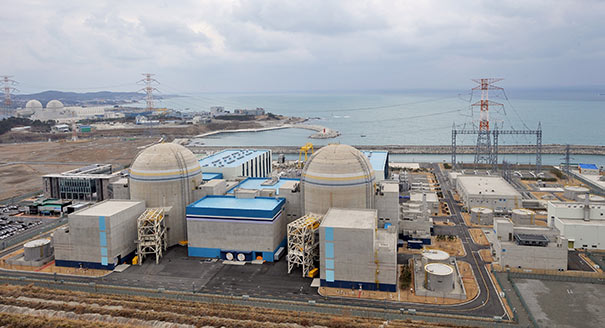
As of late May 2017, state-run nuclear operator Korea Hydro & Nuclear Power (KHNP) had five new nuclear reactors under construction; among them, three reactors were nearly complete while other two (Shin Kori no. 5 and no. 6) had been 28.8 percent done (10.4 percent in terms of actual construction) with roughly $1.4 billion already spent and estimated total losses (sunk costs) of $2.3 billion. Moon’s pursuit of “a nuclear-free era” made the fate of the two ongoing construction projects controversial, sparking heated debates between pro- and anti-nuclear campaigners in South Korea. Advocates for resuming the construction assured that the Shin Kori 5 and 6 would be “the most up-to-date version of the third-generation type, equipped with intensive safety features,” while opponents expressed their concerns about the location of these nuclear reactors in a highly-populated area, no matter how advanced safety measures would be.

This article was originally published in the Diplomat.

Read the article

About the Author

Se Young Jang

Former Nonresident Scholar, Nuclear Policy Program

Se Young Jang was a nonresident scholar in the Nuclear Policy Program at the Carnegie Endowment for International Peace.

Se Young Jang
Former Nonresident Scholar, Nuclear Policy Program
Nuclear PolicyNuclear EnergyEast AsiaSouth Korea

Carnegie does not take institutional positions on public policy issues; the views represented herein are those of the author(s) and do not necessarily reflect the views of Carnegie, its staff, or its trustees.

More Work from Carnegie China

  • An aerial view shows containers stacked at a port in Taicang, in eastern China's Jiangsu province on May 18, 2025.
    Commentary
    How to Predict China’s Economic Performance for 2025: A Sectoral Approach

    GDP growth means something fundamentally different in China than in most countries.

      Michael Pettis

  • People wave Chinese flags as the plane carrying Chinese President Xi Jinping arrives for a two-day state visit at Hanoi's Noi Bai International Airport in Hanoi on April 14, 2025
    Article
    How Southeast Asia Sees Xi Jinping’s Regional Push Amid U.S.-China Tensions

    The Trump administration’s effort to reshape the global trading system and reset overseas security commitments is creating an historic inflection point.  Less clear is how far China will be able to capitalize on these dynamics.

      • +1

      Li Mingjiang, Le Hong Hiep, Ngeow Chow Bing, …

  • Article
    Northeast Asia Is for Deterrence and Southeast Asia Is (Mostly) for Freeriding: Appreciating Divergent East Asian Approaches to Order, Uncertainty, and Contestation

    Most Southeast Asian states behave as if the actions of their Northeast Asian neighbors and the Philippines will be sufficient to maintain a regional status quo from which they can benefit.

      Chong Ja Ian

  • Commentary
    Beyond the Putin-Kim Alliance: How Can the International Community Engage China to Contain Nuclear Risks Over the Korean Peninsula?

    Faced with an increase in strategic maneuvering by Moscow and Pyongyang, Beijing will not sit idly by and allow Putin and Kim to shape the security environment on its behalf.

      Tong Zhao

  • Collection
    China Through a Southeast Asian Lens

    A Q&A series where we ask scholars from Southeast Asia for their insights on China’s influence and relations with the region. 

Get more news and analysis from
Carnegie China
Carnegie China logo, white
  • Research
  • About
  • Experts
  • Events
  • Contact
  • Careers
  • Privacy
  • For Media
Get more news and analysis from
Carnegie China
© 2026 Carnegie Endowment for International Peace. All rights reserved.






