

Article
C. Raja Mohan, Darshana M. Baruah
{
  "authors": [
    "C. Raja Mohan"
  ],
  "type": "legacyinthemedia",
  "centerAffiliationAll": "dc",
  "centers": [
    "Carnegie Endowment for International Peace",
    "Carnegie India"
  ],
  "collections": [],
  "englishNewsletterAll": "ctw",
  "nonEnglishNewsletterAll": "",
  "primaryCenter": "Carnegie India",
  "programAffiliation": "SAP",
  "programs": [
    "South Asia"
  ],
  "projects": [],
  "regions": [
    "South Asia",
    "India",
    "Oceania",
    "Japan",
    "East Asia",
    "China"
  ],
  "topics": [
    "Foreign Policy",
    "Security",
    "Military"
  ]
}
Source: Getty
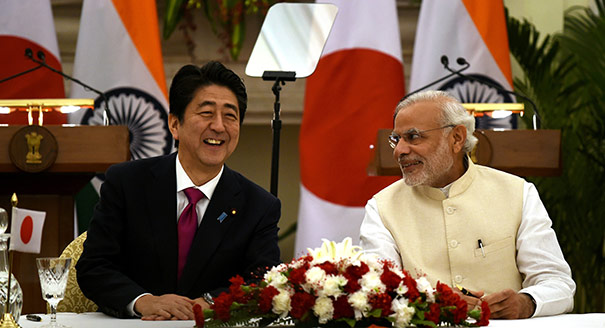
India’s issue with quadrilateral cooperation among India, Japan, Australia and the United States is no longer about the principle. New Delhi will sit down with anyone in any kind of forum if that serves India’s national interest.
Source: Indian Express
Some ideas are not easily killed. The proposal for quadrilateral cooperation among India, Japan, Australia and the United States may be one of those. The concept is inextricably linked to China’s emergence as a great power, second only to the United States. The fear of China’s growing unilateralism drives Asian nations to reduce the regional imbalance by banding together. But the attractions of doing business with China and the dangers of provoking it limit the impulses for collective action against Beijing.
The proposition that Asian democracies and the United States should get together to balance China had a brief moment in the sun during 2007. Killed in 2008 by Australia, the proposal began to breathe again in the last few years. It has gained some real traction last week. India, which was reluctant to revive the quad until recently, now seems ready for a discussion of the terms and conditions for its participation.
Just a couple of days after Prime Minister Shinzo Abe won a sweeping mandate in Sunday’s snap general elections, Japanese Foreign Minister Taro Kano told the Nikkei Asian Review that he planned to present to US President Donald Trump a formal proposal for a high-level dialogue among the four nations. Japan would like to see substantive cooperation among them on defence cooperation, maritime security, and infrastructure development. Senior officials of the four countries could meet next month on the margins of the East Asia Summit in the Philippines. Kano added that Tokyo also wants London and Paris to eventually join this effort.
*******************
It was Abe who conceived the idea of Asian democracies joining forces. In a book published in 2006 just before he began his first tenure as Prime Minister, Abe called for a quadrilateral dialogue among Japan, India, Australia and the United States. At the end of 2006, during his visit to Tokyo, Prime Minister Manmohan Singh endorsed the idea of a new dialogue among “like-minded countries” in Asia.
An exploratory meeting of officials of the four countries took place on the margins of an Asian summit at the end of May 2007. If Abe was making bold to look beyond the sole focus on the alliance with the United States, New Delhi too was shedding hesitations justified under the name of non-alignment.
In an address to the Indian Parliament in August 2007, Abe fleshed out the idea. Emphasising the shared values of freedom and democracy between India and Japan, he called for a joint effort by New Delhi and Tokyo for the formation of an “arc of freedom and prosperity… along the outer rim of the Eurasian continent”.
Abe hoped that an India-Japan strategic partnership will help construct a “broader Asia” that could evolve into an “immense network spanning the entirety of the Pacific Ocean, incorporating the United States of America and Australia. Open and transparent, this network will allow people, goods, capital, and knowledge to flow freely”.
The idea seemed to gain some real world significance with the annual Malabar exercises between India and the United States in September 2007, just days after Abe’s address. The exercise saw ships from Japan, Australia and Singapore join the Indian and American navies. Although the exercise was not planned as proof of the quad concept, Beijing went ballistic — attacking it as the first step towards the formation of an “Asian NATO”.
As China objected, the UPA government began to wobble. The then Defence Minister A K Antony ticked off the Chief of the Naval Staff, and ruled out future multilateral naval exercises amidst a chorus of protests from the communist parties. But it was Australia that delivered the blow against the quad. In early 2008, the Australian Foreign Minister Stephen Smith, standing next to his Chinese counterpart Yang Jiechi, announced that Canberra was no longer interested in the quadrilateral dialogue.
*******************
The quad certainly looked dead, but it was not buried. As China began to assert itself after the global financial crisis of 2008, the Obama Administration moved the United States away from the idea of shared leadership with China (the notorious G-2) towards a balancing strategy. In 2011, the US announced the idea of a pivot to Asia that involved the revitalisation of America’s Asian alliances and strengthening partnerships with key Asian countries like India and Indonesia.
In Japan, Abe returned to power at the end of 2012 and began an effort to revive the quad. New Delhi, however, seemed reluctant. Having seen the quad disintegrate quickly, New Delhi was content with expanding its trilateral engagement with the US and Japan at one forum, and with Australia and Japan at another. The NDA government discarded the UPA’s defensiveness on multilateral naval exercises — but while it was ready to include Japan in the Malabar exercises, it has not been too eager to bring in Australia, despite repeated requests from Canberra.
In response to the Japanese proposal to revive the quad, New Delhi has signalled a little more flexibility. In a statement on Friday, the spokesman of the foreign office said “India is open to working with likeminded countries on issues that advance our interests and promote our viewpoint.” The key question, according to the spokesman, is over what the quad does, and how.
*******************
India’s issue with the quad, therefore, is no longer about the principle. It is about the purpose and process. The UPA government suggested not participating in the quad was some kind of moralpolitik that was vaguely conflated with the tradition of non-alignment. The Narendra Modi government is no longer defensive. It is saying that New Delhi will sit down with anybody in any kind of forum if that serves India’s national interest.
At the receiving end of Chinese power, Japan thinks it must proactively shape Asian regional environment. As foreign minister Kano put it, “We are in an era when Japan has to exert itself diplomatically by drawing a big strategic picture.”
As a rising power in its own right, New Delhi argues, India must demonstrate the will to influence geopolitical outcomes in Asia and beyond. There is no doubt that the construction of quad will face many challenges, given the deep divisions in all countries on how best to deal with China. There will be differences on setting priorities and allocating resources. Yet, India’s incipient engagement with Japan, America and Australia on the quad agenda suggests that the era when a diffident New Delhi hid behind ideological slogans is now behind us. India is now confident enough to embark on complex geopolitical jousting in Asia.
This article was originally published in the Indian Express.
Former Nonresident Senior Fellow, Carnegie India
A leading analyst of India’s foreign policy, Mohan is also an expert on South Asian security, great-power relations in Asia, and arms control.
Recent Work

C. Raja Mohan, Darshana M. Baruah


Alexander Gabuev, Paul Haenle, C. Raja Mohan, …
Carnegie does not take institutional positions on public policy issues; the views represented herein are those of the author(s) and do not necessarily reflect the views of Carnegie, its staff, or its trustees.

The Plaza Accord was not an externally imposed punishment of Japan but part of a broader restructuring that Japanese economists and policymakers themselves recognized was necessary. Its effects were undermined, however, when Tokyo responded to the resulting slowdown with policies that exacerbated investment, credit expansion, and the very imbalances the adjustment was intended to resolve.

Michael Pettis

The nuclear relationship between China and the United States is increasingly shaped by widening perception gaps rather than deliberate strategic design.

Tong Zhao
China’s banking crisis in the 2000s was resolved by transferring the costs to households through financial repression—a decision that recapitalized the banks while exacerbating the structural imbalances that continue to shape the Chinese economy today.
Michael Pettis

Chinese biotech companies have been on the receiving end of U.S. economic coercion. Yet their responses have differed significantly because firm and state interests are not uniformly aligned. For Washington, treating all Chinese tech firms the same, irrespective of their actual interests, risks pushing them farther into Beijing’s corner.

Xue Gong
China’s latest energy plan explicitly calls for integrating data centers into the electricity system, particularly connecting them to green energy. It appears Beijing wants to use compute as a source of domestic demand to absorb renewables excess capacity.

Damien Ma