

Report
- +8
Salman Ahmed, Wendy Cutler, Rozlyn C. Engel, …
{
  "authors": [
    "Jake Sullivan"
  ],
  "type": "legacyinthemedia",
  "centerAffiliationAll": "dc",
  "centers": [
    "Carnegie Endowment for International Peace"
  ],
  "collections": [],
  "englishNewsletterAll": "americanStatecraft",
  "nonEnglishNewsletterAll": "",
  "primaryCenter": "Carnegie Endowment for International Peace",
  "programAffiliation": "ASP",
  "programs": [
    "American Statecraft"
  ],
  "projects": [],
  "regions": [
    "North America",
    "United States"
  ],
  "topics": [
    "Foreign Policy",
    "Global Governance"
  ]
}
Source: Getty
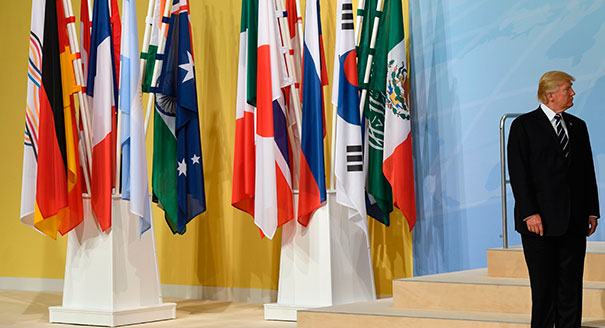
The international order is built to last through significant shifts in global politics and economics and strong enough to survive a term of President Trump.
Source: Foreign Affairs
The warnings started long before Donald Trump was even a presidential candidate. For at least a decade, a growing chorus of foreign policy experts had been pointing to signs that the international order was coming apart. Authoritarian powers were flouting long-accepted rules. Failed states were radiating threats. Economies were being disrupted by technology and globalization; political systems, by populism. Meanwhile, the gap in power and influence between the United States—the leader and guarantor of the existing order—and the rest of the world was closing.
Then came Trump’s election. To those already issuing such warnings, it sounded the death knell of the world as it was. Even many of those who had previously resisted pessimism suddenly came to agree. As they saw it, the U.S.-led order—the post–World War II system of norms, institutions, and partnerships that has helped manage disputes, mobilize action, and govern international conduct—was ending for good. And what came next, they argued, would be either an entirely new order or a period with no real order at all.
But the existing order is more resilient than this assessment suggests. There is no doubt that Trump represents a meaningful threat to the health of both American democracy and the international system. And there is a nonnegligible risk that he could drag the country into a constitutional crisis, or the world into a crippling trade war or even an all-out nuclear war. Yet despite these risks, rumors of the international order’s demise have been greatly exaggerated. The system is built to last through significant shifts in global politics and economics and strong enough to survive a term of President Trump.
Former U.S. National Security Advisor to Former President Joe Biden
Jake Sullivan, a senior fellow at the University of New Hampshire's Carsey School of Public Policy, served as the United States national security advisor to former President Joe Biden from 2021 to 2025. Sullivan previously served as deputy assistant to former President Barack Obama, national security advisor to former Vice President Biden, director of policy planning in the State Department, and as deputy chief of staff to former U.S. Secretary of State Hillary Clinton.
Recent Work
Salman Ahmed, Wendy Cutler, Rozlyn C. Engel, …
Salman Ahmed, Allison Gelman, Tarik Abdel-Monem, …
Carnegie does not take institutional positions on public policy issues; the views represented herein are those of the author(s) and do not necessarily reflect the views of Carnegie, its staff, or its trustees.

But their "principal to principal" model will only be as effective as the political strength of each leader back home.

Damien Ma

U.S. unpredictability has allowed China to capitalize on its positioning as the “responsible great power”. Paradoxically, the more China wins the perception game, the more likely expectations will rise for Beijing to deliver not just words but to demonstrate with its deeds.

Chong Ja Ian

Hanoi and Beijing have long treated each other as distant cousins rather than comrades in arms. That might be changing as both sides draw closer to hedge against uncertainty and America’s erratic behavior.

Nguyễn Khắc Giang

Across Asia, China is better positioned to withstand energy shocks from the fallout of the Iran war. Its abundant coal capacity can ensure stability in the near term. Yet at the same time, the country’s energy transition away from coal will make it even less vulnerable during the next shock.
Damien Ma

Malaysia’s chairmanship sought to fend off short-term challenges while laying the groundwork for minimizing ASEAN’s longer-term exposure to external stresses.

Elina Noor