

Paper
Erik Brattberg, Tomáš Valášek
{
  "authors": [
    "Tomáš Valášek"
  ],
  "type": "legacyinthemedia",
  "centerAffiliationAll": "",
  "centers": [
    "Carnegie Endowment for International Peace",
    "Carnegie Europe"
  ],
  "collections": [
    "Transatlantic Cooperation"
  ],
  "englishNewsletterAll": "",
  "nonEnglishNewsletterAll": "",
  "primaryCenter": "Carnegie Europe",
  "programAffiliation": "",
  "programs": [],
  "projects": [],
  "regions": [
    "Asia",
    "North America",
    "East Asia",
    "North Korea"
  ],
  "topics": [
    "Security",
    "Nuclear Policy"
  ]
}
Source: Getty
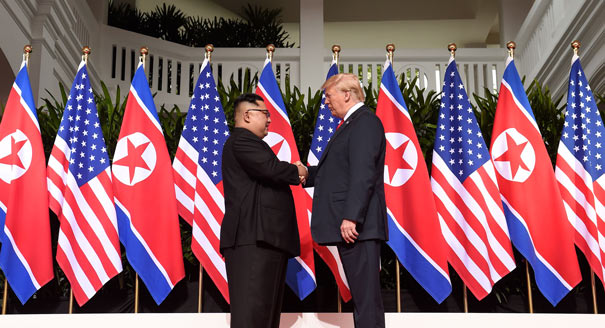
The deal between U.S. President Trump and the North Korean leader Kim Jong-un is weak and far too general. The diverging interpretations of how to develop the agreement bode poorly for the future.
Source: E!Sharp
No, the North Korean nuclear threat is not “over”, as Donald Trump declared on Wednesday. The “comprehensive” deal signed with Kim Jong-Un is weak and far too general, and the diverging interpretations of how to develop it bode poorly for the future.
But let us, if only briefly to relive the good old days, consider an alternative view: that the U.S. administration is onto something.The deal is weak by standards of usual arms control negotiations, in which both sides share a broad goal but lack trust. The elaborate sequencing and monitoring built into these deals are meant to keep distrust from getting in a way of an objective which both sides are determined to reach anyway.
North Korea poses a different kind of problem. The United States would be right to assume that Kim Jong-Un is not interested in denuclearization - at least not while the N. Korean leader believes nuclear weapons to be essential to regime (and perhaps personal) survival.
The agreement reached on Tuesday seems designed to change, overtime, Kim’s calculus. The flattery, the personal meeting (and the offer of more in the future) are to reassure North Korea that Washington is not implacably hostile. The suspension of U.S. military exercises in South Korea, announced after the summit, makes sense in this light.
Just as interestingly, the choice of summit location (a rich, essentially one-party Asian state) and Trump’s video of North Korea as next tourist heaven seem designed to tell Kim that his country and he personally can be even more secure - and richer - if he partly opens his country to the world.
The U.S. appears to be not after regime change but after a change of the regime’s assessment of its own interests. Perhaps Pyongyang comes around to view nuclear weapons as first unnecessary and later, perhaps, an impediment. This, in other words, is a long-term proposition, but not far-fetched. Pyongyang has a declared “byungjin” (parallel development) policy of advancing nuclear arms and the economy. Kim has pronounced the arms objectives accomplished and said he was moving on to economy.
Keener observers will note a (limited) similarity with the Iran nuclear agreement. Both deals assume a gradual change in the calculation of security interests of the other side. Some of the Iran deal’s crucial provisions, for example, are set to expire overtime — those familiar with negotiations say that while suboptimal, this arrangement makes sense because a broader political change is afoot in Iran, and in the medium term nuclear weapons will have lost some of their utility to the government. (This is where the similarities end. The Iran deal is very robust with intrusive inspections, because Tehran, unlike Pyongyang, was already prepared to see nuclear weapons as less than essential.)
Whether the US opening to North Korea succeeds is anyone’s guess. Kim Jong-Un would be right to wonder if the next U.S. president upholds the policy, or repudiates it, as Trump did with the Iran deal. Kim will also recall that the West once wined and dined Muammar Gaddafi in an effort to entice him to give up his nuclear program, then turned on him when the latter started killing protestors demanding reform (which is what tends to happen when closed societies start opening up).
My guess is that even if the Trump overture succeeds to start modernizing North Korea, the country will want to hang on to its weapons. But even that may be a better outcome than the status quo. Instead of a paranoid and isolated government, the weapons would be in the hands of a less neurotic one.
Let me also note, for the sake of intellectual integrity, that president Trump’s statement last Wednesday that the Korea nuclear threat is “over” is wholly inconsistent with the theory advance above. He would have been more accurate if he said “I have done something new, which could be useful in ending the Korean nuclear threat overtime”.
The tweet will be read by those who believe Washington under its current leadership incapable of strategic thought as evidence that the whole purpose of the summit was self-aggrandizement. Perhaps. But president Trump would not be the first U.S. or European leader to seek to embellish foreign policy successes for domestic political purposes. The policy can still make sense, even if it is misrepresented to domestic audiences.

Former Director, Carnegie Europe
Valášek was director of Carnegie Europe and a senior fellow, where his research focused on security and defense, transatlantic relations, and Europe’s Eastern neighborhood.
Recent Work

Erik Brattberg, Tomáš Valášek
Tomáš Valášek
Carnegie does not take institutional positions on public policy issues; the views represented herein are those of the author(s) and do not necessarily reflect the views of Carnegie, its staff, or its trustees.

The Plaza Accord was not an externally imposed punishment of Japan but part of a broader restructuring that Japanese economists and policymakers themselves recognized was necessary. Its effects were undermined, however, when Tokyo responded to the resulting slowdown with policies that exacerbated investment, credit expansion, and the very imbalances the adjustment was intended to resolve.

Michael Pettis

The nuclear relationship between China and the United States is increasingly shaped by widening perception gaps rather than deliberate strategic design.

Tong Zhao
China’s banking crisis in the 2000s was resolved by transferring the costs to households through financial repression—a decision that recapitalized the banks while exacerbating the structural imbalances that continue to shape the Chinese economy today.
Michael Pettis

Chinese biotech companies have been on the receiving end of U.S. economic coercion. Yet their responses have differed significantly because firm and state interests are not uniformly aligned. For Washington, treating all Chinese tech firms the same, irrespective of their actual interests, risks pushing them farther into Beijing’s corner.

Xue Gong

Across Asia, China is better positioned to withstand energy shocks from the fallout of the Iran war. Its abundant coal capacity can ensure stability in the near term. Yet at the same time, the country’s energy transition away from coal will make it even less vulnerable during the next shock.

Damien Ma