Source: Hindustan Times
Elections are rumoured to be very expensive in India and analysts frequently speculate that, with each passing election, the costs of campaigns are ratcheting further upwards. The perceived increase in campaign costs is often assumed to mean that bribes— what political scientists refer to as “votebuying”—might be on the rise. Yet what candidates actually spend their money on during these expensive campaigns remains unclear due to the paucity of credible data on real expenses. While official candidate expense reports provide a sense of above-board expenses, my long-term study of party networks in Mumbai provides a rare perspective on the true costs of campaigns.
Over several years, repeated interviews with political workers across three constituencies allowed me to generate estimates of legal and accounted expenses, but also of illegal, illegitimate and unaccounted expenses, and to estimate the relative amounts spent by candidates on each type of expense. This, in turn, makes it possible to estimate whether bribes are driving the cost of elections up and/or whether other types of spending are also on the rise. If it is the latter, one can identify whether the alleged increase in the cost of elections really owes to more frequent bribing or to some other, deeper cause.
The legal expenditure limit for an assembly election in Mumbai in 2014 was Rs 35 lakh. Major contenders I observed spent between Rs 1 crore and Rs 16 crore, with considerable variation across parties. As such, these unique data confirm that the legal and accounted expenses of candidates only represent a minuscule fraction of their real expenses—frequently less than 1/30th or 1/50th of the overall amount. Real expenses include a large number of gifts and handouts to voters and/or local influencers, in line with the suspicion that voters are routinely being bribed in Indian elections.
According to estimates I collected from party workers in Mumbai, major candidates (for various parties across several constituencies) spent between 19% and 64% of their budgets on gifts to voters, which were typically disbursed through a lump-sum payment to influential citizens (such as housing society presidents or regional or caste association leaders). In addition to targeted payments to “influential citizens,” money also trickled down party networks, which led to gifts and cash handouts being showered on voters in a relatively indiscriminate manner during the waning moments of the campaign.
However, gifts are not always the only, even the primary, reason why electoral campaigns are expensive. Many other expenses, from basic logistical costs to the short-term wages that candidates pay to their workers and the crowds these workers recruit, sometimes place even more meaningful constraints on candidates. Payments to campaign workers are an oft-overlooked major expenditure. While our estimates are less reliable than the ones presented above—since this is a particularly sensitive question to ask political workers directly— we estimated that candidates on average spent over 10% of their budgets on staff wages. This implies that serious candidates may be spending several times more than the overall spending limit on wages alone.
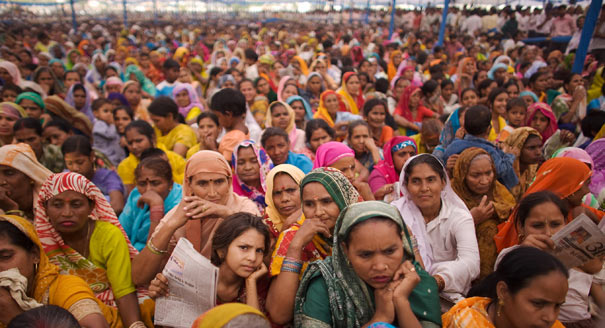
Often, the recipients of wages are not party workers but ordinary citizens (although the boundary is admittedly porous between the two categories). In Mumbai—and I suspect in most of India—much of what political scientists refer to as “political participation” (participating in processions, rallies, and meetings) is contingent on these wages. Overall, such “paid political participation” reportedly accounted for an even larger share of the expenses of candidates I observed in 2014: party workers estimated the overall amounts that the various candidates spent on hired crowds to range between 10 and 40% of their total expenses.
These payments cannot be simply equated with bribes, insofar as party workers trade wages for work rather than for votes. Further, they do not appear to mobilise likely supporters of their candidates, but simply those who are poor and readily available to carry flags or idly seat on plastic chairs.
Finally, a large part of the illegal funds mobilised by candidates—a share estimated to range between 20% and 30% of their real expenses—were also spent on perfectly mundane items such as material for rallies and processions, vehicles, speakers, chairs, tables, posters, etc. These items would be neither illegal nor illegitimate if the total spending of the candidate had remained below the legal limit. Altogether, this suggests that costs are rising not only because voters receive gifts, but also because campaigns are getting bigger and more ambitious, sophisticated, professional, and competitive. The perceived increase in the cost of campaigns does not have one cause but several; the current narrative assigning the rise in the cost of campaigns to the proliferation of bribes may be simplistic or simply erroneous.
Rising costs generally have more to do with structural changes in the context of democratic elections in India.
Regardless of the ubiquity of gifts and handouts, a number of alternative factors explain why campaigns are getting more expensive.
First, slow but steady increases in the size of constituencies may play a major role. Simply put, larger populations require candidates to spend more.
Second, there may be generational changes that affect the cost of campaigns. In Mumbai, the rising number of young educated voters who are beyond the reach of parties’ influence and increasingly independent from their families’ partisan preferences is widely described by workers as heralding the progressive disappearance of “vote banks.”
Third, and most importantly, a steady rise in political competition and in the number of candidates has sparked an arms race in campaign spending. More candidates automatically means more uncertain elections, and hence costlier contests for candidates who are forced to match the expenses of their competitors. In that sense, costlier elections may not result from lower levels of morality in the political class or from a surge in bribe giving. They instead likely flow from rising levels of political competition, which may be doing harm as well as good.
This article was originally published in the Hindustan Times.