

Commentary
Maksim Samorukov
{
  "authors": [
    "Maksim Samorukov"
  ],
  "type": "commentary",
  "centerAffiliationAll": "",
  "centers": [
    "Carnegie Endowment for International Peace",
    "Carnegie Russia Eurasia Center"
  ],
  "collections": [],
  "englishNewsletterAll": "",
  "nonEnglishNewsletterAll": "",
  "primaryCenter": "Carnegie Endowment for International Peace",
  "programAffiliation": "",
  "programs": [],
  "projects": [
    "The Return of Global Russia: A Reassessment of the Kremlin’s International Agenda"
  ],
  "regions": [],
  "topics": [
    "Economy"
  ]
}
Source: Getty
Widely regarded as the EU’s most pro-Russian member-state, Hungary is, in fact, cooling to Russia. The two countries’ leaders are focused on old projects instead of looking to the future, while Viktor Orban is growing more critical of Russia both at home and abroad. For Orban, Vladimir Putin is increasingly useless, having been replaced with an even better ally: Donald Trump.
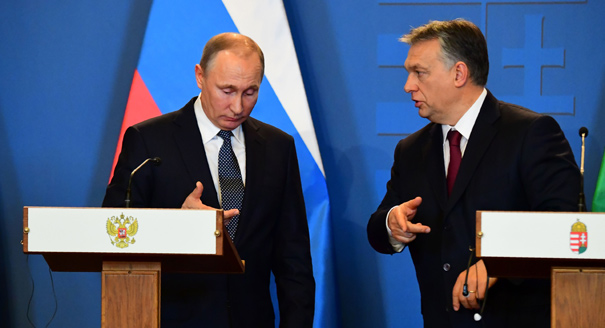
On the surface, Russo-Hungarian relations appear wonderful. Hungarian Prime Minister Viktor Orban visited Moscow on September 18, just two months after his last trip to the Russian capital. Russian President Vladimir Putin, for his part, was in Budapest twice in 2017.
However, high-level Russo-Hungarian meetings have focused on old projects, not new initiatives, suggesting that the height of bilateral cooperation is behind us. Indeed, nowadays, the Russo-Hungarian agenda is limited to gas talks and one significant joint venture: the 12 billion euro construction of two new reactors at the Paks Nuclear Power Plant in Hungary. The extreme centralization of the decisionmaking process in both countries compels the two leaders to meet regularly to ensure that the right bidders win the tenders Rosatom has been announcing since last year.
Putin and Orban are increasingly conscious that they meet far too often and that their regular contacts have failed to bring the two countries closer together. In fact, despite its reputation as the EU’s most pro-Russian member-state, Hungary actually expelled a Russian diplomat in response to the poisoning of Sergei and Yulia Skripal, unlike fellow EU member-states Slovenia, Bulgaria, Austria, Slovakia, Greece.
In the spring, Orban readily deployed anti-Russian rhetoric during Hungary’s parliamentary election campaign. Bela Kovacs, a member of the European Parliament from the Jobbik opposition party, was indicted for alleged spying on the eve of the vote, having faced accusations of being a Russian agent since 2014. Talk of importing Romanian gas also served to underscore Budapest’s independence from Moscow.
In July, Orban unequivocally declared at the NATO summit in Brussels that Russia was a threat to Europe. Although the phrase was not central to his speech, it attracted significant attention, contrasting, as it did, with the Hungarian prime minister’s earlier pronouncements. For years, he had reasoned that because Russia was not a threat to Europe, Russia sanctions should be lifted.
Orban has cooled to Putin because he now has allies other than Moscow—namely, Washington. Brussels and Washington have not been united in isolating Budapest within the West since 2017. The current U.S. president often clashes with Brussels, but he has yet to fully grasp what a powerful potential ally he has in Orban. As such, Orban has set out to explain it to the man in the White House in the most convincing terms.
Donald Trump has been in power for a year and a half already. Yet, in that time, he has not met with Orban, whose negative image in Washington, formed under Barack Obama, persists. Orban is also firmly seen as the EU’s most pro-Russian leader, further complicating his outreach to Trump.
Heeding Trump’s call to increase defense spending, the Hungarian prime minister realized—in his ninth year in office—that it was wrong for his country to spend only around 1 percent of its GDP on defense. He promised to increase spending to 2 percent and rebuked those European countries not rushing to follow suit.
In Brussels, Hungary promised to increase its Afghan and Iraqi contingents—from 117 to 129 troops and from 167 to 200 troops, respectively—as well as appropriate additional funds for training local security forces. The Hungarians will also resume their participation in NATO’s Baltic air policing mission.
Hungary is actively negotiating hosting a regional NATO command center on its territory. Orban organizes warm receptions in Budapest for Trump’s ideologist, Steve Bannon. He was also one of the few foreign leaders who supported Trump’s decision to move the U.S. Embassy in Israel to Jerusalem. Only three countries—Romania, the Czech Republic, and Hungary—blocked an EU resolution critical of the move.
Hungary’s conflict with Ukraine, however, is Orban’s main instrument in his quest to secure a personal meeting with Trump. Budapest consistently vetoes NATO-Ukraine ministerial-level summits and has recently prevented one at the presidential level, meant to take place on the eve of the last NATO summit.
Officially, Hungary is unhappy about a new law in Ukraine that drastically restricts native language instruction for ethnic minorities, including the Hungarian minority in the Transcarpathian region. The law is, in fact, discriminatory, as confirmed by the Venice Commission. Nevertheless, Budapest’s interest in this issue clearly goes beyond defending the rights of the Hungarian minority. Rather, Budapest wants Washington to mediate the conflict.
Hungarian Foreign Minister Peter Szijjarto has already met twice with U.S. Assistant Secretary of State for European and Eurasian Affairs A. Wess Mitchell to discuss his country’s dispute with Ukraine. The meetings failed to resolve the conflict, so Szijjarto was afforded a meeting with U.S. Secretary of State Mike Pompeo. But even that proved insufficient, the implication being that an Orban-Trump summit may be the only answer, as well as a precondition for the resumption of NATO-Ukraine cooperation.
In early 2017, Orban tried to attract Trump’s attention in a similarly disruptive fashion, by launching an attack on the George Soros-funded Central European University (CEU) in Budapest. Amid rumors that the Trump administration objected to the close cooperation between the U.S. Agency for International Development, the U.S. State Department, and Soros-linked organizations, the Hungarian prime minister joined Trump’s efforts to disrupt these ties. But the CEU controversy made little impact, forcing Orban to target NATO-Ukraine cooperation instead.
Szijjarto’s May meeting with Pompeo was the first such high-level contact between the two countries in six years. That same month, Trump’s appointee for U.S. ambassador to Hungary, David Cornstein, was confirmed by the U.S. Senate, while Mitchell turned his attention to developing new approaches for dealing with Hungary, reasoning that the country’s isolation within the West was harmful and forced it to embrace U.S. rivals like Russia and China.
Orban also won a major victory in July, when the U.S. State Department deferred a $700,000 grant to independent media outlets in Hungary despite having selected its recipients. Trump has personally called Orban to discuss border management, a pet cause of both leaders. In addition, Cornstein has spoken of a potential visit to Washington by the Hungarian prime minister in the near future.
As such, the fear of a Russo-Hungarian entente caused by the European Parliament’s recent decision to invoke Article 7 of the Lisbon Treaty against Hungary—a move making it possible to strip Hungary of its voting rights as an EU member-state—is exaggerated. The U.S. friendliness toward Hungary, along with Budapest’s improving relations with Rome and Warsaw, makes it impossible for the European Council to secure the consensus necessary to punish Orban.
For Hungary, these conditions obviate the need for closer relations with Russia. In fact, the main reason Hungary hugged Russia close in the first place was to discourage U.S. criticism and end Washington’s policy of isolating Budapest—an outcome that Orban has secured.
Fellow, Carnegie Russia Eurasia Center
Samorukov is a fellow at the Carnegie Russia Eurasia Center.
Recent Work
Maksim Samorukov
Maksim Samorukov
Carnegie does not take institutional positions on public policy issues; the views represented herein are those of the author(s) and do not necessarily reflect the views of Carnegie, its staff, or its trustees.

In the latest Five-Year Plan, the Chinese president cements the shift to an innovation-driven economy over a consumption-driven one.

Damien Ma
Rather than climate ambitions, compatibility with investment and exports is why China supports both green and high-emission technologies.

Mathias Larsen
“Involution” is a new word for an old problem, and without a very different set of policies to rein it in, it is a problem that is likely to persist.

Michael Pettis

While China's investment story seems contradictory from the outside, the real answers to Beijing's high-quality growth ambitions are hiding in plain sight across the nation's cities.
Yuhan Zhang
China's stimulus addiction cannot go on forever. Beijing still has policy space to clean up the country's massive debt issue, but time is running short.
Michael Pettis