

Paper
The nuclear relationship between China and the United States is increasingly shaped by widening perception gaps rather than deliberate strategic design.
Tong Zhao
{
  "authors": [
    "Richard Sokolsky",
    "Aaron David Miller"
  ],
  "type": "legacyinthemedia",
  "centerAffiliationAll": "",
  "centers": [
    "Carnegie Endowment for International Peace"
  ],
  "collections": [],
  "englishNewsletterAll": "",
  "nonEnglishNewsletterAll": "",
  "primaryCenter": "Carnegie Endowment for International Peace",
  "programAffiliation": "",
  "programs": [],
  "projects": [],
  "regions": [
    "North America",
    "United States"
  ],
  "topics": [
    "Foreign Policy"
  ]
}
Source: Getty
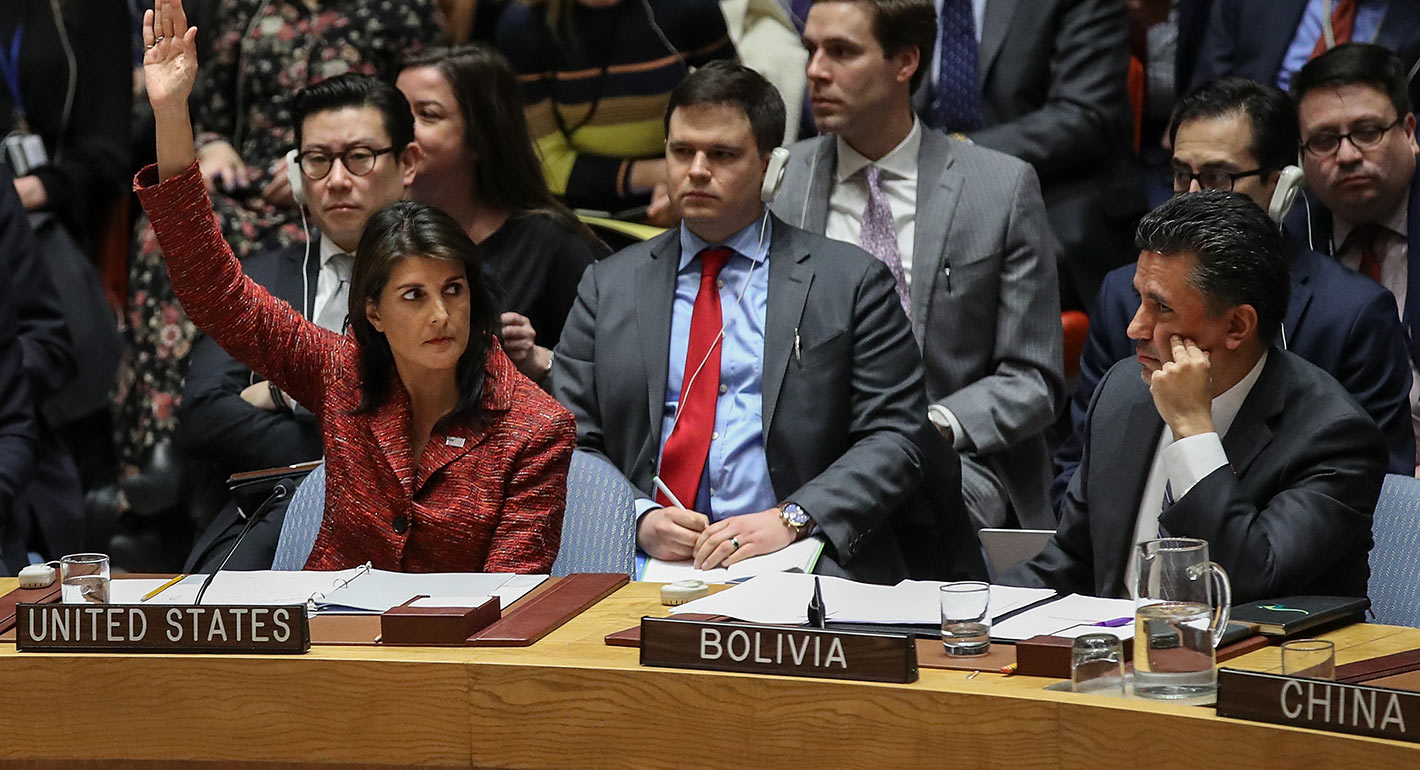
Whoever next serves as U.S. ambassador to the UN will not have Nikki Haley’s freedom to speak out or her impact on policy or the president.
Source: USA Today
Theories are banging around the Beltway faster than commuter traffic about why Nikki Haley chose to resign as the ambassador to the United Nations and why she did it now, one month before the midterm elections.
There’s the term limits theory that Haley herself referred to in her formal letter of resignation; there’s the “I need to earn more money theory,” particularly after years of public service; and then there’s this: In the post- Kavanaugh hearings era, it’s not wise to be too closely identified with a president who mocks victims of sexual assault, particularly if you have presidential aspirations, although that problem is going to conflict with Haley’s commitment to campaign for Trump in the runup to 2020.
The problem is there’s not a human being on the planet, with the exception of Haley, who can credibly tell you exactly why she resigned and why she chose to do so now. But one thing is pretty clear. Unless the president plans to choose Ivanka Trump (and the government’s nepotism policy and smart politics are likely to prevent that), whoever gets that job will not have Haley’s freedom to speak out or her impact on policy or the president.
The United States has had strong ambassadors to the U.N. before — Jeanne Kirkpatrick, John Negroponte, Tom Pickering and John Bolton come to mind. But they functioned within a system that had a greater structure and constraints than marked Haley’s first year.
In a way Haley was the lone ranger — a charismatic woman with a close relationship with the president and high public approval ratings who spoke out on policy issues from Iran to Syria to Israeli-Palestinian peacemaking, seemingly without regard to encroaching on the territory of the nearly invisible Secretary of State Rex Tillerson and a practically dysfunctional National Security Council. That vacuum, however challenging and confusing for foreign governments and our own — must have been energizing and exciting for Haley as she grabbed the center of attention. Physical proximity to the president, which usually favors an NSC adviser who’s a five-minute walk from face time with the boss, was not a handicap for Haley.
That party is over. Haley’s star started to dim with the appointments of Mike Pompeo and Bolton. Trump now has two foreign-policy heavyweights — a smart secretary of State who has very good relationship with the president and a national security adviser who has held Haley’s job in New York and is well-versed in the art of bureaucratic warfare.
There’s going to be scant room for an independent and outspoken ambassador crossing swords with these strong personalities. Haley lost a battle over the recent decision to have the president chair a U.N. Security Council meeting only on Iran, according to The New York Times. Bolton won that round by smartly broadening the agenda to nonproliferation and avoided having the president totally isolated because of the unpopularity of his Iran policy.
Before Haley was a diplomat, she was (and still is) a calculating and ambitious politician. As a rising star in the Republican Party, she was all too happy to check four of Trump’s political boxes: pleasing Israel, Christian evangelicals, conservative Republicans and the American Jewish community, especially those with deep pockets for GOP causes and candidates.
She accomplished all these objectives, while kicking the U.N. around to please the global governance haters among Trump’s base with great aplomb and political acumen.
Her successor, assuming she or he wants to keep the job, will simply have to follow the path Haley cut. And what’s remarkable is that she did all of this with a warm and engaging persona, a quick mastery of the issues and even a capacity to challenge the president on issues such as Russia without suffering fatal consequences. All of this is a testament to her formidable political skills and, even as she carried out Trump’s policies, an independent streak.
Haley’s successor will also not have to operate under the glare of the diplomatic spotlight. The three big foreign policy issues on the president’s plate for the next two years — defanging Iran, denuclearizing North Korea, and derailing China’s expansionist policies — are politically charged, therefore the policy and the diplomacy will be controlled and managed by the White House and the State Department. Ditto if the White House is successful in relaunching Middle East peace negotiations. But sanctions policy on both North Korea and Iran will be driven by the Treasury Department, and trade negotiations and tariff policies will be fought out between the White House and the Commerce and Treasury Departments.
Haley’s successor will have a seat at the table, but it might as well be empty because whoever is chosen — unlike Haley — and no matter how well-spoken and qualified, the new ambassador to the U.N. is more than likely to speak softly and carry a small stick.
Nonresident Senior Fellow, Russia and Eurasia Program
Richard Sokolsky is a nonresident senior fellow in Carnegie’s Russia and Eurasia Program. His work focuses on U.S. policy toward Russia in the wake of the Ukraine crisis.

Senior Fellow, American Statecraft Program
Aaron David Miller is a senior fellow at the Carnegie Endowment for International Peace, focusing on U.S. foreign policy.
Carnegie does not take institutional positions on public policy issues; the views represented herein are those of the author(s) and do not necessarily reflect the views of Carnegie, its staff, or its trustees.

The nuclear relationship between China and the United States is increasingly shaped by widening perception gaps rather than deliberate strategic design.

Tong Zhao

But their "principal to principal" model will only be as effective as the political strength of each leader back home.

Damien Ma

U.S. unpredictability has allowed China to capitalize on its positioning as the “responsible great power”. Paradoxically, the more China wins the perception game, the more likely expectations will rise for Beijing to deliver not just words but to demonstrate with its deeds.

Chong Ja Ian

Hanoi and Beijing have long treated each other as distant cousins rather than comrades in arms. That might be changing as both sides draw closer to hedge against uncertainty and America’s erratic behavior.

Nguyễn Khắc Giang

Across Asia, China is better positioned to withstand energy shocks from the fallout of the Iran war. Its abundant coal capacity can ensure stability in the near term. Yet at the same time, the country’s energy transition away from coal will make it even less vulnerable during the next shock.
Damien Ma