

Paper
Sarah Yerkes, Natalie Triche, Amr Hamzawy
{
  "authors": [
    "Sarah Yerkes"
  ],
  "type": "legacyinthemedia",
  "centerAffiliationAll": "dc",
  "centers": [
    "Carnegie Endowment for International Peace",
    "Malcolm H. Kerr Carnegie Middle East Center"
  ],
  "collections": [],
  "englishNewsletterAll": "menaTransitions",
  "nonEnglishNewsletterAll": "",
  "primaryCenter": "Carnegie Endowment for International Peace",
  "programAffiliation": "MEP",
  "programs": [
    "Middle East"
  ],
  "projects": [
    "Tunisia Monitor"
  ],
  "regions": [
    "North America",
    "United States",
    "Middle East",
    "Qatar",
    "Saudi Arabia",
    "Gulf"
  ],
  "topics": [
    "Political Reform",
    "Global Governance",
    "Foreign Policy"
  ]
}
Source: Getty
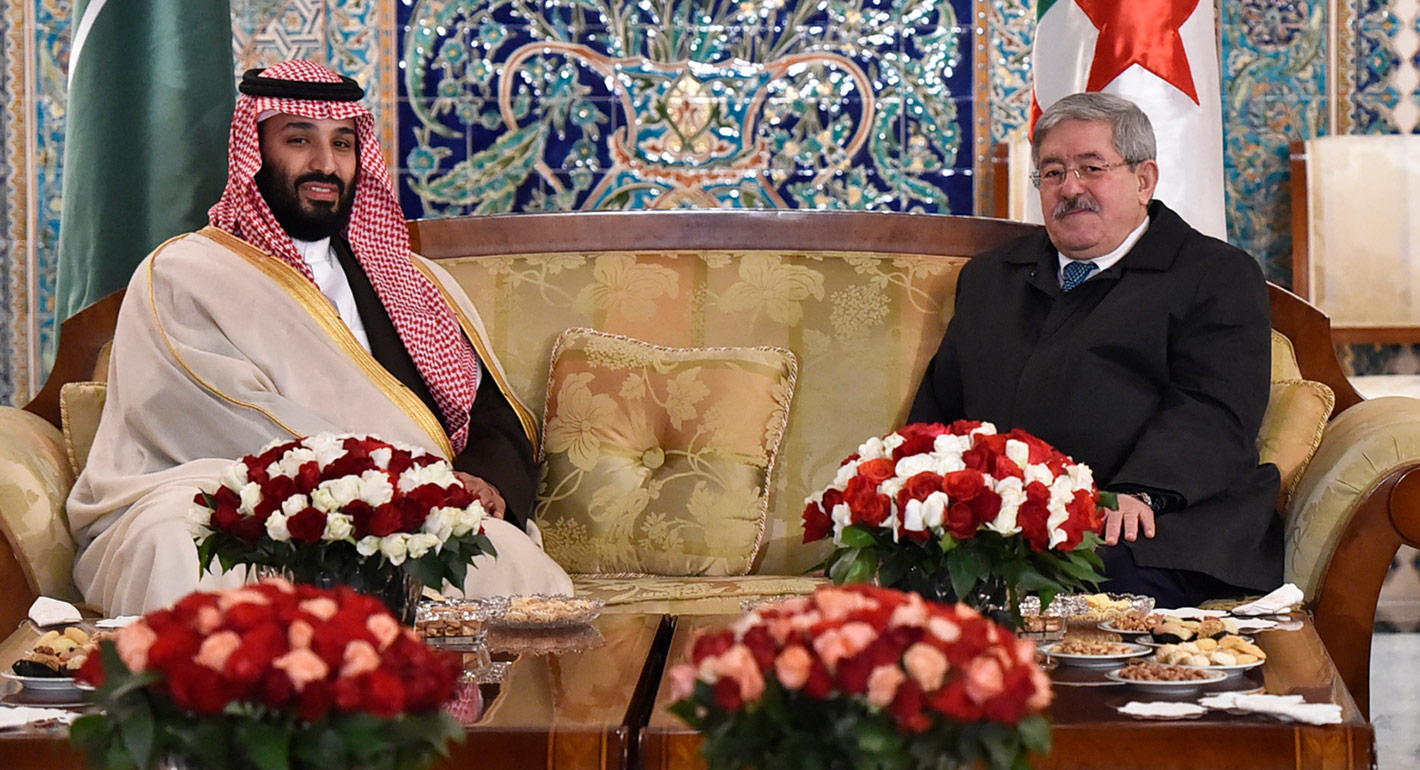
As Saudi Crown Prince Mohammed bin Salman wraps up his tour of the Middle East and North Africa, it was made clear that he is back to business as usual.
Source: Washington Post
As Saudi Crown Prince Mohammed bin Salman (MBS) wraps up his two-week tour of the Middle East and North Africa (with a weekend stopover at the Group of 20 summit in Argentina), there is little question that the region’s leaders have moved on from the Khashoggi affair.
While people in Tunisia and Mauritania took to the streets to protest the crown prince’s visit and a group of prominent Algerian journalists and intellectuals wrote an open letter calling the visit “unethical and politically inappropriate,” political leaders at each stop along the way showered MBS with praise and affection.
With much of this adoration to be expected – MBS chose friendly spots to visit – the tour had three important takeaways.
The first three stops on the tour – UAE, Bahrain, and Egypt – were largely unremarkable. While there was some fear that Khashoggi’s killing would cloud the trip, any criticism that threatened to arise was quickly silenced. In Egypt, while nearly 100 journalists officially rejected the visit, the press (which is almost exclusively controlled by the military) was prevented from publishing anything about Khashoggi during the visit or acknowledging that this was MBS’s first visit to Egypt since the killing. If the goal of his tour was to reintroduce himself to the world and remind his (largely Western) critics that he operates with impunity, the first leg of the tour was a smashing success.
Despite what appeared to be an international tide turning against MBS for both his suspected role in the killing of Washington Post contributing columnist Jamal Khashoggi and Saudi support for the war in Yemen, the overarching theme of the tour was that silence pays. During the tour, the U.S. Senate voted to advance legislation that would end American support for the Saudi-led coalition in Yemen, and an Argentine prosecutor agreed to pursue a war crimes accusation against MBS. Nevertheless, Arab leaders engaged in a competition of sorts to see who could kiss up to MBS the most.
As a thank you, throughout his visit, MBS bestowed gifts upon the leaders who stood by him, from a new oil pipeline jointly managed by Saudi Aramco and Bahrain’s Bapco to a promise to establish the King Salman Hospital in Nouakchott, Mauritania. There was even talk of a possible $5 billion “King Salman Causeway” linking Saudi Arabia with Egypt via Aqaba Bay, first proposed in 2016.
Things got a little messier in Tunisia, where a few hundred activists protested the visit, including depictions of MBS with a bonesaw in a nod to the Khashoggi killing and chants against the Saudi role in Yemen. While much of the Western press has focused on the Tunisian protests, the more remarkable aspect of the trip was his reception by Tunisian President Beji Caid Essebsi. Essebsi, the only democratically elected head of state in the Arab world, not only greeted MBS at the airport and welcomed him to the presidential palace but also went above and beyond his autocratic counterparts by bestowing upon MBS the country’s highest official honor – the Grand Cordon of the Republic. The dissonance was striking between the warm welcome by the Tunisian president and the hundreds of protesters in the streets of Tunis, along with the announcement that the public prosecutor is examining a complaint filed by the National Journalists’ Union accusing MBS of human rights abuses in Yemen.
The close relationship between MBS and Essebsi (whom MBS likened to his father during the visit) is due in part to the broader Gulf conflict. Essebsi and MBS share a common enemy in Qatar, who supports Essebsi’s traditional political rival, the Islamist Ennahda party. For now, Essebsi’s cozying up to MBS paid off in the literal sense – the Saudis have announced a $500 million loan to Tunisia and have said they will finance two development projects worth $140 million.
Yet the price of ignoring MBS’s vast human rights abuses remains yet to be seen. Saudi Arabia’s investment in Tunisia pales in comparison to the European Union and its members states such as France, whose investment accounted for 44 percent of total direct investment in Tunisia in 2017. The Western donors whose financial support keeps Tunisia afloat may not take kindly to the way Essebsi so lavishly welcomed MBS against the wishes of large sectors of the Tunisian public. Furthermore, Tunisia will hold presidential and parliamentary elections in late 2019. The decision by Essebsi to so blatantly and publicly ignore Saudi’s abuses may end up catapulting Ennahda into the presidential palace.
The only country to reject MBS’s advances during the trip is Morocco, where King Mohammed VI said he was too busy to meet the crown prince. He reportedly proposed the king’s diplomat brother, Moulay Rachid, meet him instead, which MBS rejected. The Moroccan-Saudi relationship took a hit when the ruling Islamist political party (the PJD) publicly sided with Qatar over Saudi Arabia during the Gulf crisis. While the king has traditionally been one of Saudi’s closest allies in the region, an influx of Qatari funds and a strong desire to maintain close ties to the West have allowed Morocco to take a more neutral, if not aggressive stance against Saudi Arabia.
The region’s other non-Gulf monarchy, Jordan, may be following a similar path. MBS’s visit to Jordan, which was scheduled to take place on Dec. 3, has been postponed for at least two days. While we do not yet know what caused the postponement or if the visit will happen at all, it is possible Jordan is taking a page from Morocco’s book and quietly shunning the crown prince.
The global debate around Saudi Arabia’s abuses and MBS’s role in Khashoggi’s killing is not likely to disappear soon. But this tour through the Middle East and North Africa made clear that MBS is back to business as usual.
This article was originally published in the Washington Post.

Acting Co-Director and Senior Fellow, Middle East Program
Sarah Yerkes is acting co-director and a senior fellow in the Middle East Program at the Carnegie Endowment for International Peace. Her research focuses on democracy and governance, U.S. foreign policy towards the Middle East and North Africa, and political and economic reform in Tunisia.
Recent Work

Sarah Yerkes, Natalie Triche, Amr Hamzawy
Carnegie does not take institutional positions on public policy issues; the views represented herein are those of the author(s) and do not necessarily reflect the views of Carnegie, its staff, or its trustees.

The nuclear relationship between China and the United States is increasingly shaped by widening perception gaps rather than deliberate strategic design.

Tong Zhao

But their "principal to principal" model will only be as effective as the political strength of each leader back home.

Damien Ma

U.S. unpredictability has allowed China to capitalize on its positioning as the “responsible great power”. Paradoxically, the more China wins the perception game, the more likely expectations will rise for Beijing to deliver not just words but to demonstrate with its deeds.

Chong Ja Ian

Hanoi and Beijing have long treated each other as distant cousins rather than comrades in arms. That might be changing as both sides draw closer to hedge against uncertainty and America’s erratic behavior.

Nguyễn Khắc Giang

Across Asia, China is better positioned to withstand energy shocks from the fallout of the Iran war. Its abundant coal capacity can ensure stability in the near term. Yet at the same time, the country’s energy transition away from coal will make it even less vulnerable during the next shock.
Damien Ma