

Commentary
Konstantin Skorkin
{
  "authors": [
    "Konstantin Skorkin"
  ],
  "type": "commentary",
  "centerAffiliationAll": "",
  "centers": [
    "Carnegie Endowment for International Peace",
    "Carnegie Russia Eurasia Center"
  ],
  "collections": [],
  "englishNewsletterAll": "",
  "nonEnglishNewsletterAll": "",
  "primaryCenter": "Carnegie Russia Eurasia Center",
  "programAffiliation": "",
  "programs": [],
  "projects": [],
  "regions": [],
  "topics": [
    "Economy"
  ]
}
Source: Getty
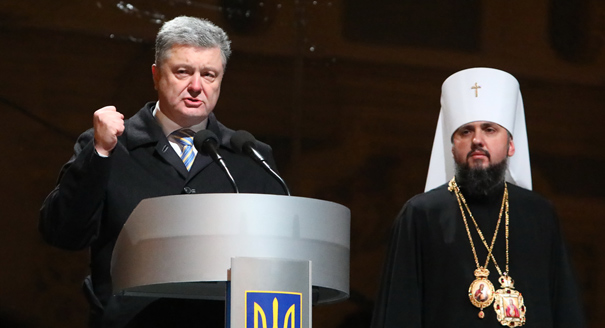
President Poroshenko is making use of the newly created Orthodox Church of Ukraine for political ends. The new church may become a state-sponsored church, while the pro-Moscow church could present itself as a marginalized persecuted entity.
On December 15, Ukraine’s newly independent church, the Ukrainian Orthodox Church (UOC) came into being. The Unification Council, held in Kyiv’s St. Sofia Cathedral, was supposed to mark the conclusion of Ukrainian Orthodoxy’s many years of struggle for separation from Moscow. The significant achievement is already encountering one difficulty, however. No matter how much it can claim historical justice, the church is tainted by being associated with the election campaign of President Petro Poroshenko.
Ukraine’s independence in 1991 caused a schism between Ukrainian Orthodox believers loyal to the Moscow and Kyiv Patriarchates (UOC MP and UOC KP). The Moscow Patriarchate was considered canonical and boasted the largest number of churches (in fact, the current President Petro Poroshenko was one of its adherents). The Kyiv Patriarchate claimed the mantle of the national church and was supported by the Ukrainian government, but lacked international legitimacy. A third church—the breakaway Ukrainian Autocephalous Orthodox Church (UAOC), which dates back to the early twentieth century—was less significant.
The fragile equilibrium between the different churches looked set to endure for decades. Then, conflict with Russia in 2014 radically changed matters, and the government in Kyiv could no longer tolerate the Russian Orthodox Church’s dominance in spiritual matters.
For President Poroshenko, who is running for reelection in 2019 under the national conservative slogan “Army, Faith, Language,” the issue of establishing a unified church has become one of political survival. His declining poll ratings led him to take drastic populist steps. Poroshenko has secured himself a place in Ukrainian history, but his motivations are mainly political.
At the historic council meeting, Poroshenko had a privileged seat and made powerful speeches about the split from Moscow—while incidentally making no mention of Jesus, as the Orthodox writer Sergei Chapnin pointed out. Poroshenko was the man of the hour. A casual observer might have believed that he was the one being elected the head of the church. The president is winning the support of nationalist and conservative voters, whose allegiance he needs to steal from his main rival Yulia Tymoshenko.
Patriarch Filaret has also benefited from the unification. Now aged eighty-nine, a cleric from the Soviet era, he has found his life’s calling in promoting the Ukrainian national autocephalous church. In effect a self-proclaimed Ukrainian patriarch, who was excommunicated by the ROC’s Bishop Council, he has been working for this goal throughout all the years of Ukrainian independence.
Filaret’s ambitions have also clashed with those of Poroshenko. Poroshenko failed to install his own protégé Simeon as head of the unified church. Instead, the thirty-nine-year-old Metropolitan Epifaniy, Filaret’s protégé, who has made his entire career in independent Ukraine, became the head of the new Ukrainian Orthodox Church.
Filaret managed to get his candidate elected after a fierce behind-the-scenes struggle. He will retain the status of “patriarch emeritus” and permanent Synod membership, albeit at the price of effective liquidation of his own patriarchate, which will now be dissolved in the new church. While Poroshenko may still lose the election, Filaret has secured his place in the informal leadership of the Ukrainian church till the end of his life and made sure that the new patriarch will pursue his agenda.
The main issue to be faced by the unified church is that thousands of parishes in Ukraine are still affiliated to the Moscow Patriarchate. The UOC MP’s position is vulnerable. Moderate forces inclined toward compromise with the supporters of autocephaly were defeated. Only two of the ten UOC MP bishops who signed the autocephaly appeal to the Ecumenical Patriarch made it to the Unification Council. Others adopted a wait-and-see attitude.
Hostile rhetoric in Moscow by hierarchs, pushing their Ukrainian colleagues toward confrontation, certainly escalates the tensions. So do repressive steps taken by the Ukrainian authorities, who have been using the Security Service of Ukraine (SBU) to pacify the UOC MP. The situation around Ukraine’s most famous Orthodox holy sites in Kyiv is also becoming potentially explosive. Radical nationalists are proposing that the UOC MP register as “the Russian Orthodox Church in Ukraine,” which will necessitate reregistration of church assets.
Paradoxically, the leading clergy of the Moscow Patriarchate in Ukraine and its head Metropolitan Onufriy find themselves in a completely opposite position to their counterparts of the Russian Orthodox Church. They are now members of a persecuted church that opposes the secular authorities and must rely on its congregations for support. Two-thirds of a congregation is required to ensure that a church transfers to another jurisdiction.
This may lead to a religious revival in the pro-Moscow church, most likely a “counter-renaissance” propagating ultra-conservative values. The struggling Opposition Bloc politicians, who came out of the former Party of Regions and advocate better relations with Moscow, may try to build support defending the “canonical church.”
For its part, the newly created Orthodox Church of Ukraine is now tempted to become the state-sponsored church, as President Poroshenko also wants. Ukrainian political analyst Sergei Rudenko noted that “Poroshenko has accomplished his historical mission. Now it’s very important that, as an informal founder of the Orthodox Church of Ukraine, he doesn’t turn it into one of the departments of the presidential administration.”
The Ukrainian authorities feel an urgent need to create their own version of the ideological solidarity President Putin has described as “spiritual bonds,” so as to counter Russian aggression. The head of the National Security and Defense Council Oleksandr Turchynov (who is a Protestant) recently made waves by assailing “the propaganda of Neo-Marxism, tolerance, and homosexuality” that is corrupting the nation.
This conservative agenda clashes with Ukraine’s declaration of European values, but that puts it in line with other right-wing populist and conservative trends sweeping through Eastern Europe. Nationalizing Orthodox Christianity is part of the same trend. Breaking with Moscow is the beginning of a long process.

An independent journalist.
Recent Work
Konstantin Skorkin
Konstantin Skorkin
Carnegie does not take institutional positions on public policy issues; the views represented herein are those of the author(s) and do not necessarily reflect the views of Carnegie, its staff, or its trustees.

China has showcased its engineering prowess with small modular reactor demonstration projects. But turning these technological achievements into commercial success will be a greater challenge.

Tong Zhao

The Plaza Accord was not an externally imposed punishment of Japan but part of a broader restructuring that Japanese economists and policymakers themselves recognized was necessary. Its effects were undermined, however, when Tokyo responded to the resulting slowdown with policies that exacerbated investment, credit expansion, and the very imbalances the adjustment was intended to resolve.

Michael Pettis
China’s banking crisis in the 2000s was resolved by transferring the costs to households through financial repression—a decision that recapitalized the banks while exacerbating the structural imbalances that continue to shape the Chinese economy today.
Michael Pettis

In the latest Five-Year Plan, the Chinese president cements the shift to an innovation-driven economy over a consumption-driven one.

Damien Ma
Rather than climate ambitions, compatibility with investment and exports is why China supports both green and high-emission technologies.
Mathias Larsen