Source: Nikkei Asian Review
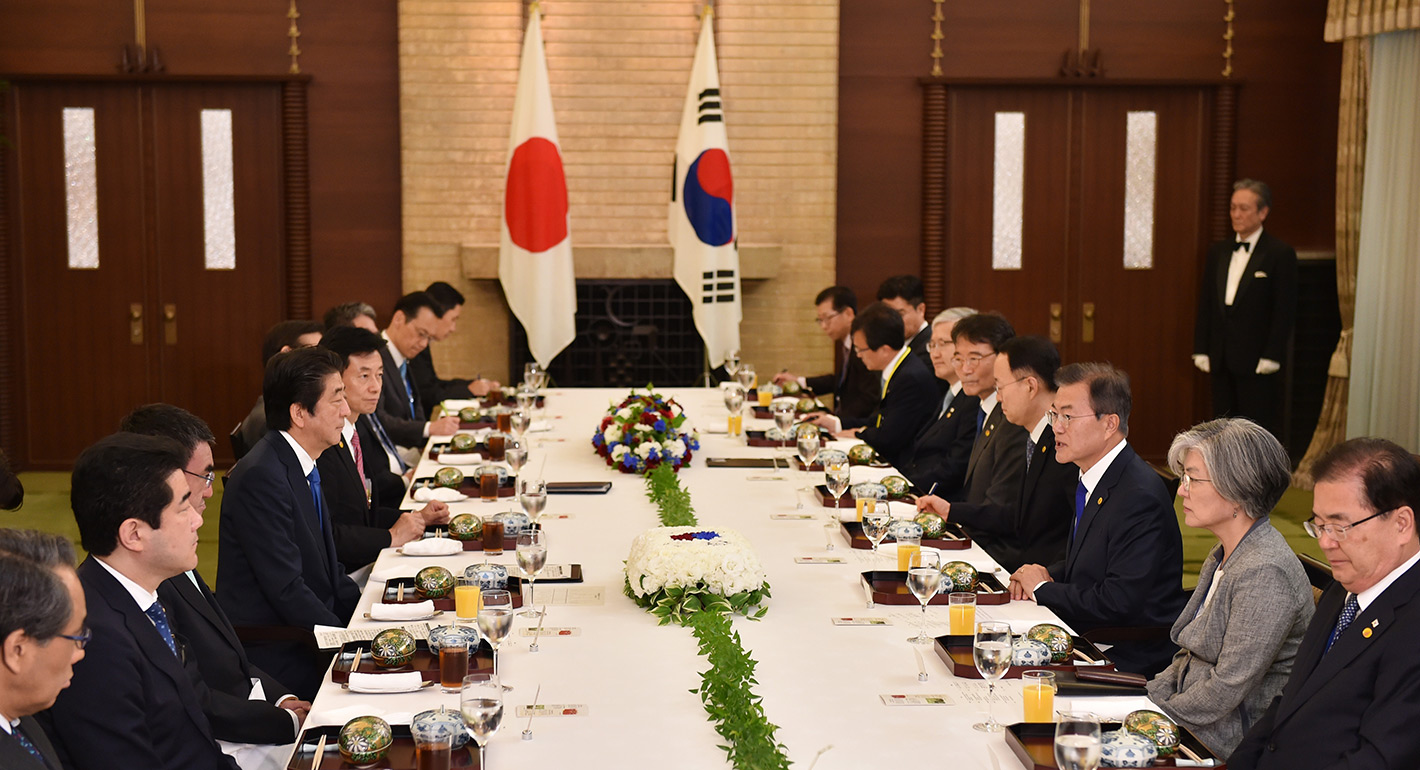
The escalation of tensions between South Korea and Japan seemed inevitable last week before Korean President Moon Jae-in's administration made a surprise decision to postpone withdrawal from a military information-sharing pact with Japan just hours before its November 23 expiration deadline.
The pragmatic decision to remain in the General Security of Military Information Agreement, or GSOMIA, represents a step in the right direction at a critical moment when South Korea, Japan and their ally the U.S. face significant obstacles from China and North Korea to maintaining stability in the region.
Extending GSOMIA was a difficult political decision for Moon. Public opinion remains deeply critical of Japan in the wake of disputes over the issue of laborers forced to work in Japan during Japanese colonial rule. The extension of GSOMIA also came in response to U.S. pressure, and Moon faces negative perceptions of having caved to America.
But despite these political hurdles, Seoul has reintroduced pragmatism into the debate and Tokyo should respond in kind. South Korea made clear that GSOMIA's continuation beyond the current three-month extension is contingent upon Tokyo removing export controls and reinstating South Korea's status as a most-favored trading partner.
To this end, the Moon administration also made another politically unpopular decision to temporarily withdraw its World Trade Organization complaint against Japan, creating space for talks over export control measures to move forward.
Tokyo should capitalize on this opportunity. The two countries have an added incentive to prioritize trilateral cooperation as North Korean leader Kim Jong Un's self-imposed end-of-year deadline for meaningful progress in negotiations with the U.S. looms.
There is still room for diplomacy and North Korea may only be posturing. But if diplomacy does fail, there is also a possibility that it will resume nuclear or long-range missile testing, threatening stability in Northeast Asia. Given the unpredictability of the security environment, South Korea, Japan and the U.S. have renewed urgency for cooperation.
The GSOMIA decision is also a relief for Washington, which places a high value on security cooperation between Japan and South Korea as it competes for influence with China and confronts the North Korean threat.
The U.S. viewed the impending termination of GSOMIA, which the Obama administration spent years negotiating, as a slap in the face and a reason to question Seoul's priorities as a security partner. A U.S. State Department spokesperson captured this view pointedly, describing the move as reflecting "a serious misapprehension on the part of the Moon administration regarding the serious security challenges we face in Northeast Asia."
Terminating the agreement would have exacerbated heightened tensions in the alliance as Seoul confronts negotiations over the Trump administration's excessive demand that it contribute nearly $5 billion to the stationing of U.S. troops on the peninsula -- roughly five times more than it currently does.
The dispute has raised questions about the possibility of U.S. troop withdrawal and what adjustments would need to be made for South Korea to defend itself in the absence of security commitments from Washington. Many of these adjustments would run counter to U.S. goals of stability in the region.
Concerns over the future of the alliance are so potent that they have even fueled calls for South Korea to acquire domestic nuclear weapons, a once fringe conservative opinion that is gaining popularity and justification in the face of Washington's unpredictability.
Though still not a mainstream view, this argument illustrates how Washington's unpredictability is encouraging dangerous solutions that would undermine alliance coordination and raise tensions on the peninsula.
For the U.S. to support pragmatic decision-making between its allies, it must take a more pragmatic approach itself. In addition to reconsidering its unreasonable military-cost demand, Washington should handle mediation between South Korea and Japan more subtly. The very public pressure on South Korea highlighted incongruities in the alliance, which North Korea relishes and seeks to exploit.
Moreover, Washington's timing contributed to a long-held perception in South Korea that the U.S. favors Tokyo over Seoul. Though South Korea called for the U.S. to get involved in the trade dispute, the U.S. only did so when South Korea announced its withdrawal from GSOMIA -- not when Japan imposed export controls.
Neither the perception of favoritism nor the creation of opportunities for North Korea to drive a wedge between allies is constructive for alliance coordination and progress on denuclearization.
The extension of GSOMIA does not guarantee an end to Seoul and Tokyo's trade dispute. Additional obstacles have already emerged over Japan's announcement of the resumption of trade talks, which South Korea complained was "completely different from the content that was coordinated in advance."
Japan's tenuous justification for its decision on the basis of security concerns also makes it difficult for Tokyo to walk back on its export controls. But trade talks will resume, and that is an important step in the right direction.
The relationship between South Korea and Japan has grown substantially closer over the past few decades despite the ebb and flow of harsh political rhetoric in both countries. The priority for Seoul, Tokyo and Washington now should be to focus on strengthening alliances and existing cooperation mechanisms when they are vitally important to maintaining peace and stability in the region.
This article was originally published by Nikkei Asian Review.