

Article
Dalia Ghanem
{
  "authors": [
    "Dalia Ghanem"
  ],
  "type": "legacyinthemedia",
  "centerAffiliationAll": "dc",
  "centers": [
    "Carnegie Endowment for International Peace",
    "Malcolm H. Kerr Carnegie Middle East Center"
  ],
  "collections": [
    "Arab Spring 2.0"
  ],
  "englishNewsletterAll": "menaTransitions",
  "nonEnglishNewsletterAll": "",
  "primaryCenter": "Malcolm H. Kerr Carnegie Middle East Center",
  "programAffiliation": "MEP",
  "programs": [
    "Middle East"
  ],
  "projects": [],
  "regions": [
    "Maghreb",
    "North Africa",
    "Algeria"
  ],
  "topics": [
    "Political Reform"
  ]
}
Source: Getty
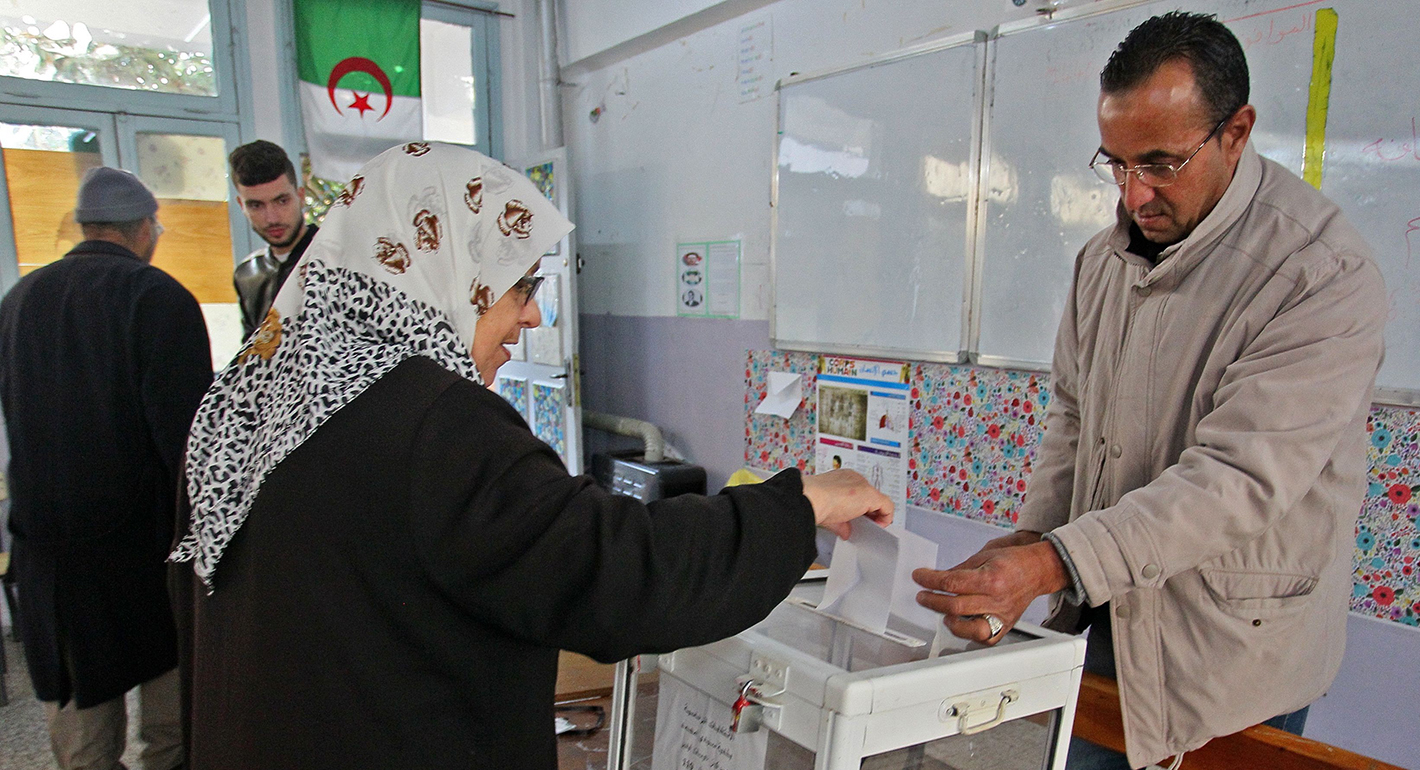
A new president will not mean the end of the old regime rather a continuation of the military involvement in politics.
Source: Middle East Eye
On 10 December, Algerian former Prime Ministers Ahmed Ouyahia and Abdelmalek Sellal were sentenced respectively to 15 and 12 years in prison. Others, among them the ministers of industry, Youcef Yousfi and Mahdjoub Bedda, were sentenced to 10 years in prison, along with several businessmen including Ali Haddad and Hassan Larbaoui .
A few days before, the first-ever televised election debate between the five candidates – all relics of the Bouteflika era – took place in Algeria on 6 December, on the same day protesters held their last Friday rally before the presidential election due on Thursday.
Both these trials and this so-called “historical debate” are masquerades, and many Algerians did not buy into it.
The politico-military leadership has been trying all kinds of subterfuges to convince people that the election is the only way forward and that a vote boycott would constitute a menace to the stability of the country that, according to Chief of Staff Ahmed Gaid Salah, may be "entering the dark tunnel of the constitutional void".
While the presidential elections will undoubtedly be held as planned- it has already started abroad - questions remain about how the regime will manage its ongoing crisis of legitimacy. In other words, what is the regime’s next move in the face of the peaceful and massive mobilisation that is showing no signs of abating.
The regime is confronted today with three options. It can continue to disregard people’s demand and count on the exhaustion of the movement, or it can use coercive measures and severely crackdown on the protesters. Lately the security services have been arresting many opposition activists and political figures, and on the eve of the elections, police violently dispersed demonstrators.
A third option would be to start a negotiation process with the protest movement once a new president is elected. Such a move would allow the politico-military leadership to create a modicum of legitimacy for a president who will be lacking one and also avoid violent repression that might drive the country into a cycle of violence.
The full article was originally published in the Middle East Eye.
Former Senior Resident Scholar, Malcolm H. Kerr Carnegie Middle East Center
Dalia Ghanem was a senior resident scholar at the Malcolm H. Kerr Carnegie Middle East Center in Beirut, where her research focuses on Algeria’s political, economic, social, and security developments. Her research also examines political violence, radicalization, civil-military relationships, transborder dynamics, and gender.
Recent Work
Dalia Ghanem


Frances Z. Brown, Judy Dempsey, Dalia Ghanem, …
Carnegie does not take institutional positions on public policy issues; the views represented herein are those of the author(s) and do not necessarily reflect the views of Carnegie, its staff, or its trustees.
Transactional relationships are stable but can be shallow.



Paul Haenle, Maha Yahya, Benjamin Ho, …

It’s about managing oil prices, bread prices, and strategic partnerships.



Amr Hamzawy, Karim Sadjadpour, Aaron David Miller, …
The murder of George Floyd has underscored the deep inequities that have long plagued American society. In a note to the Carnegie community, Bill Burns reflects on Carnegie’s commitment to build a more just future here at home and around the world, without which peace will remain beyond our grasp.
William J. Burns
While the world hoped this pandemic might lead to more cooperation between these two great powers, American and Chinese leaders instead fell into a blame game and allowed their increasing suspicions to guide their decision-making.
Lyu Jinghua
Biological viruses and computer malware differ in important respects. They have considerable potential to spread widely, invading, disrupting and destroying their targets.

Ariel (Eli) Levite, Lyu Jinghua