

Commentary
But their "principal to principal" model will only be as effective as the political strength of each leader back home.
Damien Ma
{
  "authors": [
    "Frederic Wehrey",
    "Jalel Harchaoui"
  ],
  "type": "legacyinthemedia",
  "centerAffiliationAll": "dc",
  "centers": [
    "Carnegie Endowment for International Peace"
  ],
  "collections": [],
  "englishNewsletterAll": "menaTransitions",
  "nonEnglishNewsletterAll": "",
  "primaryCenter": "Carnegie Endowment for International Peace",
  "programAffiliation": "MEP",
  "programs": [
    "Middle East"
  ],
  "projects": [],
  "regions": [
    "North Africa",
    "Libya"
  ],
  "topics": [
    "Security",
    "Foreign Policy"
  ]
}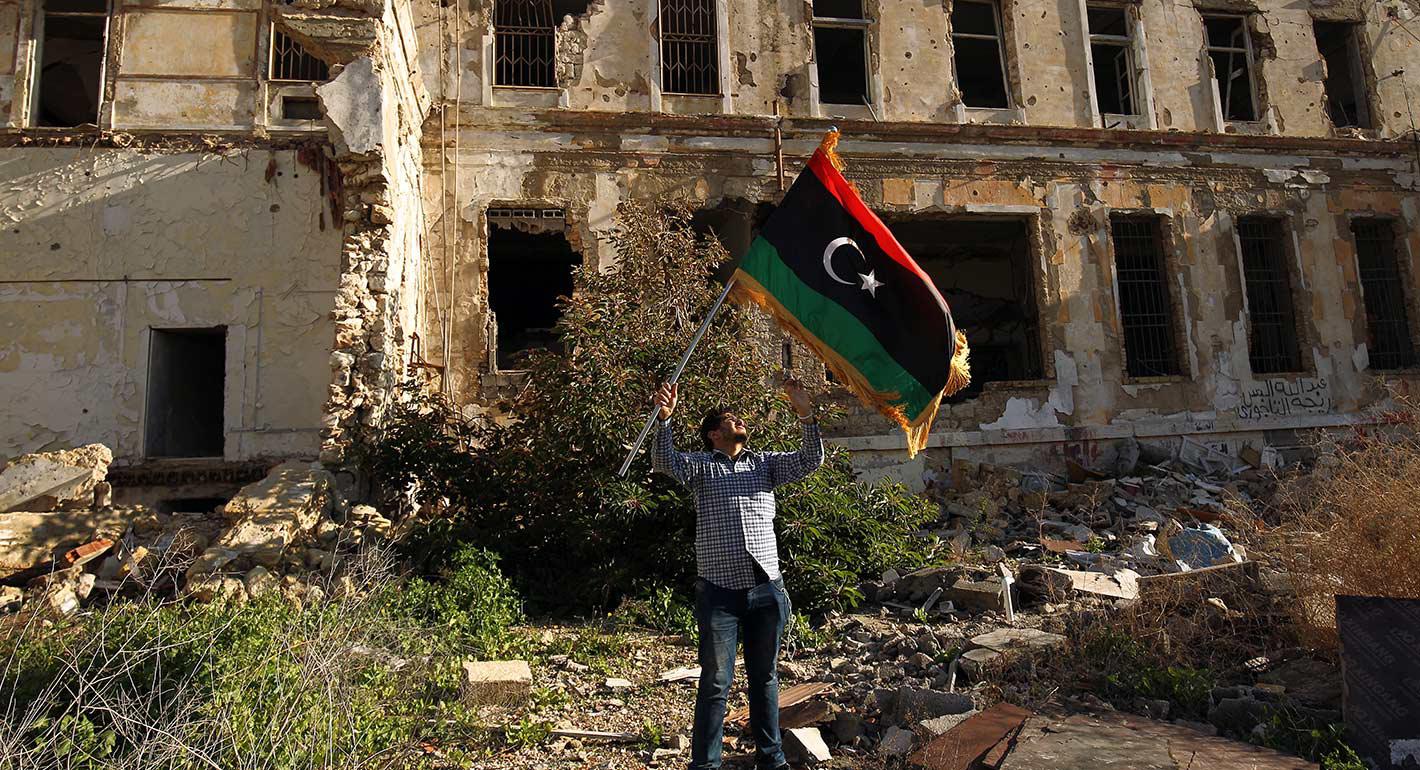
Source: Getty
More robust U.S. diplomacy is urgently needed in Libya, not just to halt Haftar’s destructive campaign but to salvage U.S. credibility in a region marked by multipolarity and increasing defiance of the West.
Source: Foreign Affairs
In April 2019, Khalifa Haftar, the militia commander whose forces control much of eastern Libya, began an assault on the capital, Tripoli, in an effort to topple the country’s internationally recognized Government of National Accord (GNA). But instead of a swift, decisive victory establishing Haftar as Libya’s undisputed leader, the offensive resulted in a stalemate. Militias from across western Libya came together to repel Haftar, slowly pushing his forces back into the southern outskirts of the capital. For the next six months, the fighting ground on like this, with drone strikes, artillery barrages, and mortar fire creating a humanitarian crisis but no clear advantage for either side.
Then, in September, hundreds of Russian mercenaries arrived to support Haftar and shifted the battlefield momentum in his direction. Since 2015, Moscow has been gradually ramping up its engagement in Libya, where it sees economic opportunities and a chance to expand its influence at the expense of Western powers. It now supplies Haftar’s forces with antitank missiles and laser-guided artillery and supports them with paramilitary fighters from the Wagner Group, a shadowy military contractor that does the Kremlin’s bidding in a growing list of countries in Africa and the Middle East. Buoyed by the Russians’ tactical expertise, Haftar’s forces are now making slow territorial gains in the capital—and pushing the war into a new and more dangerous phase.
Senior Fellow, Middle East Program
Frederic Wehrey is a senior fellow in the Middle East Program at the Carnegie Endowment for International Peace, where his research focuses on governance, conflict, and security in Libya, North Africa, and the Persian Gulf.
Jalel Harchaoui
Associate Fellow at the Royal United Services Institute (RUSI).
Jalel Harchaoui is a political scientist specialising in North Africa, with a specific focus on Libya. He worked on the same topics previously at The Global Initiative Against Transnational Organised Crime, a Geneva-based NGO, as well as at the Clingendael Institute, based in The Hague. His research has concentrated on Libya’s security landscape and political economy.
Carnegie does not take institutional positions on public policy issues; the views represented herein are those of the author(s) and do not necessarily reflect the views of Carnegie, its staff, or its trustees.

But their "principal to principal" model will only be as effective as the political strength of each leader back home.

Damien Ma

U.S. unpredictability has allowed China to capitalize on its positioning as the “responsible great power”. Paradoxically, the more China wins the perception game, the more likely expectations will rise for Beijing to deliver not just words but to demonstrate with its deeds.

Chong Ja Ian

Hanoi and Beijing have long treated each other as distant cousins rather than comrades in arms. That might be changing as both sides draw closer to hedge against uncertainty and America’s erratic behavior.

Nguyễn Khắc Giang

Across Asia, China is better positioned to withstand energy shocks from the fallout of the Iran war. Its abundant coal capacity can ensure stability in the near term. Yet at the same time, the country’s energy transition away from coal will make it even less vulnerable during the next shock.
Damien Ma

Malaysia’s chairmanship sought to fend off short-term challenges while laying the groundwork for minimizing ASEAN’s longer-term exposure to external stresses.

Elina Noor