

Commentary
Sana Jaffrey
{
  "authors": [
    "Sana Jaffrey"
  ],
  "type": "commentary",
  "centerAffiliationAll": "dc",
  "centers": [
    "Carnegie Endowment for International Peace"
  ],
  "englishNewsletterAll": "asia",
  "nonEnglishNewsletterAll": "",
  "primaryCenter": "Carnegie Endowment for International Peace",
  "programAffiliation": "AP",
  "programs": [
    "Asia"
  ],
  "regions": [
    "Asia",
    "Southeast Asia",
    "Indonesia"
  ],
  "topics": [
    "Domestic Politics",
    "Democracy"
  ]
}
Source: Getty
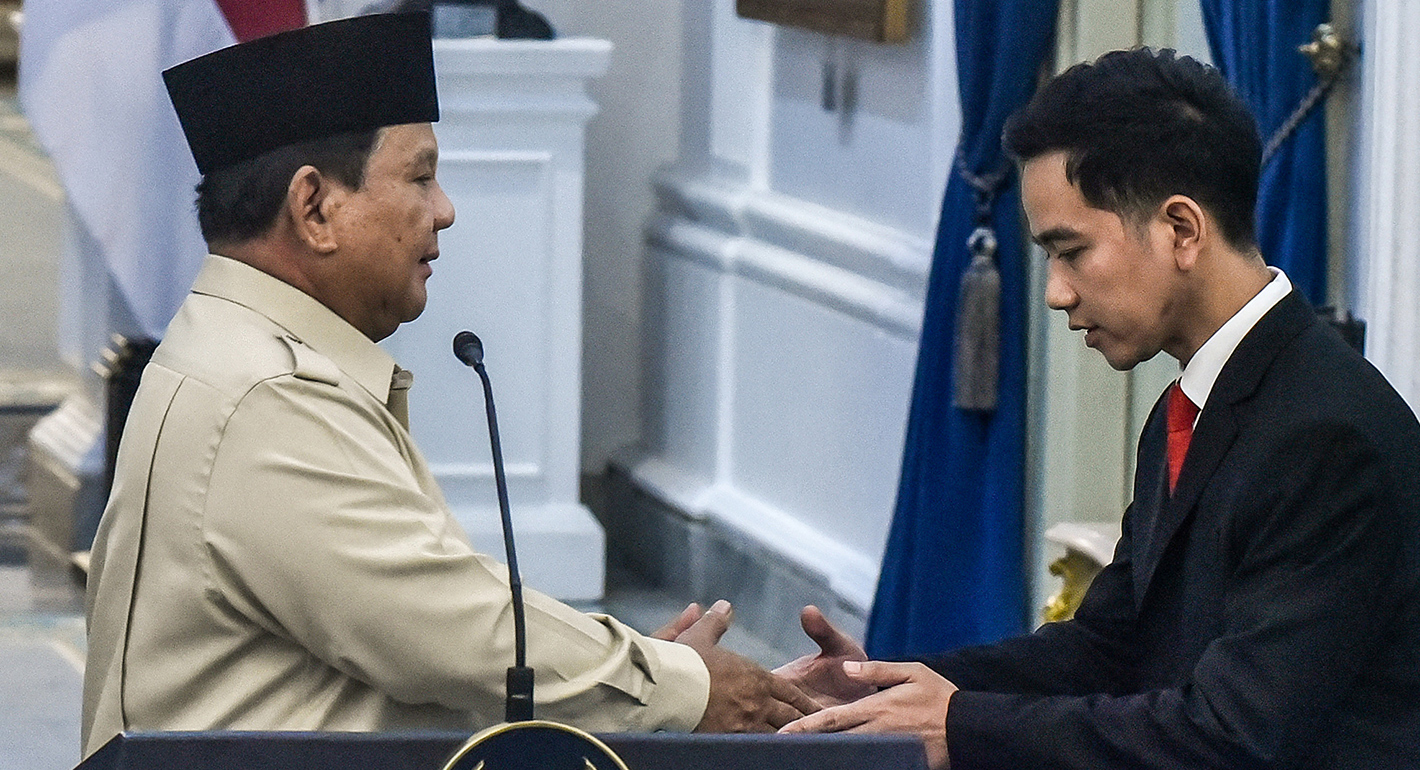
A once-unlikely partnership between President Prabowo and former president Joko Widodo has ended, with important consequences for Southeast Asia’s largest democracy.
Indonesia’s vice president, Gibran Rakabuming Raka, submitted his resignation on November 12 after weeks of controversy over his educational qualifications. His exit forestalled a move to initiate impeachment proceedings supported by all eight parties in the parliament. It also brought into the open the breakdown of the alliance between Gibran’s father, former president Joko Widodo (Jokowi), and the current President Prabowo Subianto.
Prabowo, who had lost two bitterly contested presidential elections to Jokowi, secured his former rival’s backing for the 2024 election by taking Jokowi’s son, Gibran, as his running mate. A highly controversial Constitutional Court ruling cleared the way for the underage Gibran to become Prabowo’s running mate. The pair’s landslide victory owed much to Jokowi’s popularity, as his supporters overwhelmingly backed the ticket. As the sitting president, he also tilted the field in the pair’s favor by deploying welfare funds and coercive tactics during the campaign. For Jokowi, who had unsuccessfully sought a third term and lacked a political party of his own, his son’s vice presidency offered a means of retaining influence after leaving office.
The alliance was tenuous from the beginning, with rumors of private snubs and slights between Jokowi and Prabowo regularly making the rounds among Jakarta’s political elite. Over the past two years, Prabowo has removed or reassigned several of the ministers he retained from Jokowi’s administration. These changes initially appeared consistent with an expected, gradual distancing from his predecessor. Meanwhile, members of the public brought court challenges to Gibran’s educational qualifications. In a political climate where criticism of senior officials, or even of government policy, routinely attracts intimidation, the relative freedom with which these challenges were pursued suggested that there was some tolerance, if not outright backing, from those in power.
In October, however, a rapid succession of events made it clear that the relationship between these former rivals was heading for a split. Prabowo removed police chief Listyo Sigit, whom Jokowi had handpicked to lead the police, and who helped transform the institution into an extension of Jokowi’s personal power by enforcing political loyalty and suppressing opposition. On October 30, the Supreme Court invalidated the administrative recognition of Gibran’s overseas education as equivalent to an Indonesian secondary-school qualification, giving lawmakers grounds for a possible impeachment. Just days later, in a dramatic escalation, Listyo was named a suspect and detained over allegations that he illegally wiretapped the president. Listyo’s close ties to Jokowi fueled speculation about the motives behind the wiretapping and calls from some quarters to investigate the former president’s possible involvement. The twin prospect of a public impeachment and the Jokowi family being drawn into the wiretapping scandal plausibly forced Gibran’s hand.
Throughout these rising tensions, Prabowo stayed publicly above the fray, a posture that reflects both his firm control of institutions and his growing rift with the public. Unlike in the neighboring Philippines, where Vice President Sara Duterte, who was elected on her own mandate, has been able to obstruct impeachment attempts with support from her allies in the Senate, Prabowo’s parliamentary dominance in Indonesia meant he could have seen the impeachment through.
But Prabowo’s public reticence suggested a reluctance to risk a backlash from Jokowi’s supporters, who were critical for his victory. It remains unclear how much influence Jokowi retains among voters. Still, as satisfaction with Prabowo’s performance has fallen to 44.5 percent in October, from over 80 percent a year earlier, largely due to poor governance and economic management, the president can ill afford an open feud with the predecessor whose support helped elect him.
If the split was deliberate, Prabowo’s plummeting popularity raises questions about its timing. However, his ambition to seek re-election in 2029 suggests he saw only a narrow window in which to act. Had it come earlier, it could have risked resistance from the police, given the institution’s perceived loyalty to Jokowi. At present, the police have undergone not only a change of leadership but a mass rotation of officers. Had the split come later, it would have pushed the confrontation closer to the 2029 election, giving Jokowi’s family an opportunity to mobilize sympathy alongside discontent with Prabowo’s governance.
For now, there is little prospect of resistance from Jokowi or his supporters. Nevertheless, the split is likely to have two important consequences for Indonesian politics and the declining state of its democracy.
First, the police’s politicization under Jokowi, and its alleged role in wiretapping Prabowo and his inner circle, could open the door for those who have long argued for curbing the police and strengthening the military’s role instead. Prabowo, a former general who has sought to extend the military’s footprint into governance, yet has previously pledged to maintain the status quo. But if he becomes convinced that the police cannot be trusted, he may be swayed. Second, the police will likely come under pressure to prove its loyalty to Prabowo through increasingly aggressive action against the administration’s opponents and critics precisely when scrutiny of the government is most needed. Indonesia’s beleaguered civil society, which remains the only meaningful source of accountability, may have to bear the brunt of this escalation.
Under Indonesia’s constitution, the president nominates two candidates to fill a vice-presidential vacancy, and the People’s Consultative Assembly, made up of both parliamentary chambers, chooses between them. Given the size of his coalition, there is little doubt that Prabowo will be able to choose a loyal figure who does not harbor presidential ambitions to challenge him in 2029. In this sense, this episode can be seen as a way for Prabowo to consolidate his institutional control further. It allows him to tighten his grip on the security institutions and to showcase unity in parliament. It may also bring the Indonesian Democratic Party of Struggle (PDIP), the only party outside of his coalition, closer to the government, since its opposition stemmed largely from Gibran’s selection as vice president. If PDIP joined the coalition, Prabowo could exercise near-total control of parliament.
What replacing the vice president is unlikely to do is address Prabowo’s real vulnerability: a crisis of governance that is rapidly eroding the huge mandate with which he entered office. If the rift between Prabowo and his voters continues to widen in the run-up to the 2029 elections, it remains to be seen whether party elites will begin distancing themselves and looking for ways to salvage their reputations, or whether Prabowo will instead try to reduce his reliance on voters by reverting to indirect presidential elections as he has previously sought to do.

Nonresident Scholar, Asia Program
Sana Jaffrey is a nonresident scholar in the Asia Program at the Carnegie Endowment for International Peace and is a research fellow at the Australian National University's Department of Political and Social Change.
Recent Work
Sana Jaffrey
Sana Jaffrey
Carnegie does not take institutional positions on public policy issues; the views represented herein are those of the author(s) and do not necessarily reflect the views of Carnegie, its staff, or its trustees.
China’s political future will be shaped between now and next October. As the Communist Party enters its intense “campaign season” to prepare for a major political transition in 2027, reading Beijing's actions and responses may become more difficult as domestic politics weigh on its behavior more than usual.
Damien Ma

The Plaza Accord was not an externally imposed punishment of Japan but part of a broader restructuring that Japanese economists and policymakers themselves recognized was necessary. Its effects were undermined, however, when Tokyo responded to the resulting slowdown with policies that exacerbated investment, credit expansion, and the very imbalances the adjustment was intended to resolve.

Michael Pettis
The nuclear relationship between China and the United States is increasingly shaped by widening perception gaps rather than deliberate strategic design.

Tong Zhao
China’s banking crisis in the 2000s was resolved by transferring the costs to households through financial repression—a decision that recapitalized the banks while exacerbating the structural imbalances that continue to shape the Chinese economy today.
Michael Pettis

Chinese biotech companies have been on the receiving end of U.S. economic coercion. Yet their responses have differed significantly because firm and state interests are not uniformly aligned. For Washington, treating all Chinese tech firms the same, irrespective of their actual interests, risks pushing them farther into Beijing’s corner.

Xue Gong