

Article
China has showcased its engineering prowess with small modular reactor demonstration projects. But turning these technological achievements into commercial success will be a greater challenge.
Tong Zhao
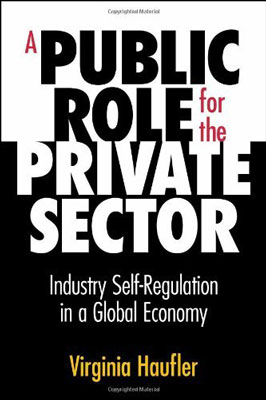
This book explores corporate self-regulation on an international level across three different policy issues—environment, labor, and information privacy.
Source: Washington

Virginia Haufler directed the Project on the Role of the Private Sector in International Affairs at the Carnegie Endowment. She is associate professor at the University of Maryland, College Park.
"Anyone seeking to become better-informed about the changing role of business in the modern world should read this book."
—Debora L. Spar, Harvard Business School
"Breaks new ground in explaining the nature of industry self-regulation in today's globalizing economy. The rich case material makes this book essential reading for understanding the role of business in the 21st century."
—Georg Kell, UN Office of the Global Compact
"Offers a useful framework for assessing the drivers and mechanisms for industry self-regulation and poses a set of questions that policy makers, business leaders, activists, and academics cannot afford to ignore."
—Jane Nelson, International Business Leaders Forum
Former Visiting Scholar
Carnegie does not take institutional positions on public policy issues; the views represented herein are those of the author(s) and do not necessarily reflect the views of Carnegie, its staff, or its trustees.

China has showcased its engineering prowess with small modular reactor demonstration projects. But turning these technological achievements into commercial success will be a greater challenge.

Tong Zhao

The Plaza Accord was not an externally imposed punishment of Japan but part of a broader restructuring that Japanese economists and policymakers themselves recognized was necessary. Its effects were undermined, however, when Tokyo responded to the resulting slowdown with policies that exacerbated investment, credit expansion, and the very imbalances the adjustment was intended to resolve.

Michael Pettis
China’s banking crisis in the 2000s was resolved by transferring the costs to households through financial repression—a decision that recapitalized the banks while exacerbating the structural imbalances that continue to shape the Chinese economy today.
Michael Pettis

In the latest Five-Year Plan, the Chinese president cements the shift to an innovation-driven economy over a consumption-driven one.

Damien Ma

Rather than climate ambitions, compatibility with investment and exports is why China supports both green and high-emission technologies.

Mathias Larsen