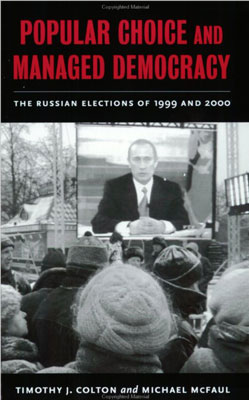
Demonstrates key trends in an extinct superpower, a troubled country in whose stability, modernization, and openness to the international community the West still has a huge stake.
Twice in the winter of 1999-2000, citizens of the Russian Federation flocked to their neighborhood voting stations and scratched their ballots in an atmosphere of uncertainty, rancor, and fear. This book is a tale of these two elections—one for the 450-seat Duma, the other for President. The book also demonstrates key trends in an extinct superpower, a troubled country in whose stability, modernization, and openness to the international community the West still has a huge stake.
Timothy J. Colton is professor of government and Russian studies in the Department of Government and director of the Davis Center for Russian Studies at Harvard University. His previous books include Moscow: Governing the Socialist Metropolis (Harvard, 1995), named best book in government and political science 1995 by the Association of American Publishers.
"This is an excellent book, and an unusually valuable contribution to the growing literature on Russian electoral behavior. It brings together the skills and knowledge of two top scholars of Russian politics, and does so in an accessible, crisply written style. It will be a standard source on this election cycle for a long time."
—Thomas F. Remington, Professor and Chair, Department of Political Science, Emory University
"This is one of those rare books that combines policy relevance with the kind of argumentative rigor that will satisfy even hard-core social scientists. Written by two of the West's best known academic specialists on Russian politics, it is almost certain to become regarded as one the best (if not the best) books on the 1999-2000 election cycle."
—Henry E. Hale, Assistant Professor of Political Science, Indiana University
In addition to his role at Carnegie, McFaul is Peter and Helen Bing Senior Fellow at the Hoover Institution and associate professor of political science at Stanford University.
Carnegie does not take institutional positions on public policy issues; the views represented herein are those of the author(s) and do not necessarily reflect the views of Carnegie, its staff, or its trustees.
The Plaza Accord was not an externally imposed punishment of Japan but part of a broader restructuring that Japanese economists and policymakers themselves recognized was necessary. Its effects were undermined, however, when Tokyo responded to the resulting slowdown with policies that exacerbated investment, credit expansion, and the very imbalances the adjustment was intended to resolve.
China’s banking crisis in the 2000s was resolved by transferring the costs to households through financial repression—a decision that recapitalized the banks while exacerbating the structural imbalances that continue to shape the Chinese economy today.