

Paper
The nuclear relationship between China and the United States is increasingly shaped by widening perception gaps rather than deliberate strategic design.
Tong Zhao
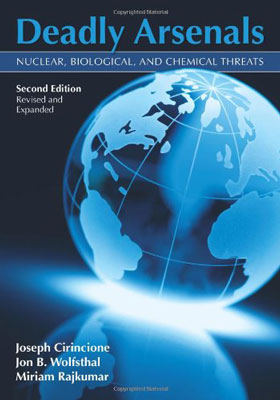
The revised and expanded edition ofDeadly Arsenals provides the most up-to-date and comprehensive assessment available on global proliferation dangers, with a critical assessment of international enforcement efforts.
Source: Washington

The new edition addresses the recent, dramatic developments in Iran, Iraq, Libya, North Korea, and the nuclear black market, analyzing strategic and policy implications.
On July 12, 2005, the authors of this new study presented their findings and then chaired a discussion and debate with experts from the audience. Click here to go to the LIVE AT CARNEGIE site, featuring archived audio and a slideshow presentation with new maps and charts from the book.
About the Authors
Joseph Cirincione previously served as a senior associate and director for Non-Proliferation at the Carnegie Endowment for International Peace, and is coauthor of the major Carnegie report, Universal Compliance: A Strategy for Nuclear Security and editor of Repairing the Regime: Preventing the Spread of Weapons of Mass Destruction (Routledge, 2000).
Jon B. Wolfsthal is former associate and deputy director for non-proliferation at the Carnegie Endowment. He is coauthor of Universal Compliance and coeditor of Nuclear Status Report: Nuclear Weapons, Fissile Material, and Export Controls in the Former Soviet Union (Carnegie/Monterey, 2001).
Miriam Rajkumar is former project associate for nonproliferation at the Carnegie Endowment.
"[A] comprehensive and useful guide to nuclear and CBW proliferation issues, and an essential companion to the SIPRI Yearbook.”
—Pierre-Emmanuel Dupont, Caucasian Review of International Affairs

Former Senior Associate, Director for NonProliferation

Former Nonresident Scholar, Nuclear Policy Program
Jon Wolfsthal was a nonresident scholar with the Nuclear Policy Program.

Former Associate, Non-Proliferation Project
Carnegie does not take institutional positions on public policy issues; the views represented herein are those of the author(s) and do not necessarily reflect the views of Carnegie, its staff, or its trustees.

The nuclear relationship between China and the United States is increasingly shaped by widening perception gaps rather than deliberate strategic design.

Tong Zhao

But their "principal to principal" model will only be as effective as the political strength of each leader back home.

Damien Ma

U.S. unpredictability has allowed China to capitalize on its positioning as the “responsible great power”. Paradoxically, the more China wins the perception game, the more likely expectations will rise for Beijing to deliver not just words but to demonstrate with its deeds.

Chong Ja Ian

For Malaysia, the conjunction that works is “and” not “or” when it comes to the United States and China.

Elina Noor

Regulation, not embargo, allows Beijing to shape how other countries and firms adapt to its terms.

Alvin Camba