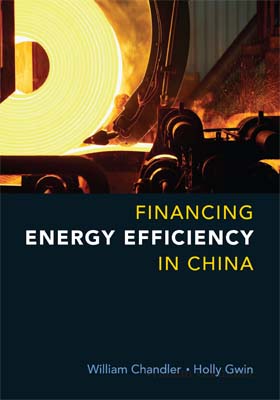
Carnegie's William Chandler argues that reforming China’s financial sector can curb China’s greenhouse gas emissions even as work continues on an international treaty. China’s impressive national policies to promote clean and renewable energy have been undermined by unnecessary financial hurdles and bureaucratic struggles that increase financial risks and costs for potential investors.
As delegates in Bali struggle to agree on a climate change treaty, a new report from the Carnegie Endowment argues that reforming China’s financial sector can curb China’s greenhouse gas emissions even as work continues on an international treaty. China’s impressive national policies to promote clean and renewable energy have been undermined by unnecessary financial hurdles and bureaucratic struggles that increase financial risks and costs for potential investors.
In Financing Energy Efficiency in China, leading climate expert and Carnegie Senior Associate William Chandler argues that restrictions on debt financing and foreign equity investment, unfavorable tax policies, and even the United Nations’ emissions trading system all discourage foreign investment in clean energy in China.
Chandler concludes that to encourage investment in clean energy, China should:
Exempt clean energy investments from foreign exchange, foreign-invested enterprise, and industrial policy controls
provide tax exemptions for clean energy companies and services—particularly in regards to the value added tax (VAT), which sucks up 17 percent of total revenues
make risk-based clean energy lending more worthwhile for banks
provide loan guarantees for energy-efficiency projects in China
reduce required paperwork for clean energy investment; and
address restrictions created through the emissions trading system that actually increase risk to investors.
“Removing barriers to clean energy investment in China is an essential step toward climate protection. The incentives and rules of a global climate treaty will be blunted and frustrated by distortions of the world’s largest potential clean energy marketplace unless policy makers recognize and deal with the realities of that market,” argues Chandler.
Click on the links above for the full text of this Carnegie report.
About the Authors William Chandler is a senior associate at the Carnegie Endowment and director of Energy and Climate Program. Chandler has spent over 35 years working in energy and environmental policy and was a lead author for the Nobel Prize winning Intergovernmental Panel on Climate Change. He is president of Transition Energy, co-founder of DEED China, and founder and former director of Advanced International Studies at the Joint Global Change Research Institute. Chandler received the 1992 Champion of Energy-Efficiency Award from the American Council for an Energy Efficient Economy for his work. In 1999, he received the first Global Climate Leadership Award from the International Energy Agency. He has authored or co-authored ten books which have been favorably reviewed by scholarly and popular critics and translated into several foreign languages.
Holly Gwin is general counsel and co-founder of Transition Energy. Gwin served six years in the Clinton administration as general counsel and staff director of the White House Office of Science and Technology Policy, where she reported directly to the President’s science advisor. She also worked as staff director of the President’s Commission on Gulf War Veteran’s Illnesses, and previously served as General Counsel of the U.S. Congress Office of Technology Assessment. Gwin has published widely in science policy. She holds a law degree from the University of Tennessee and is a member of the District of Columbia Bar.
Former Adjunct Senior Associate, Energy and Climate Program
Chandler is a leading expert on energy and climate. As an adjunct senior associate in the Energy and Climate Program he supports Carnegie’s work in these fields, collaborating closely on projects with Carnegie’s offices in Moscow, Beijing, Brussels, and Beirut.
Carnegie does not take institutional positions on public policy issues; the views represented herein are those of the author(s) and do not necessarily reflect the views of Carnegie, its staff, or its trustees.
The Plaza Accord was not an externally imposed punishment of Japan but part of a broader restructuring that Japanese economists and policymakers themselves recognized was necessary. Its effects were undermined, however, when Tokyo responded to the resulting slowdown with policies that exacerbated investment, credit expansion, and the very imbalances the adjustment was intended to resolve.
The nuclear relationship between China and the United States is increasingly shaped by widening perception gaps rather than deliberate strategic design.
China’s banking crisis in the 2000s was resolved by transferring the costs to households through financial repression—a decision that recapitalized the banks while exacerbating the structural imbalances that continue to shape the Chinese economy today.
Chinese biotech companies have been on the receiving end of U.S. economic coercion. Yet their responses have differed significantly because firm and state interests are not uniformly aligned. For Washington, treating all Chinese tech firms the same, irrespective of their actual interests, risks pushing them farther into Beijing’s corner.
China’s latest energy plan explicitly calls for integrating data centers into the electricity system, particularly connecting them to green energy. It appears Beijing wants to use compute as a source of domestic demand to absorb renewables excess capacity.