
• Commentary
  • Research
  • Experts
  • Events
Carnegie China logoCarnegie lettermark logo
Rising Tension Between North and South Korea

Source: Getty

Article

Rising Tension Between North and South Korea

While tensions are rising on the Korean Peninsula and forecasting the North Korean leadership’s next steps is difficult, none of the parties involved have any interest in further escalation.

Link Copied
By Vladimir Dvorkin
Published on May 27, 2010

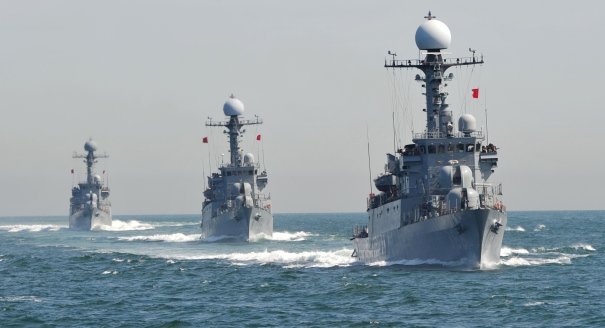
The rising tension on the Korean Peninsula sparked by the torpedoing of a South Korean military vessel, which evidence suggests was committed by North Korea, once more demonstrates the unpredictable nature of Kim Jong Il’s political regime.

The incident makes forecasting the North Korean leadership’s next steps difficult. Are further military provocations likely, or will the situation be limited to belligerent rhetoric? Much will depend on the positions taken by China and Russia. However, the harsh response from the United States, coupled with South Korea’s decision to suspend humanitarian aid to North Korea, leaves little chance for a rapid settlement of the conflict.

It is hard to say what type of sanctions the UN Security Council might impose on North Korea, or how Pyongyang may react. No one has an interest in further escalation, much less outright military conflict—not least North Korea, given its severe economic difficulties.

But the latest crisis deals a heavy blow to the six-party talks on defusing the North Korean nuclear situation and to the nuclear nonproliferation regime in general. No one knows for certain what North Korea has at its disposal: nuclear warheads that could be fitted to its Nodong or other ballistic missiles, or more primitive nuclear devices that could, for example, be delivered by ship to the coast of Japan or South Korea.

But it is impossible to rule out that Kim Jong Il, if backed into a corner, could take extreme measures. Attempts to resolve the conflict must keep this danger in mind. 

Vladimir Dvorkin is a Carnegie Moscow Center expert on nuclear security.

About the Author

Vladimir Dvorkin

Major General Dvorkin (retired) is a chief researcher at the Center for International Security at the Institute of World Economy and International Relations.

Vladimir Dvorkin

Major General Dvorkin (retired) is a chief researcher at the Center for International Security at the Institute of World Economy and International Relations.

East AsiaSouth KoreaNorth KoreaAsiaNuclear Policy

Carnegie does not take institutional positions on public policy issues; the views represented herein are those of the author(s) and do not necessarily reflect the views of Carnegie, its staff, or its trustees.

More Work from Carnegie China

  • An aerial view shows containers stacked at a port in Taicang, in eastern China's Jiangsu province on May 18, 2025.
    Commentary
    How to Predict China’s Economic Performance for 2025: A Sectoral Approach

    GDP growth means something fundamentally different in China than in most countries.

      Michael Pettis

  • People wave Chinese flags as the plane carrying Chinese President Xi Jinping arrives for a two-day state visit at Hanoi's Noi Bai International Airport in Hanoi on April 14, 2025
    Article
    How Southeast Asia Sees Xi Jinping’s Regional Push Amid U.S.-China Tensions

    The Trump administration’s effort to reshape the global trading system and reset overseas security commitments is creating an historic inflection point.  Less clear is how far China will be able to capitalize on these dynamics.

      • +1

      Li Mingjiang, Le Hong Hiep, Ngeow Chow Bing, …

  • Article
    Northeast Asia Is for Deterrence and Southeast Asia Is (Mostly) for Freeriding: Appreciating Divergent East Asian Approaches to Order, Uncertainty, and Contestation

    Most Southeast Asian states behave as if the actions of their Northeast Asian neighbors and the Philippines will be sufficient to maintain a regional status quo from which they can benefit.

      Chong Ja Ian

  • Commentary
    Beyond the Putin-Kim Alliance: How Can the International Community Engage China to Contain Nuclear Risks Over the Korean Peninsula?

    Faced with an increase in strategic maneuvering by Moscow and Pyongyang, Beijing will not sit idly by and allow Putin and Kim to shape the security environment on its behalf.

      Tong Zhao

  • Collection
    China Through a Southeast Asian Lens

    A Q&A series where we ask scholars from Southeast Asia for their insights on China’s influence and relations with the region. 

Get more news and analysis from
Carnegie China
Carnegie China logo, white
  • Research
  • About
  • Experts
  • Events
  • Contact
  • Careers
  • Privacy
  • For Media
Get more news and analysis from
Carnegie China
© 2026 Carnegie Endowment for International Peace. All rights reserved.






