

Paper
Douglas H. Paal
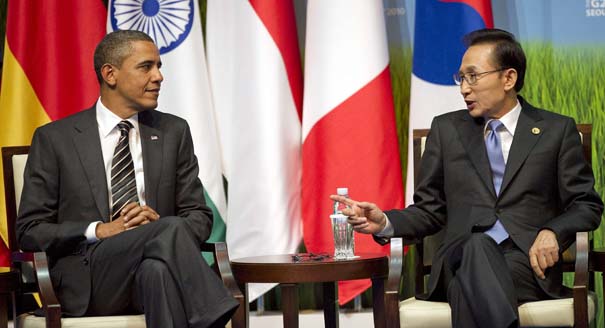
Source: Getty
The Obama administration will use an upcoming series of high-level diplomatic meetings to try to redirect relations with China in a more positive direction and move beyond recent tensions in the bilateral relationship.
Last week, the Obama administration seized the opportunity of a visit by the Chinese official most directly responsible for daily dealings with the United States to try to redirect relations with China in a more positive direction from the bumpy course of the past few months. Vice Minister of Foreign Affairs Cui Tiankai was told during his Washington stay that the two sides should now focus on how to make next year’s visit to the United States by Chinese President Hu Jintao a success.
This effort by the Obama team to send a consistent, upbeat message to Vice Minster Cui is intended to pull United States–China relations out of the contest of wills that media and officials in both countries have been making of it. U.S. frustration and disappointment have run high over China’s unwillingness to separate itself from North Korea’s sinking of the South Korean corvette Cheon’an. Joint U.S.–South Korean exercises to deter further aggression by Pyongyang produced vocal Chinese warnings against exercising in the Yellow Sea. Then, Secretary of State Hillary Clinton’s warning against unilateral attempts to change the status of claims in the South China Sea produced another round of recriminations.
Emerging from this round of charges and countercharges with neither side having yielded to the other, Obama’s Asia team is seeking to persuade China to accentuate the positive through a series of upcoming exchanges. The first will be this coming weekend, when Deputy National Security Advisor Thomas Donilon and National Economic Council Advisor Lawrence Summers lead a small delegation to Beijing.
Donilon and Summers are very high ranking officials in the U.S. system and can be expected to be received at appropriately high levels in China. They are likely to use this visit to disabuse China’s leadership of any notions of new American hostility, while expressing resolution to pursue vigorously and prudently U.S. maritime, defense, and other interests in the region. Summers will have the particularly challenging responsibility to convince the Chinese that America’s best economic days are not behind it and that Obama is putting the U.S. economy back on track after the regulatory and other failures of the past few years.
The two will also try to flesh out the possibilities for what can be achieved during the state visit by President Hu. This trip is a chance for both sides to display their “wish lists.”
Early indications are that China’s officials are receptive to the Obama initiative to put relations on a positive course and will try to redirect Chinese public attention away from the negative chorus of the past months. It will be interesting to observe whether China will follow past precedent and try to portray the Donilon-Summers visit as a U.S. concession to which China is responding graciously. Another alternative would be for the United States to say that sending Vice Minister Cui to Washington indicated Beijing made the first concession. Good diplomacy, of course, will avoid having either side play the game of who “cried uncle” first.
The next four months will produce a sequence of opportunities to reset the relationship. Premier Wen Jiabao will attend the UN General Assembly in New York in late September and President Obama is expected to meet with him bilaterally to press the U.S. agenda—from international finance, to bilateral trade issues, to sanctions on Iran.
Senior officials from Commerce will travel to Beijing in October to participate in the Joint Committee on Commerce and Trade. This is the primary venue for resolving thorny trade issues short of taking them to arbitration by the World Trade Organization’s contentious dispute mechanism. The growing list of issues being raised by the U.S. business community about obstacles in the Chinese market would be a natural focus, as the United States urges China to demonstrate good intentions through positive remedies.
There will be an ASEAN defense ministers’ meeting in October in Hanoi, where Vietnam’s ostensibly neutral territory could permit a tentative renewal of strained military-to-military ties between U.S. and Chinese defense officials. Chinese officers have recently discussed holding Defense Consultative Talks in Washington this fall at the level of undersecretary for political affairs. And a visit to China by Defense Secretary Robert Gates should not be ruled out before the end of the year. U.S. officials are arguing to the Chinese that stable military relations are a prerequisite for potential strategic partners and a positive state visit.
In November, Presidents Hu and Obama themselves will meet on the margins of the APEC Leaders’ Meeting in Yokohama and at the G20 meeting in South Korea. Again, the two will have an interest in advancing positive movement on their issues, especially with President Hu preparing to make his last state visit to the United States before he leaves office an important part of his political and foreign policy legacy.
There will be other exchanges at various official levels that are too numerous to list here, but which will form the elements of the “positive, cooperative, and comprehensive” relationship promised during President Obama’s state visit to Beijing in November 2009. If the U.S. effort to set a positive course takes hold, the two leaders can sum up the results and give instructions to take it forward from the winter summit in Washington to the Strategic and Economic Dialogue in late May or early June of next year.

Distinguished Fellow, Asia Program
Paal previously served as vice chairman of JPMorgan Chase International and as unofficial U.S. representative to Taiwan as director of the American Institute in Taiwan.
Recent Work
Douglas H. Paal


Douglas H. Paal, Tong Zhao, Chen Qi, …
Carnegie does not take institutional positions on public policy issues; the views represented herein are those of the author(s) and do not necessarily reflect the views of Carnegie, its staff, or its trustees.

China’s political future will be shaped between now and next October. As the Communist Party enters its intense “campaign season” to prepare for a major political transition in 2027, reading Beijing's actions and responses may become more difficult as domestic politics weigh on its behavior more than usual.

Damien Ma

China has showcased its engineering prowess with small modular reactor demonstration projects. But turning these technological achievements into commercial success will be a greater challenge.
Tong Zhao

The Plaza Accord was not an externally imposed punishment of Japan but part of a broader restructuring that Japanese economists and policymakers themselves recognized was necessary. Its effects were undermined, however, when Tokyo responded to the resulting slowdown with policies that exacerbated investment, credit expansion, and the very imbalances the adjustment was intended to resolve.

Michael Pettis

The nuclear relationship between China and the United States is increasingly shaped by widening perception gaps rather than deliberate strategic design.
Tong Zhao
China’s banking crisis in the 2000s was resolved by transferring the costs to households through financial repression—a decision that recapitalized the banks while exacerbating the structural imbalances that continue to shape the Chinese economy today.
Michael Pettis