• Commentary
  • Research
  • Experts
  • Events
Carnegie China logoCarnegie lettermark logo
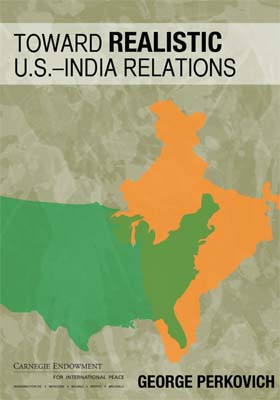
Toward Realistic U.S.–India Relations
Report

Toward Realistic U.S.–India Relations

Near-term expectations for a partnership between the United States and India too often overlook how the interests, policies, and diplomatic style of the two countries sometimes diverge.

Link Copied
By George Perkovich
Published on Oct 25, 2010

Additional Links

Full Text

As President Obama prepares to visit India next month, he faces criticism that his administration has done too little to enhance U.S.-India relations. George Perkovich argues that expectations for a partnership between the two countries in the near term are unrealistically high and overlook how their interests, policies, and diplomatic style will often diverge. U.S. policy cannot do much to help India’s rise, but it can inflict major damage on global problem-solving efforts if it defers too readily to the narrow, often mercantile demands of the current relationship. 

Key Conclusions

  • Interests are divergent. Careful analysis of U.S. and Indian interests does not show a close convergence in some key areas, and in cases such as China, Pakistan, and Afghanistan, they differ in how to pursue shared interests even when both states benefit from each other’s successes.
     
  • Democracy can divide. Shared democracy is said to make the United States and India “natural allies,” but domestic politics and economics often keep each state from adopting policies that would befit a partnership. 
     
  • Bilateral relations should not be used to contain China. Emphasizing military competition with China, as some do, is counterproductive. For the foreseeable future, the United States, India, and China will operate in a triangular relationship that mixes cooperation with competition and pressure and none will be close partners of the others. Economic development and effective governance are the keys to countering China’s rising strength. 
     
  • Nuclear energy cannot transform the relationship. The civil nuclear cooperation agreement between the two countries has not turned the relationship into a partnership, as envisioned. But it has undermined U.S. leadership credibility in trying to strengthen the global nonproliferation regime.
     
  • Global problem solving is the priority. The United States can contribute only marginally to India’s success or failure. Washington should focus on global issues—such as trade, nuclear security, peace in Asia, and climate change—that will also affect India’s longer-term interests.

“Rather than maintaining the pretense of partnership, a truly pro-India policy would acknowledge that India has different near-term needs and interests as a developing country than does the United States, even as it recognizes that each will benefit in the long run from the success of the other,” writes Perkovich. “Most of what the U.S. government can do for India lies in the broader global arena, and most of what India needs at home it must do for itself.”

 

About the Author

George Perkovich

Japan Chair for a World Without Nuclear Weapons, Senior Fellow

George Perkovich is the Japan Chair for a World Without Nuclear Weapons and a senior fellow in the Carnegie Endowment for International Peace’s Nuclear Policy Program. He works primarily on nuclear deterrence, nonproliferation, and disarmament issues, and is leading a study on nuclear signaling in the 21st century.

    Recent Work

  • Paper
    How to Assess Nuclear ‘Threats’ in the Twenty-First Century

      George Perkovich

  • Commentary
    “A House of Dynamite” Shows Why No Leader Should Have a Nuclear Trigger

      George Perkovich

George Perkovich
Japan Chair for a World Without Nuclear Weapons, Senior Fellow
George Perkovich
North AmericaUnited StatesSouth AsiaIndiaForeign PolicyNuclear PolicyNuclear Energy

Carnegie does not take institutional positions on public policy issues; the views represented herein are those of the author(s) and do not necessarily reflect the views of Carnegie, its staff, or its trustees.

More Work from Carnegie China

  • Commentary
    China Sells Stability Amid American Volatility

    U.S. unpredictability has allowed China to capitalize on its positioning as the “responsible great power”. Paradoxically, the more China wins the perception game, the more likely expectations will rise for Beijing to deliver not just words but to demonstrate with its deeds.

      Chong Ja Ian

  • Vietnam's Top Leader To Lam meets with young representatives from China and Vietnam participating in the "Red Study Tours" at the Great Hall of the People on April 15, 2026 in Beijing, China. T
    Commentary
    Why Vietnam Is Swinging in China’s Direction

    Hanoi and Beijing have long treated each other as distant cousins rather than comrades in arms. That might be changing as both sides draw closer to hedge against uncertainty and America’s erratic behavior.

      • Nguyen-khac-giang

      Nguyễn Khắc Giang

  • Commentary
    China’s Energy Security Doesn’t Run Through Hormuz but Through the Electrification of Everything

    Across Asia, China is better positioned to withstand energy shocks from the fallout of the Iran war. Its abundant coal capacity can ensure stability in the near term. Yet at the same time, the country’s energy transition away from coal will make it even less vulnerable during the next shock.


      • Damien Ma

      Damien Ma

  • Commentary
    Malaysia’s Year as ASEAN Chair: Managing Disorder

    Malaysia’s chairmanship sought to fend off short-term challenges while laying the groundwork for minimizing ASEAN’s longer-term exposure to external stresses.

      Elina Noor

  • Commentary
    When It Comes to Superpower Geopolitics, Malaysia Is Staunchly Nonpartisan

    For Malaysia, the conjunction that works is “and” not “or” when it comes to the United States and China.

      Elina Noor

Get more news and analysis from
Carnegie China
Carnegie China logo, white
Keck Seng Tower133 Cecil Street #10-01ASingapore, 069535Phone: +65 9650 7648
  • Research
  • About
  • Experts
  • Events
  • Contact
  • Careers
  • Privacy
  • For Media
Get more news and analysis from
Carnegie China
© 2026 Carnegie Endowment for International Peace. All rights reserved.