

Paper
- +4
Dmitri Trenin, Alexey Arbatov, Maria Lipman, …
Source: Getty
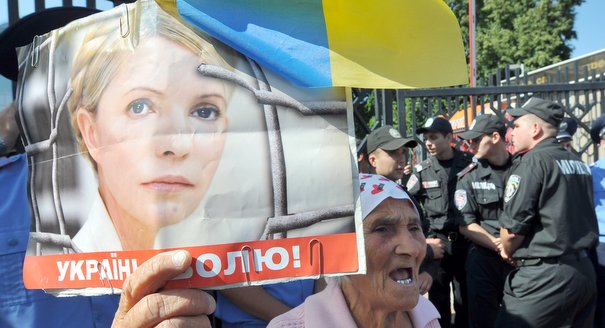
By arresting former Prime Minister Yulia Tymoshenko, the Ukrainian authorities were trying to both weaken the domestic opposition and get Moscow to soften its stance on the gas prices. They appear to have failed to achieve either objective.
By arresting former prime minister Yulia Tymoshenko, the current Ukrainian authorities were pursuing two aims at once. The first was a domestic political objective: to remove the most influential opposition leader at a time of increasing social and economic difficulty. With Ukraine scheduled to hold a parliamentary election next year and President Viktor Yanukovych’s popularity not particularly high, this looked like a perfect tactic to help the Party of Regions secure control of the new parliament.
The second goal was foreign policy related. Tymoshenko was charged with abuse of power for signing gas contracts with Russia. The Ukrainian authorities have implied that the unfolding criminal case against her could also bring to the surface unwelcome details involving the Russian authorities; there was even talk that Russian Prime Minister Vladimir Putin could be called as a witness. Kiev seemed to think that the Kremlin’s desire to avoid scandal would make Moscow soften its position and perhaps make concessions on Ukraine’s key demand—that Russia lower the price of its gas supplies to the country.
In reality, it looks as though Yanukovych and his team have achieved neither their domestic nor foreign policy goals by arresting Tymoshenko. Placing the country’s most prominent opposition leader into custody unexpectedly brought groups out into the streets in protest, even though her popularity had been on the decline since the 2010 presidential election. The rough tactics employed by the ruling Party of Regions may at least temporarily inject new energy into the opposition.
Given that no serious legal arguments against Tymoshenko have been forthcoming, people in Ukraine and abroad see her arrest as exclusively politically motivated. Her former partners in the gas talks in Moscow and leading Western governments have all reacted negatively to her arrest. This is a complication that the Ukrainian authorities, currently trying to expand their trade and economic ties with the West, do not need.
In terms of putting pressure on Moscow, Yanukovych’s recent meeting with Russian President Dmitry Medvedev in Sochi showed that the tactic has failed here too. Although the Russian president did not raise the issue of Tymoshenko’s arrest at the meeting, he also refused to revise the gas price, because of Kiev’s unwillingness to give its approval to Gazprom’s acquisition of Ukraine’s Naftogaz.
The big question now is how Yanukovych and his team will extract themselves from this awkward situation. Will they push forward to the bitter end and try to shut Tymoshenko out of Ukrainian political life regardless of the cost, or will they assess the potential damage and back down, finding some convenient pretext for letting Tymoshenko go free?
Time will soon provide the answer.
Former Scholar-in-Residence, The East East: Partnership Beyond Borders Program, Moscow Center
Ryabov was chair of the Carnegie Moscow Center’s East East: Partnership Beyond Borders Program. He is also the chief editor of the journal World Economy and International Relations and a leading researcher at the Russian Academy of Sciences’ Institute of World Economy and International Relations.
Recent Work
Dmitri Trenin, Alexey Arbatov, Maria Lipman, …
Andrei Ryabov
Carnegie does not take institutional positions on public policy issues; the views represented herein are those of the author(s) and do not necessarily reflect the views of Carnegie, its staff, or its trustees.