

Commentary
Transactional relationships are stable but can be shallow.
- +1
Paul Haenle, Maha Yahya, Benjamin Ho, …
Source: Getty
Mitigating the repercussions of climate change in Kuwait is crucial for lessening economic disparities and achieving social justice.
Located in one of the world’s hottest regions, with an economy that is reliant largely on the production of hydrocarbons, Kuwait presents a critical case study in the effects of climate change, particularly for specific sectors of the population. Though the country boasts a relatively high Gross Domestic Product per capita, wealth is not distributed equally. Furthermore, global warming and extreme weather disproportionately affect those people in areas marked by weak infrastructure and little government aid, with conditions likely to become even more severe in the future. The bidun jinsiyya, or those without citizenship, often referred to simply as the bidun, are arguably the most vulnerable. For this reason, mitigating the repercussions of climate change in Kuwait is not only necessary for its own sake, but also for lessening economic disparities and achieving some measure of social justice.
The bidun population comprises tens if not hundreds of thousands of lifelong yet stateless residents of Kuwait. (This category of people is found across the oil-wealthy rentier states of the Gulf.) Bidun residents experience a form of internal displacement within a wealthy (and largely) urban landscape; they are administratively invisible yet materially exposed. Their situation underscores how legal marginalization and climate vulnerability intersect, producing a spatial precarity that is neither accidental nor temporary. It is a state of affairs that is structurally embedded in Kuwait’s management of citizenship and welfare.
In Kuwait, to obtain “original” citizenship, people are required to trace their roots to the country as far back as 1920. Following independence in 1961, new legislation allowed for the naturalization of Kuwaitis who did not have documentary evidence of their families’ having settled in Kuwait by 1920. At the time, this was approximately one-third of the resident population, and consisted primarily of Kuwaitis of tribal origin whose families had not sedentarized by 1920. Nonetheless, to this day, there remains a large number of bidun, who are legally distinct from the country’s population of foreign workers.
The bidun have been classified as illegal residents since 1986. This status renders them incapable of obtaining Kuwaiti citizenship.
Unable to vote in parliamentary elections, legally prevented from forming nongovernmental organizations, and excluded from the handsome government benefits that Kuwaiti citizens enjoy, the bidun have been classified as illegal residents since 1986. This status renders them incapable of obtaining Kuwaiti citizenship, which complicates employment opportunities for members of the community. One interviewee complained that jobs for bidun are few and far between, and that, because salaries rarely rise above the bare minimum, it is difficult for one to afford to pay rent.1 Others lamented their inability to buy property or even register vehicles due to their status.2
Between September 2024 and December 2025, the Kuwaiti government stripped some 50,000 Kuwaitis of their citizenship, arguing that they had obtained it illegally. In October 2025, the authorities overrode Article 8 of the Kuwaiti Nationality Law,* which allowed non-Kuwaiti wives of Kuwaiti men to be naturalized, and applied it retroactively, thereby once again augmenting the numbers of bidun overnight. And in February 2026, the government passed an amended citizenship law. The details of the law have not yet been released, but the government’s justification for such new legislation is telling. The new law “stems from the importance of regulating citizenship as a pillar of state sovereignty, and from a commitment to preserving Kuwait’s national identity, strengthening national affiliation and maintaining Kuwait’s legal sovereignty in all nationality matters.” It seems likely that the state will use this law to, among other things, revoke certain people’s Kuwaiti citizenship.
Earlier, the state had made some efforts to address the community’s grievances. The Central System to Resolve Illegal Residents’ Status was created in 2010 as a means of helping bidun to prove their familial roots in Kuwait or, alternatively, to obtain identity cards that would grant them access to education, healthcare, drivers’ licenses, and employment opportunities. Results, however, have been mixed. Several interviewees for this article cited government programs through the Central System, which allow bidun to join the military or to attend university, as those most helpful to them.3 Such programs represent the sole opportunity for many members of the community to secure reliable and gainful employment as well as obtain access, however limited, to the state’s social welfare networks. Nevertheless, as one interviewee pointed out, “Major obstacles remain, such as documentation restrictions, limited access to higher education, and [an] inability to obtain essential civil certificates.”4
Because not all have registered with the Central System—many fear that doing so could subject them to increased government surveillance—the total number of bidun is unknown. Estimates range from 83,000 to 180,000 people in a country with a population estimated at just over 5.2 million (including foreign workers). Moreover, obtaining an identity card from the government through the Central System equates to formally renouncing any claim to citizenship. As Claire Beaugrand has pointed out, this “forces bidūn to accept un-belonging to acquire identification papers, without which they cannot interact with the rest of Kuwait’s government bodies.”
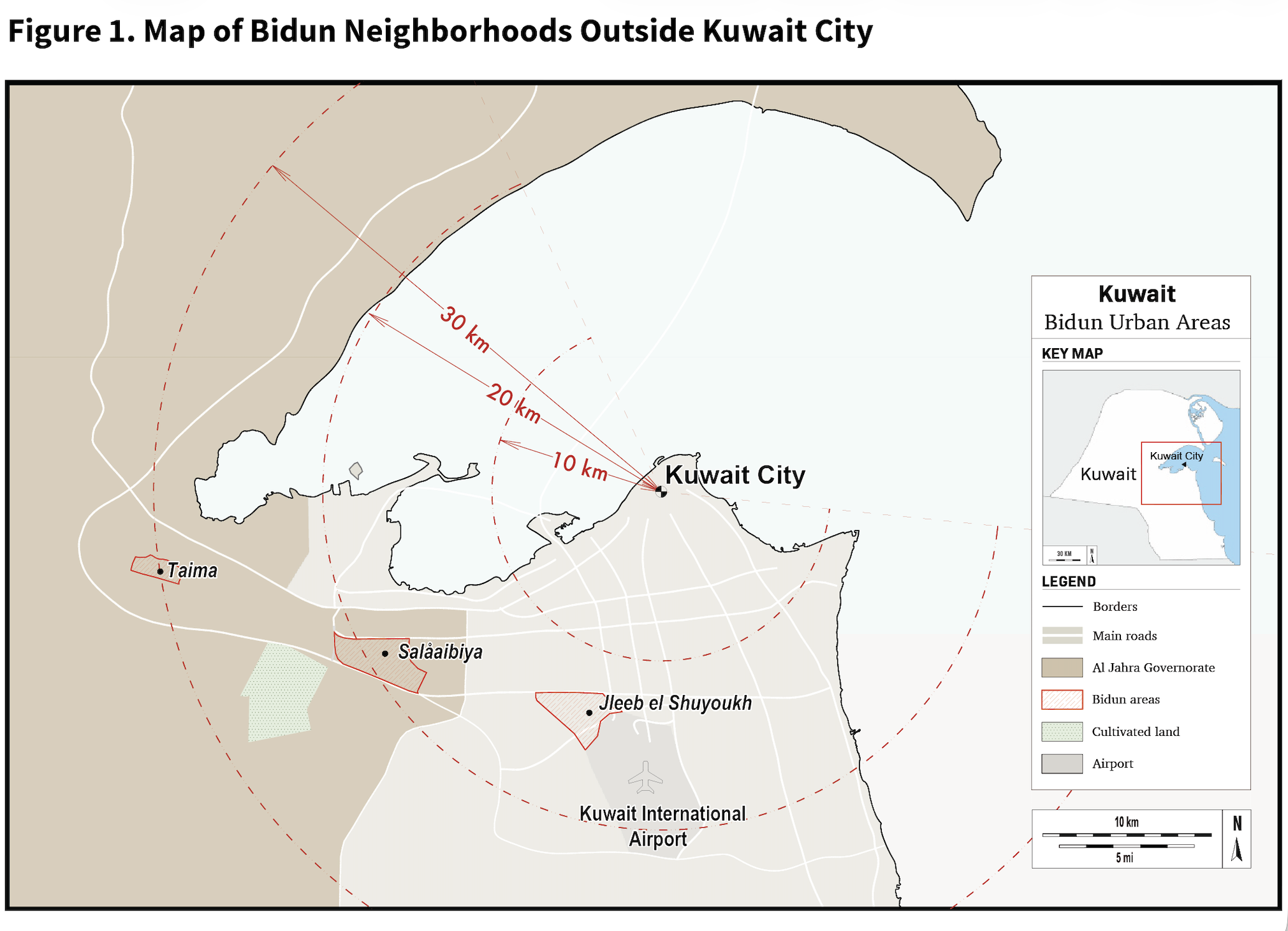
Though the bidun population is by no means homogeneous, the majority lives either in urban or suburban areas, specifically the Jleeb al-Shuyoukh slum of Kuwait City or Sulaibiya and Taima in the outlying Jahra governorate. All three of these districts suffer neglect at the hands of the state. Overcrowding and shoddy infrastructure are of especial concern. Additionally, informal or temporary dwellings and poor insulation exacerbate the effects of extreme heat, dust storms, and episodic heavy rainfall. All of this turns climate stress into everyday health and livelihood risks.
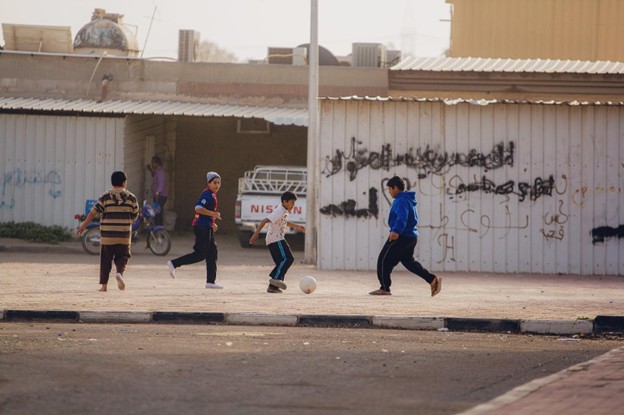
The living environment in Sulaibiya, where children play amid sub-standard housing. Source: Ali Fares
In Sulaibiya, residents have documented a clear lack of government support and investment. In December 2020, a bidun man attempted to take his life by self-immolation in protest of his poor living conditions; he had reportedly been unable to renew his identity card, which rendered him incapable of gaining employment. And in 2022, several bidun activists in Sulaibiya went on a nineteen-day hunger strike outside the neighborhood’s police station. Over the course of May 2025, Jleeb al-Shuyoukh lost electricity due to alleged violations, such as people overburdening the network with direct power connections and changing circuit breaker size without notifying government authorities. (The area was already suffering cutbacks because Kuwait as a whole is struggling with blackouts due to overstretched demand.) As for Taima, which lies even further outside Kuwait City (see map), it has faced security crackdowns owing to the construction of structures on state-owned land.
In 2025, Kuwait City Municipality announced new measures to better regulate housing and avoid overcrowding and fires in Jleeb al-Shuyoukh. These included the construction of foreign worker accommodations in industrial zones and on agricultural land, and the repair of damaged infrastructure in the area. Still, such projects will take between two and six years to complete. In the meantime, and perhaps even afterward, the living conditions of most bidun will continue to be shaped by chronic housing insecurity, degraded infrastructure, and heightened exposure to environmental stress.
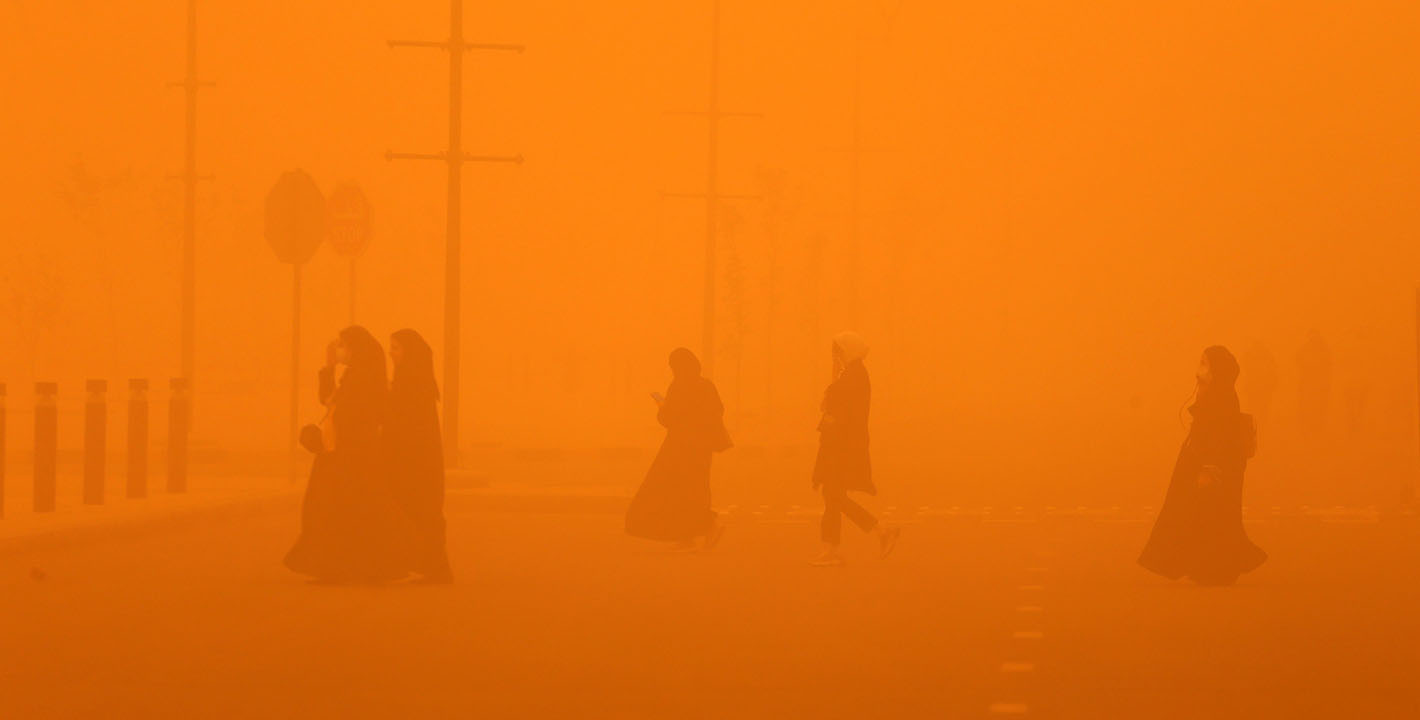
The bidun live in a country grappling with an acute case of global warming as well as other forms of extreme weather. A 2022 Harvard study predicted a temperature increase in Kuwait of 5.54 degrees Celsius by the end of the twenty-first century. In a country where temperatures reached 50 degrees Celsius (122 degrees Fahrenheit) in 2025, leading the Ministry of Electricity, Water, and Renewable Energy to resort to rolling power cuts to help handle the enormous demand on the system, this will likely increase heat-related deaths by 5.1 percent overall by the end of the century (among foreign workers, who were included in the count, the projected increase is 15.1 percent). Such heat also has a massive impact on ecosystems surrounding Kuwait, threatening fishing and agriculture and the people working in these realms. In addition to rising temperatures, Kuwait is likely to experience extreme weather in the form of droughts, dust storms, and flash floods.
Extreme weather and other climate issues disproportionately affect populations in areas with weak infrastructure and little government aid. So it is in Kuwait, with bidun neighborhoods more vulnerable than others. Interviewees consistently reported that rising heat in summer, regular power outages, and high cooling expenses adversely affected them. As one interviewee explained, “Older housing and limited economic means make extreme heat more difficult to manage.”5
Insufficient or faulty drainage systems, the absence of sewage facilities, and the use of inferior construction materials have made homes vulnerable to rain and dust storms. Several interviewees reported experiencing water intrusion in their homes during rainstorms and a significant decline in housing quality over time. As one of them put it, “When it’s rainy in Sulaibiyah, it’s like the whole city is [affected]. The whole home will be damaged, also in the summer with dusty storms.”6 In certain instances, families relocate to makeshift shelters or arid regions during severe weather episodes.
Air conditioning is a huge burden on Kuwait’s power consumption, with one 2020 study finding that some 67 percent of electricity used in Kuwaiti homes is linked to its use. The costs are heavily subsidized for Kuwaiti citizens but remain high for members of the bidun population. As a result, numerous bidun households decrease their air conditioning usage when they need it most. This raises health risks, especially for children, older adults, and those with chronic medical conditions. Furthermore, air conditioning is not available in some of the temporary housing structures where bidun live.
Given the instability and unsustainability of bidun living conditions, climate pressure deepens existing marginalization.
There is also a pyschological impact. Several interviewees reported stress associated with the cost of air conditioning in the long summer months, a lack of proper sleep when it is not used, and resulting physical and mental fatigue.7 On a larger scale, many people described anxiety about the future as well as an inability to plan long-term life decisions related to education, employment, housing, and family stability.8 Given the instability and unsustainability of bidun living conditions, climate pressure deepens existing marginalization.
Economic insecurity is closely related to climate pressures for members of the community. Many bidun are employed in informal or outdoor roles such as delivery, construction, and security at building sites. In times of severe heat, these occupations turn hazardous, resulting in shorter work hours, employment loss, or inconsistent earnings. This economic fragility restricts households’ capacity to cope with climate challenges and perpetuates cycles of poverty. The Kuwaiti government does not seem to have recognized this fact; indeed, there is little targeted assistance for the bidun outside the Central System, which can provide identification cards but little else.
Given that government efforts to alleviate the effects of climate change have been limited, members of the bidun population have sought to use the informal diwaniyya system as a means of airing their grievances. The system in question involves weekly meetings in the private homes of community leaders. (Obtaining an audience directly with the authorities is nearly impossible; for example, only citizens are permitted to attend the various ministries’ open house discussions, which were inaugurated following the ruling emir’s dissolution of parliament in May 2024.) The hope is that those whom the bidun deputize to speak on their behalf may find a way to convey to government authorities, indirectly, the challenges the community faces. If state officials are unaware of the living conditions of the bidun, they will not be motivated to improve them.
Yet the government demolished the Sulaibiya diwaniyyas in the spring of 2025, claiming that they were built on public land and therefore illegal. The move signaled the state’s awareness of bidun efforts to organize and its intention to curb the phenomenon. In light of all this, the modus operandi of most Kuwaiti bidun has been to devise methods to better endure their conditions, rather than attempt to change them in any sort of fundamental way.
As it happens, the state itself advocates precisely such an approach. The Central System’s website, as translated by the author, counsels that “the focus should be on removing and addressing existing shortcomings so this segment [the bidun] can overcome its suffering instead of ‘adapting’ existing laws and proposing ‘costly’ amendments with their associated risks and unforeseen complications affecting security, social, cultural, and economic dimensions, and posing a threat to national identity in the present and future.” Systemic change, then, does not appear to be part of the institution’s mandate. One interviewee aptly described the situation of the bidun as a state of “permanent waiting.”9
In Kuwait, state-funded research has produced irrefutable evidence of climate change’s impact. The government has acknowledged as much and stated that it “is committed to efforts that harmonize economic growth with a low-carbon, climate resilient development.” Though this suggests that political elites view action as necessary, no climate-related legislation has been passed since 2023, and greenhouse gas emissions remain high. Research has shown that “while the Government of Kuwait has committed the country toward moving to a ‘low carbon equivalent emissions economy’, there is an absence of discussion as to what this pledge means or how it should be implemented.”
Political will, of the sort demonstrated by the government’s periodic statements, is important in coming to terms with the challenges presented by climate change. Yet action—in the form of initiatives—is sorely needed. This is particularly true in the case of the bidun, given their marginalized status. Several initiatives would make for a good start. The sooner they are launched, the better.
Granting the bidun access to government services, particularly with regard to infrastructure, and doing so without discrimination, would aid the community in combating pressing issues related to climate change. The provision of identity cards similar to those issued to long-term residents or citizens would help to remove any stigma from this community. Throughout interviews, participants highlighted that statelessness (which is indicated in the paperwork carried by bidun, even for those who obtain identity cards through the Central System) increases vulnerability to climate stressors. Indeed, due to their lack of citizenship, the bidun are not only barred from government housing initiatives and electricity subsidies, but also emergency aid.
Tackling unsafe housing conditions would serve to protect the bidun. At present, building codes appear to be enforced primarily in affluent Kuwaiti neighborhoods. Ideally, they would be applied throughout the country. Additionally, services such as sewage and garbage collection should be provided uniformly and without prejudice. Such initiatives would go a long way toward ensuring that the most vulnerable sectors of the population are not left exposed to increasingly harsh elements. Taking into account Kuwait’s hydrocarbon-generated wealth, this goal is achievable.
Additionally, there is a serious need for Kuwait to upgrade its electricity grid. In the longer term, it would be more sustainable for the state to raise awareness about the environmental costs of overuse of air conditioning or to tax households for such practices. Yet in the short to medium term, as high temperatures persist, the electricity grid must shoulder the burden. And this requires an overhaul of the system.
It was telling that, among the bidun interviewed, no mention was made of government efforts to temper the repercussions of climate change on their population, despite the extent to which global warming in particular impacts their daily lives. The Central System does not include any reference to mitigating its effects on the bidun. This is ironic, given that the body is supposed to help them deal with the challenges facing their community. It is essential to tie the Central System into state-wide efforts at combating the consequences of changing climate.
Ultimately, the need for all these initiatives must be communicated to the government in a way that aligns with its stated aims to address climate-related issues. By properly understanding and assessing the challenges at hand, including those facing the bidun population, the government can more effectively address them. Moreover, treating the bidun on an equal basis with Kuwaiti citizens would further social justice across the state. This would improve people’s material conditions as well as enhance social cohesion.
In Kuwait, intense heat is already a serious climate-associated issue. It is also one that will grow more acute in the near future. Dealing with its effects is therefore quite urgent; there is little time for trial and error. Kuwait is fortunate in that it has the resources to address the matter. Officially, the government has signaled a willingness to do just that, but on the ground the relevant measures have been lacking. This is particularly true when it comes to the bidun, who receive the least government assistance despite the fact that they (and foreign workers) need it the most. Without a dedicated and concentrated campaign to overhaul infrastructure and services in bidun-populated areas, climate change will exact an ever-greater toll, both human and material.
This work is licensed under a Creative Commons Attribution 4.0 International License. For more details regarding the license deed, please visit: CC BY 4.0 Deed | Attribution 4.0 International | Creative Commons.
*An earlier version of this article incorrectly referred to “Article 8 of the Constitution.” This has been corrected to “Article 8 of the Kuwaiti Nationality Law.”

Courtney Freer
Assistant Professor in the Department of Middle Eastern and South Asian Studies at Emory University
Courtney Freer is an assistant professor in the Department of Middle Eastern and South Asian Studies at Emory University.
Carnegie does not take institutional positions on public policy issues; the views represented herein are those of the author(s) and do not necessarily reflect the views of Carnegie, its staff, or its trustees.
Transactional relationships are stable but can be shallow.



Paul Haenle, Maha Yahya, Benjamin Ho, …
It’s about managing oil prices, bread prices, and strategic partnerships.



Amr Hamzawy, Karim Sadjadpour, Aaron David Miller, …
Chinese economic players in Myanmar initially relied on ties to the government and ruling elites. Faced with controversy, they turned to actors that local communities trust and listen to as de facto partners and informal advisers.

Xue Gong

China is on course to lead the world in the deployment of nuclear power technology by 2030. Should it succeed, China will assume global leadership in nuclear technology development, industrial capacity, and nuclear energy governance.

Mark Hibbs

The days of simply sticking a pipe in the ground and tapping a pool of easy-to-handle and profitable crude oil are fading. Changing resources require people challenge conventional thinking on oil.

Deborah Gordon