

Commentary
ASEAN needs to determine how to balance perpetuating the benefits of technology cooperation with China while mitigating the risks of getting caught in the crosshairs of U.S.-China gamesmanship.
Elina Noor
{
  "authors": [
    "Jane Munga"
  ],
  "type": "other",
  "centerAffiliationAll": "",
  "centers": [
    "Carnegie Endowment for International Peace"
  ],
  "collections": [
    "Technology",
    "Understanding Africa’s Digital Economy Policy Landscape"
  ],
  "englishNewsletterAll": "",
  "nonEnglishNewsletterAll": "",
  "primaryCenter": "Carnegie Endowment for International Peace",
  "programAffiliation": "",
  "programs": [
    "Africa"
  ],
  "projects": [],
  "regions": [
    "North Africa",
    "Southern, Eastern, and Western Africa"
  ],
  "topics": [
    "Technology"
  ]
}
The Carnegie Africa Program, in collaboration with the African Telecommunications Union, has developed the first-ever continent-wide repository of digital economy laws, policies, and regulations.
The African continent is undergoing a digital revolution, characterized by increased accessibility to digital products and services transforming people’s socioeconomic lives. In recognition of the potential of digital technologies to transform entire ecosystems, African governments have developed and implemented policies and frameworks to capture the benefits of digital transformation. As such, Africa is now characterized by continent-wide national policies and strategies defining and envisioning digital transformations. The proliferation of Africa’s digital policy documents is essential in the continent’s digital transformation journey as there is an established link between an enabling policy environment and the growth of a digital economy.1 A key question, however, and motivation for this research is how the continent is formulating policies, laws, and regulations to govern the digital economy. What exists, and where? Are there gaps? Do the various laws, policies, and regulations allow for harmonization to promote the continental vision of regional integration?
Posing these questions led to the realization of the need for a central repository of digital economy policies, laws, and regulations in African countries. A starting point to unpacking these issues is providing visibility to what has been developed by African governments and consequently having a comprehensive repository for Africa’s digital policy documents. To address this need, the Carnegie Africa Program, in collaboration with the African Telecommunications Union, has developed the first-ever continent-wide aggregate of digital economy laws, policies, and regulations: The Africa Technology Policy Tracker (AfTech). AfTech has aggregated data from thirty-five African countries and the African Union, providing an interactive digital tool that helps give insights into the diverse approaches that African countries are taking to govern the digital economy. This summary will briefly present the analytical framework used to develop AfTech, briefly describe key findings, and present trends in the African digital regulatory landscape.
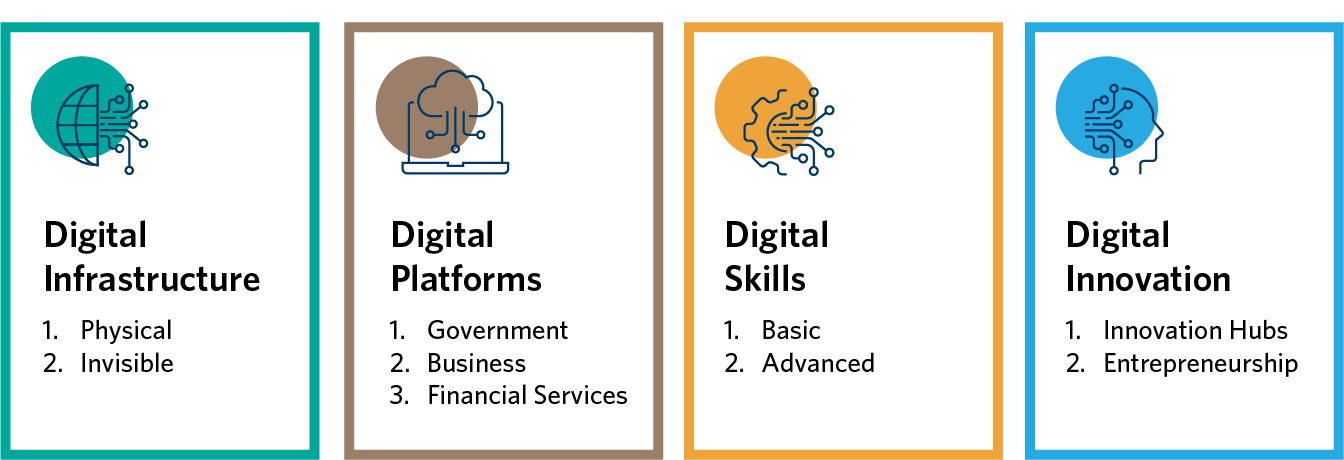
The analytical framework of AfTech comprises four pillars with associate components:
a. Digital Infrastructure: The availability of affordable and quality internet which is instrumental to bringing more people online;
b. Digital Platforms: Software-based infrastructure that facilitates online exchanges, transactions, and access to public and private services;
c. Digital Skills: The competencies required to access, use, manage, and create digital information and digital tools; and
d. Digital Innovation: The presence of an ecosystem that supports firms to generate new products and services leveraging new technologies and business models, which help widen and deepen digital economic transformation.
How are African nations formulating digital economy policies, laws, and regulations?
a. Nationally: AfTech has aggregated over 555 data points covering thirty-five countries and the AU.2 The distribution of these documents is across all four pillars but varies per country (see Figure 2). Rwanda has the highest number of data points—thirty-one regulations, twenty-three policies, and nine laws. Data points per country range from sixty-three to one, showing the diversity and complexity of governing Africa’s digital economy.
| Table 1. The 10 Countries With the Most Data Points | |
| Country | Data Points |
| Rwanda | 63 |
| Nigeria | 61 |
| Gambia | 59 |
| Kenya | 57 |
| South Africa | 44 |
| Egypt | 31 |
| Senegal | 29 |
| Mauritius | 27 |
| Uganda | 22 |
| Namibia | 14 |
| Source: AfTech | |
b. Continentally: Africa’s digital economy ecosystem is also guided by continental frameworks, which provide a shared vision including a single digital market in Africa through the African Continental Free Trade Area.3 Toward this end, the African Union (AU) has developed ten digital frameworks anchored in the continent’s common agenda, Agenda 2063: The Africa We Want.4 The Digital Transformation Strategy for Africa (DTS) 2020-2030 serves as the foundational document to guide member states in developing policies and strategies that harness digital technologies for economic development.5
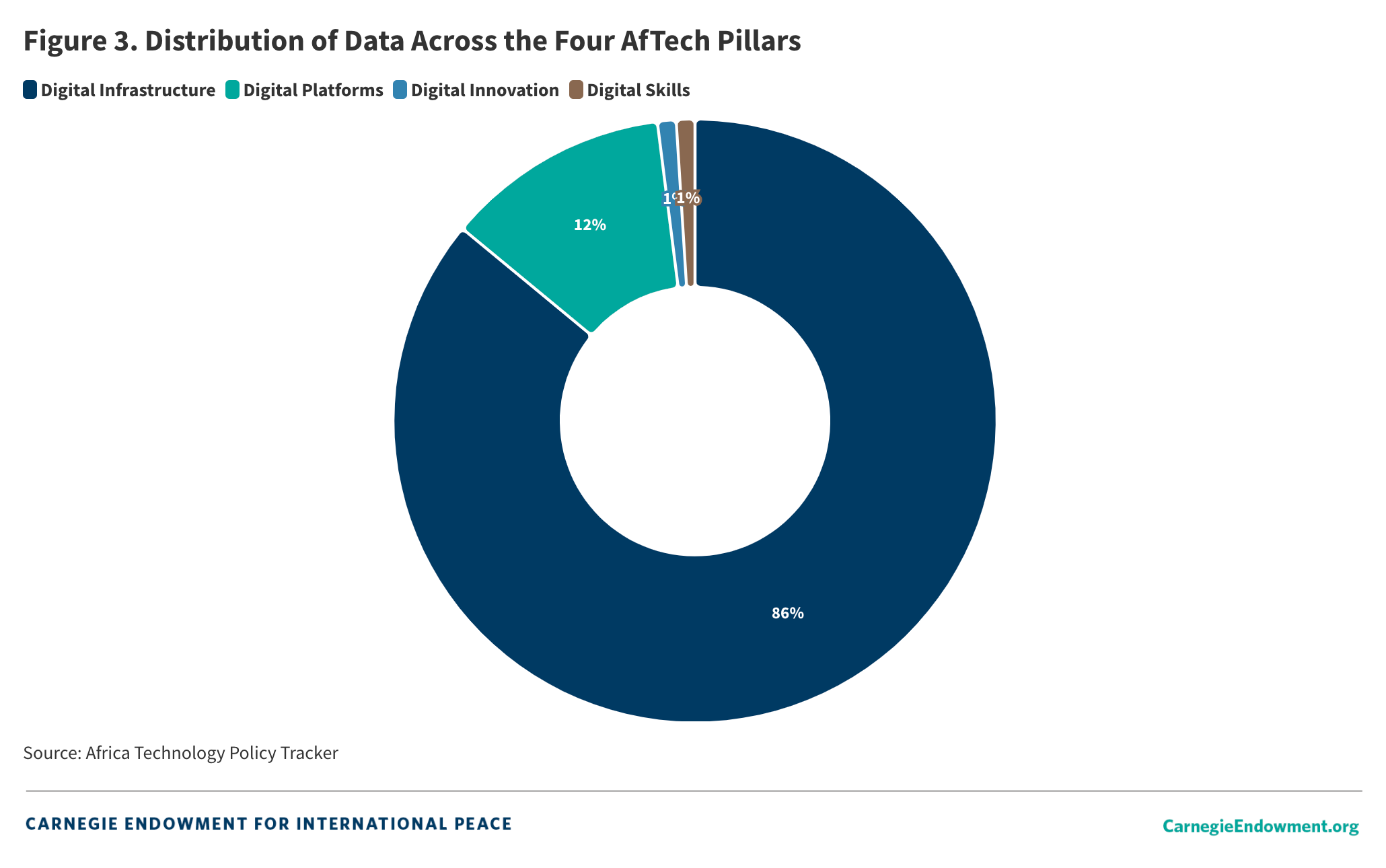
c. By Pillar: Data breakdown by pillar reveals that the digital infrastructure pillar (500) has received the most policy attention, followed by digital platforms (246), digital skills (105), and finally innovation and entrepreneurship (101) (see Figure 3). Most documents touch on more than one pillar, revealing a desire for cross-cutting frameworks within the digital economy spectrum.
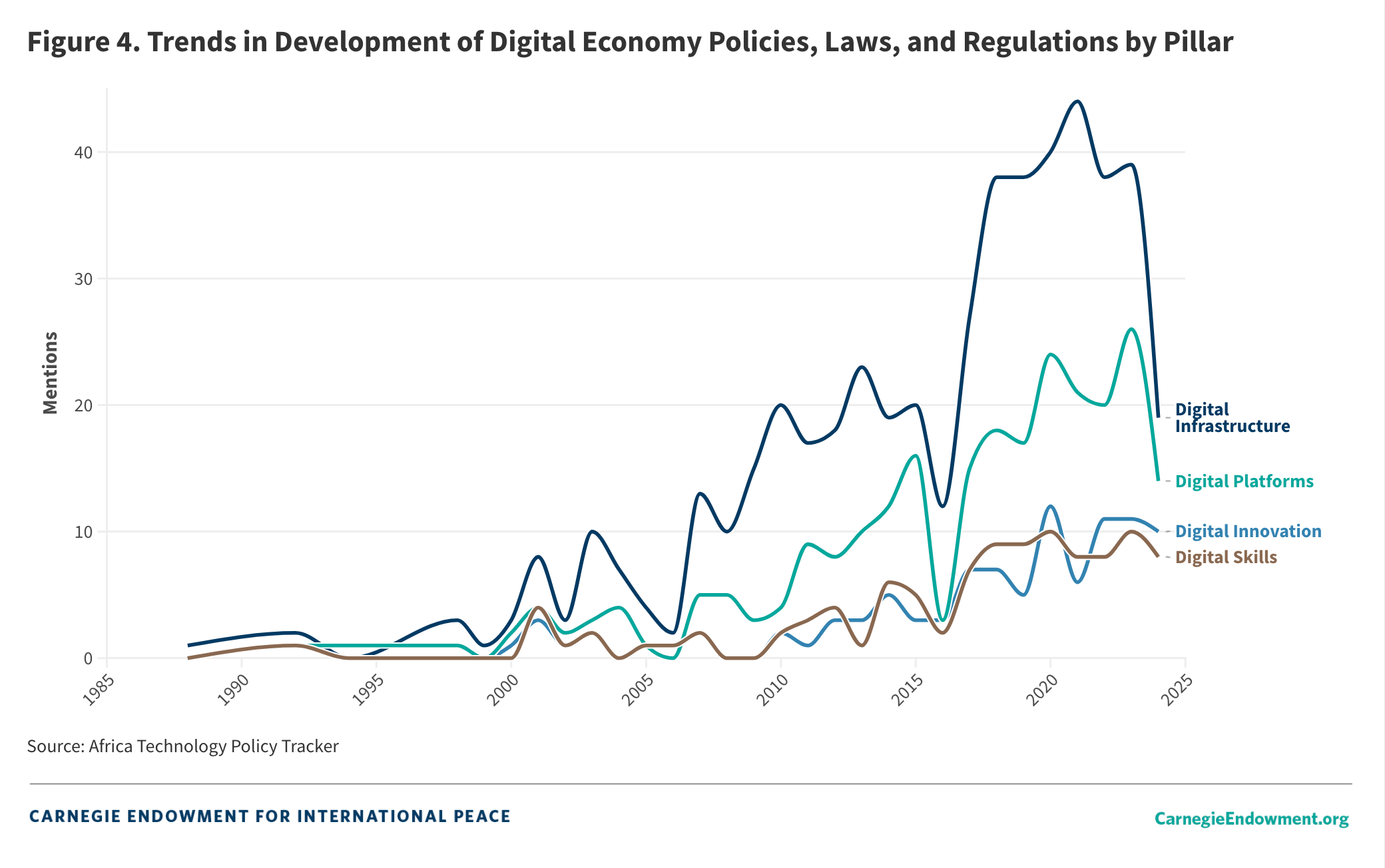
AfTech covers the period from 1988 to 2024 with a consistent rise in the quantity of documents pertaining to the digital economy in all four pillars (see Figure 4). Starting in 2017, there has been an increase in the number of published documents. To date, AfTech has aggregated 217 policies, 170 laws, and 168 regulations, indicating efforts across the continent to provide direction through policies and strategies and to provide guardrails through laws and regulations. The digital infrastructure pillar remains consistent as the pillar with the most data points.
In recent years, there has been a discernible trend regarding the evolution of cybersecurity, cloud, and data protection policy legislation, reflecting a prioritization of a safe and secure digital economy among African nations. Additionally, artificial intelligence has recently emerged as a priority for the continent. In 2024, four AI documents have been published: three by the AU and one by Nigeria, highlighting the continent's intention to leverage emerging technologies for socioeconomic development.
The majority of countries (twenty-five out of thirty-five) covered by AfTech data have a national information communication and technology (ICT) strategy. These strategies serve as a foundational reference for other digital-related policies, laws, and regulations, while also outlining the necessary institutional frameworks. Two focus areas are observed in the national agendas. First, African countries position ICT as a catalyst for socioeconomic development. For instance, the Gambia, Tanzania, and Nigeria have positioned digital technologies within their digital economy strategies as tools for socioeconomic development, with the potential to create jobs and boost economic growth. Second, inclusivity is established as a priority and integrated throughout the digital transformation agenda.
The author thanks Sylvester Quansah for excellent research assistance.

Carnegie does not take institutional positions on public policy issues; the views represented herein are those of the author(s) and do not necessarily reflect the views of Carnegie, its staff, or its trustees.

ASEAN needs to determine how to balance perpetuating the benefits of technology cooperation with China while mitigating the risks of getting caught in the crosshairs of U.S.-China gamesmanship.

Elina Noor

As tech competition moves into the biotech sector, China is increasingly shifting its focus to nearby regions to alleviate U.S.-induced supply chain pressures. As part of this transition, Southeast Asia has emerged as a favored destination.

Xue Gong

Ignoring the problems of its historical precedents won’t make China’s success any more likely.

Michael Pettis

Beijing’s reaction to Washington’s proposed ban on TikTok could manifest in three distinct scenarios.


Xing Jiaying, Li Mingjiang

It’s about managing oil prices, bread prices, and strategic partnerships.



Amr Hamzawy, Karim Sadjadpour, Aaron David Miller, …