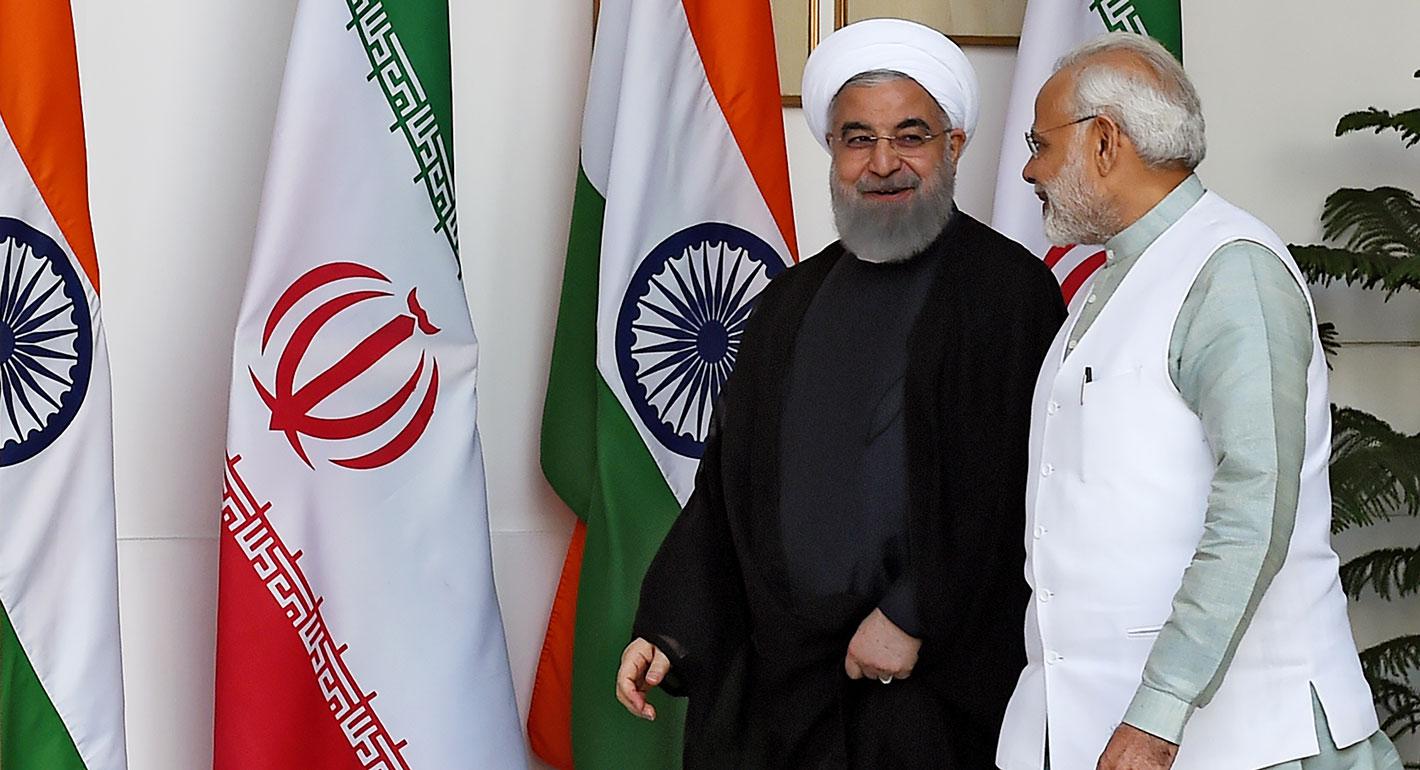
The targeted killing of Iranian military commander Qassem Soleimani and Iran’s retaliatory ballistic missile attacks on U.S. bases in Iraq only further complicate India’s delicate balance in maintaining close-knit ties with both Washington and Tehran. The bottom line for the Indian government is that it does not want to be forced to choose between its relations with the United States and Iran. The Indian Ministry of External Affairs’ judiciously chosen three-line response to Soleimani’s death is telling. “The increase in tension has alarmed the world,” it stated. “It is vital,” the statement continued, “that the situation does not escalate further.”
For India, the equation is pretty simple: better diplomatic relations between the United States and Iran would let New Delhi deal more smoothly with both countries. A decline in the relationship adversely affects Indian interests.
India unhesitatingly welcomed the November 2015 conclusion of the Joint Comprehensive Plan of Action (JCPOA), the nuclear deal with Iran. India has never supported Iran’s mission to build a nuclear bomb. In addition, the subsequent easing of sanctions (initially for six months) against Iran in exchange for a temporary pause of its nuclear program removed the hurdles of exporting oil to India.
Between 2013 and 2014, when sanctions were in place, India imported only 11 million tons of crude oil from Iran. In 2018–2019, during sanctions relief, it was able to purchase almost 24 million tons of Iranian crude. Clearly, the conclusion of the JCPOA greatly benefited India’s desperately oil-thirsty economy. U.S. President Donald Trump’s decision to withdraw from the JCPOA in May 2018, his administration’s reestablishment of the sanctions regime on Iran, and the cancelation of waivers to countries engaged in economic activity with Iran (in April 2019) meant that Indian imports of Iranian oil had all but halted by May 2019.
While India has managed to secure its energy needs from alternative suppliers, it still has equities in Iran. Despite Iran’s support to certain Taliban factions in southwestern Afghanistan, it reportedly provides much-needed intelligence to Indian counterparts. More than 8 million Indians resided in the Persian Gulf as of 2015, making them vulnerable to any escalation of hostilities. In December 2018, an Indian company took over operations at the Shahid Beheshti Port in Chabahar in southeastern Iran. Although the viability of the port project is yet to be adequately determined, it provides India a land route into Afghanistan otherwise blocked by Pakistan. In February 2019, the first Afghan consignment was exported from Chabahar. Given that the port has and could continue to provide humanitarian supplies to Afghanistan, Indian operations in Chabahar have been kept out of the U.S. sanctions regime. Such an exemption is likely to be removed in the event of rising hostilities between the United States and Iran.
Further, and beyond all the material factors that bind India and Iran, these are two countries that share deep cultural and historical ties. India entered into a Treaty of Friendship with Iran on March 15, 1950. Both countries have planned a range of activities to mark the treaty’s seventieth anniversary in March 2020. Like any bilateral relationship, there are all sorts of commercial, political, and strategic differences between New Delhi and Tehran.
Yet, this is not a relationship that India can, should, or would give up on, even in a (now-unlikely) scenario of serious conflict between the United States and Iran. It just means that the delicate work of diplomacy will get much harder. Trump’s walk back from escalation, as underlined in his briefing on January 8, 2020, is welcome news to Indian officials and practitioners. While there will likely be some argument within India on the legality and legitimacy of killing Soleimani, at present, and from New Delhi’s perspective, it can only be hoped that Trump himself heeds the advice he had for the “people and leaders of Iran,” that “the United States is ready to embrace peace with all who seek it.”